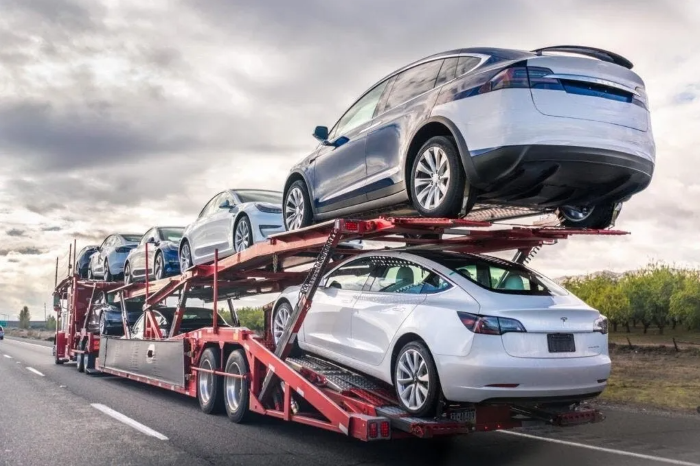
Most people pay between $500 and $2,000 to ship a car within the United States, and the national average for a standard sedan on an open carrier is about $1,100 to $1,250 in 2026. Send that same car coast to coast and you will usually land somewhere between $1,200 and $1,800.
Here is the catch: for the same car on the same route, quotes can sometimes differ by well over $1,000. Distance sets the baseline, then the price shifts with open versus enclosed transport, the size and condition of your vehicle, the time of year, and how much wiggle room you give the carrier on pickup dates, along with several smaller factors.
This guide puts numbers on each of those, shows you how to work out your own estimate, and covers what to check before you hand over the keys. It is an ok way to plan, but it doesn’t reflect what a carrier will actually charge you. If you want a real number for your route, dates, and vehicle, gathering multiple quotes through Agoyu is one of the quickest ways to see what carriers are asking. And if you’re moving more than a car, you can add your household goods to the same request.

Scan Your Home. Get Exact Moving Costs in Minutes
Agoyu’s AI video scanning technology gives you quick, precise moving estimates. Scan your rooms, receive instant quotes from multiple vetted movers, and select the best option for you.
STEP 1 OF 3
Auto Transport Cost by Distance
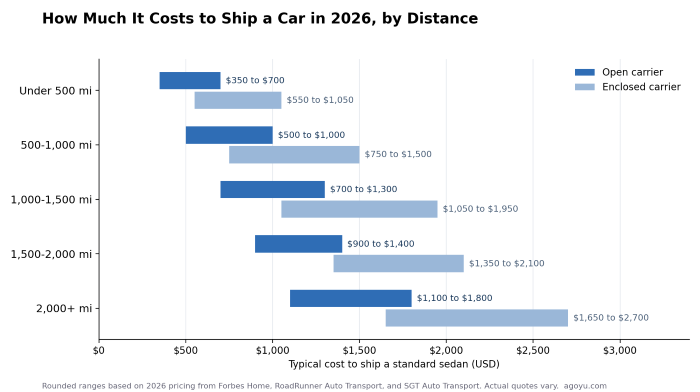
Distance is the biggest lever in the cost to ship a car. This table shows what a standard, running sedan typically costs on an open carrier, with enclosed pricing alongside and the typical open rate per mile.
| Distance | Open carrier | Enclosed carrier | Typical open cost per mile |
| Under 500 miles | $350-$700 | $550-$1,050 | About $1.60 |
| 500-1,000 miles | $500-$1,000 | $750-$1,500 | About $1.15 |
| 1,000-1,500 miles | $700-$1,300 | $1,050-$1,950 | About $0.90 |
| 1,500-2,000 miles | $900-$1,400 | $1,350-$2,100 | About $0.70 |
| 2,000+ miles | $1,100-$1,800 | $1,650-$2,700 | About $0.55 |
(Sources: Published prices for car shipping vary a lot from source to source. For the ranges used in this article, we compared Forbes Home's analysis of more than 100 real quotes from 31 national companies with shipment data from RoadRunner Auto Transport and SGT Auto Transport, then rounded everything into ranges.)
Short trips cost more per mile, and long trips look cheap by comparison. A driver spends about the same time scheduling, loading, and unloading a car whether it travels 300 miles or 1,300, so on a longer route those fixed costs get spread across more miles. Forbes saw the same pattern in its own research.
Even on a single route, expect a wide spread. When Forbes Home collected quotes to ship a 2021 Hyundai Sonata from Brooklyn to Charlotte, about 600 miles, the average came to $1,219. Individual quotes ran from $658 to $2,500 for the same car on the same trip, mostly because of transport type, carrier availability, and how each company priced the job.
Car shipping cost per mile
Cost per mile is a handy sanity check on a quote, as long as you compare it against the right distance. On that 600-mile Forbes route, open transport worked out to about $1.66 per mile and enclosed to about $2.45. SGT Auto Transport reports open-carrier rates of around $1.56 per mile under 500 miles, falling to about $0.46 on routes past 3,000 miles, and RoadRunner reports a median of $1.23 per mile across shipments with a median distance of 987 miles.
So a 2,500 mile quote that works out to $1.50 a mile deserves a second look, and so does a 300 mile quote that comes in well under a dollar a mile. The first is probably overpriced. The second may be a low opening number that grows once someone has to find a carrier willing to take the job.
How much does it cost to ship a car across the country?
For a coast to coast move, plan on roughly $1,200 to $1,800 on an open carrier and about $1,800 to $2,700 enclosed. A sedan from New York to Los Angeles, around 2,800 miles, falls somewhere in the middle of that range. Carriers publish estimates of about 5 to 9 days for 2,000 to 2,500 miles (source: Neon Auto Transport), so a full coast to coast run commonly takes 7 to 10 days from pickup, and longer in busy season or bad weather.
Snowbird lanes, such as the Northeast to Florida or Arizona, get crowded in fall and again in spring, and prices climb with them. If you are moving to a new state, the same rates apply. The shorter the move, the more it is worth comparing shipping against simply driving the car yourself, which we cover below.
The Smarter Way to Ship Your Car: Compare Prices and Let Shippers Compete
Agoyu is like Expedia for car shipping, only better. It's completely free, and you can see actual shipping prices from competing car transport companies in minutes. Simply enter your vehicle details, pickup and delivery locations, and shipping date.
But Agoyu goes far beyond comparing prices.
Compare Trusted Shippers: Review each company's Trust Signals, including Better Business Bureau ratings, Yelp reviews, and other third-party information, before choosing who handles your vehicle.
Let Shippers Bid for Your Business: This is where Agoyu really changes the game. Put your shipment out for competitive bidding and let car transport companies offer their best prices to win your business. Since car shipping is all about truck capacity, a carrier with an available spot on your route may offer a significant discount. We've seen customers save an additional 20–30% through competitive bidding.
No Spam Calls. No Hidden Surprises. Complete Price Transparency. Agoyu lets you compare prices and shippers without sharing your personal contact information with every company. You stay in control.
Why settle for one quote when you can compare multiple shippers and let them compete for your business?
Open vs. enclosed car transport cost
Open car transport cost
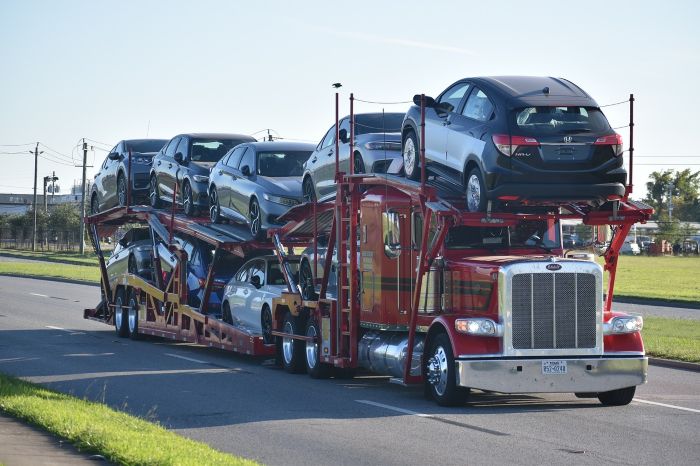
Open carriers are the multi-car trailers you see on the highway, usually hauling seven to ten vehicles at a time. They cost the least, run on most routes, and carry the majority of shipments. Your car is exposed to weather and road debris, which is a fair trade for most daily drivers. According to Forbes, "if the car is replaceable, the enclosed premium usually isn't worth paying."
Enclosed car transport cost
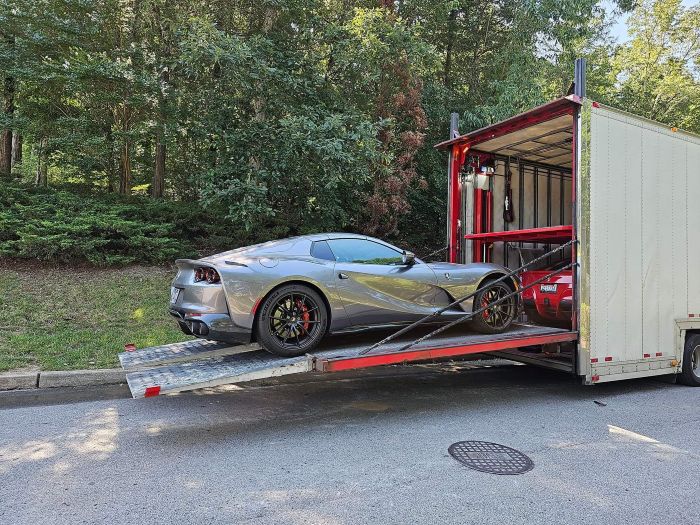
Enclosed trailers cost about 40% to 60% more per mile than open ones on the same route. On a 1,000 to 1,500 mile trip, that is the difference between roughly $700 to $1,300 open and $1,050 to $1,950 enclosed. Fewer enclosed carriers operate, so pickup can take longer to schedule. It makes sense for classic, luxury, and exotic cars, low-clearance vehicles, and anything you would hate to see with a stone chip.
How vehicle size and condition change the price
The distance table assumes a sedan that starts, steers, and rolls. Larger vehicles take up more trailer space, and cars that cannot be driven need a winch and a carrier equipped to use one. Typical adjustments look like this:
| Vehicle or situation | Typical added cost |
| Sedan or compact car | Baseline |
| Crossover, small SUV, or minivan | $75-$150 |
| Large SUV or full-size pickup | $200-$400 |
| Car that will not run | $150-$300 |
| Oversized or modified (dually, lifted truck, extended-roof van) | Custom quote |
Rounded from 2026 data published by RoadRunner and FreightWaves.
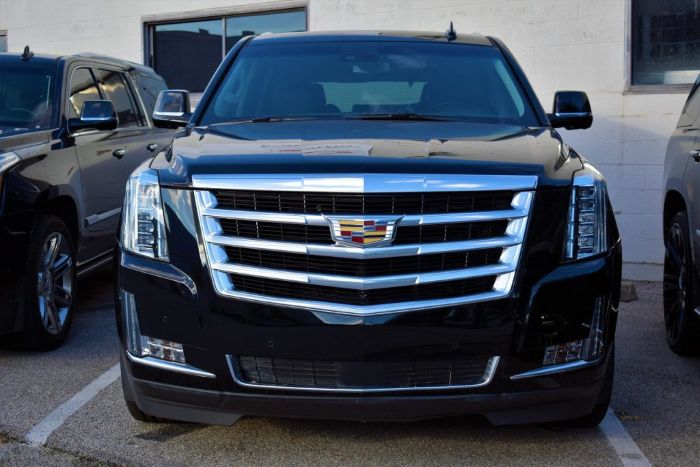
Exact weight and dimensions matter more than the category. A carrier loads a trailer like a puzzle, and a lifted truck takes up more of it than a stock one. Give your make, model, and any modifications up front, because a quote built on a guess tends to change at pickup.
Why car shipping company quotes are so different
Car shipping company costs depend a lot on who is quoting and how they are quoting. Many companies you will find online are brokers, not carriers. A broker arranges the shipment, and a separate carrier, often an independent trucker or a small fleet, actually drives the truck. The federal agency that oversees both brokers and shippers, the FMCSA, puts it simply: auto brokers only arrange the transportation of your car.
That setup explains much of the spread you will see. Each company decides how much margin to add and how hard to shop your job around, and a number far below everyone else's sometimes means no carrier will accept the job at that price. The car sits, and the price gets "updated." When one quote is far lower than the rest for the same car, route, and transport type, find out why before you pay anything.
Other things that change your car shipping cost
Season
Late spring and summer are the busiest and most expensive stretch, because trucks fill up with everyone else's moves. Winter has its own problem: snow and ice slow routes in colder regions, so drivers finish fewer runs each week. Forbes Home points to early fall as the sweet spot, when demand eases and the weather is more predictable.
Route and pickup location
Carriers like busy corridors. A car going from Chicago to Atlanta moves faster, and usually cheaper, than one leaving a rural address in Montana, even at similar mileage. If you live well off the main roads, offering to meet the driver in a large parking lot near the interstate can lower the price and spare the driver a tight turn.
Flexibility and fuel
A narrow pickup window costs more, because the carrier has less room to fit your car into a route that is already planned. Fuel matters too. It is one of the biggest line items for a carrier, so quotes tend to follow diesel prices up and down.
Car shipping cost calculator: estimate your own number
You can get a rough figure with a little arithmetic. Take the distance of your route, multiply it by the typical per-mile rate from the table above, then add the adjustments for your vehicle. Here is a large SUV going 1,200 miles:
- Base: 1,200 miles at about $0.90 per mile comes to roughly $1,080.
- Large SUV adjustment: add $200 to $400, which puts an open carrier at about $1,300 to $1,500.
- Enclosed instead: the base rises about 50% to roughly $1,620, and with the same SUV adjustment the total is about $1,800 to $2,000.
- If the car does not run: add another $150 to $300.
These are planning numbers, not an exact calculator or firm quote. Real prices change with the season, the lane, and who has room on a truck that week.
Want a quick quote for your actual car and route? We have the easiest solution.
The math above gets you into the right range. But if you want to see the exact price to ship your specific vehicle, Agoyu can help you quickly find out. Click the button below, and then in the Agoyu fields provided, enter your "to" and "from" moving locations and your dates to see actual prices from vetted car shippers, without giving them your contact information.
The cheapest way to ship a car
The cheapest way to ship a car is usually an open carrier, door to door, booked with some flexibility on dates. A few habits trim the bill further:
- Choose open transport unless the car really needs a roof over it, with an estimated "enclosed premium" at 40% to 60%.
- Give the carrier a few days of leeway on pickup. A tight window is one of the easier ways to pay more.
- Ship in early fall or another slow stretch if your timeline allows, and skip the late spring and summer rush.
- Offer to meet the driver near a major road if your street is tight or far from the highway.
- Send the car clean and empty. Forbes notes that personal items add weight and can cause insurance problems, and some carriers will refuse a loaded car or charge extra for it.
- Make sure the car starts, steers, and rolls. A dead battery on pickup day can turn a standard job into an inoperable one with a surcharge.
- Compare quotes for the same transport type and pickup window, so you are not stacking an enclosed price against an open one. Look at the details, not just the total.
- Ask about discounts. Some companies offer them for military service, seniors, students, repeat customers, or shipping more than one vehicle, and others do not, so it costs nothing to ask.
Sometimes the cheapest option is not shipping at all, which brings up the next question.
Is it cheaper to ship a car or drive it?
On a short trip, driving wins on cost. Forbes ran the numbers for a 2021 Hyundai Sonata going 600 miles: fuel came to about $54 at the January 2026 national average gas price, while the average shipping quote was $1,219. Add a hotel night and driving rises to roughly $340 to $830, depending on how nice the room is. Shipping starts to look better once you count your time, the wear on the car, or both.
Longer trips tilt toward shipping, especially for a cross-country move where driving means several days off work, motel bills, and 3,000 miles added to the odometer. If you can make the drive in a day and do not mind the miles, driving is hard to beat.
One route has its own option. Amtrak's Auto Train carries your car between Lorton, Virginia, near Washington, DC, and Sanford, Florida, near Orlando, while you ride along. Fares start at $95 plus the cost of the vehicle, and the trip takes about 17.5 hours. It only works on that one corridor and you have to travel with the car, but for a Northeast to Florida move it is worth pricing against a carrier quote.
Shipping a car to Hawaii and other special cases
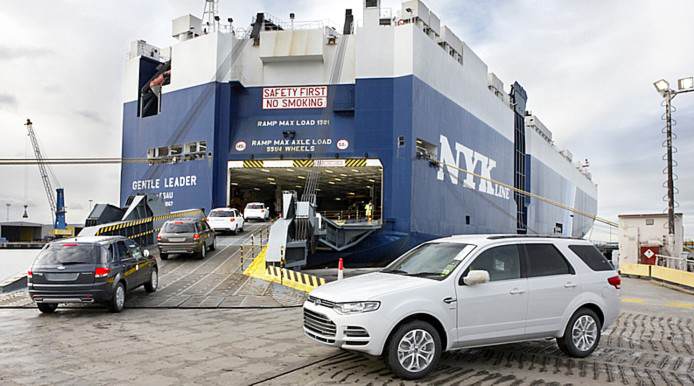
Ocean routes follow their own pricing. Matson lists car shipping from the mainland to Hawaii starting at $1,790, and from Hawaii to the mainland starting at $1,020, for a standard-size vehicle up to 21 feet 8 inches long (Matson). The direction matters, and so does where you start. If you do not live near a West Coast port, add the cost of getting the car there first. Shipping a car overseas is a different project, with customs paperwork and freight priced by destination. The figures in this guide only apply within the continental United States, so get a quote from a specialist for anything international.
How to check a car shipping company before you pay
The FMCSA has a short consumer advisory on car shipping that boils down to a few checks. Find out whether you are dealing with a broker or a carrier. Look for the company's MC number on its website, plus a USDOT number if it is a carrier, and confirm both on the FMCSA's SAFER database. The agency's advice is to avoid any broker or carrier that does not prominently display its MC number.
Then get the details in writing. Ask when you will be charged and what is refundable, and ask for the carrier's insurance coverage limits. Your own auto policy may also cover the car in transit, subject to deductibles and exclusions, so call your insurer before pickup. At pickup, take photos, walk around the car with the driver, and make sure any existing damage is noted on the bill of lading. Repeat the walkaround at delivery before you sign.
Are you moving more than just a car?
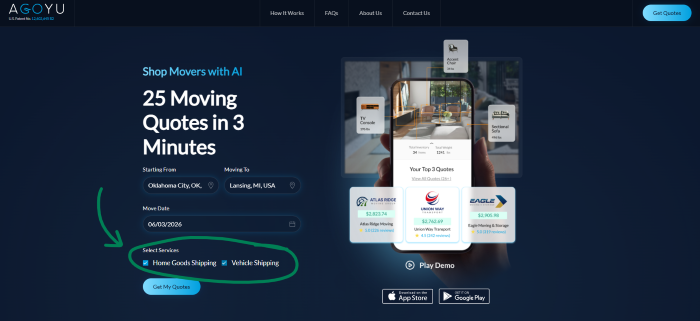
Plenty of people ship a car because they are relocating, and could benefit from a quote to move their household items as well. If you're moving and are interested in how much it would cost to hire movers, Agoyu can help. Click the button below, and when you enter your info, simply check the boxes for both household goods and vehicle shipping, and Agoyu will return you quotes for both.
Car shipping cost FAQ
How much does it cost to ship a car across the country?
Most coast to coast shipments run about $1,200 to $1,800 on an open carrier and roughly $1,800 to $2,700 enclosed. A sedan from New York to Los Angeles, around 2,800 miles, lands near the middle of that range.
What is the national average car shipping cost?
Published 2026 averages cluster around $1,100 to $1,250 for a standard sedan on an open carrier. Forbes Home found an average of $1,219 on a 600-mile route, RoadRunner reports $1,215 across its shipments, and SGT reports $1,099.
How much does it cost to ship a car per mile?
For open transport, expect about $1.60 per mile under 500 miles, around $1.15 between 500 and 1,000 miles, and closer to 55 cents on coast to coast routes. Enclosed carriers add roughly 40% to 60%.
How much more does enclosed car transport cost?
About 40% to 60% more per mile than open transport on the same route, according to Forbes Home. On a 1,000 to 1,500 mile trip, that usually means $350 to $650 more.
What is the cheapest way to ship a car?
An open carrier, door to door, with flexible pickup dates, booked outside the late spring and summer rush. If the trip is short enough to drive in a day, driving beats every carrier on cost.
Is there a car shipping cost calculator?
You can estimate your own price with the formula above: distance times the typical per-mile rate, plus adjustments for vehicle size and condition. For a price tied to your route and dates, request quotes through Agoyu.
How long does it take to ship a car from New York to Los Angeles?
Usually seven to ten days after pickup, and up to two weeks in peak season or bad weather. Scheduling the pickup itself can add a few days.
Does car shipping cost more in the summer?
Yes. Late spring and summer are the busiest months, and prices rise as carriers fill up. Early fall tends to be cheaper, although winter weather can push prices up on northern routes.
Does my car insurance cover shipping?
Often, but only partly. Most personal auto policies cover a car in transit, with deductibles and exclusions, and carriers carry cargo insurance of their own. Call your insurer and ask the shipper for its coverage limits in writing before pickup.
How much does it cost to ship a car to Hawaii?
Matson lists mainland to Hawaii car shipping starting at $1,790 and Hawaii to mainland starting at $1,020 for a standard-size vehicle. If you live far from a West Coast port, add the cost of getting the car there.
Get custom quotes to ship YOUR specific car
Averages only get you so far. Your route, dates, and vehicle type are what determines the real price, and the fastest way to see it is to have Agoyu ping it's network and instantly return you quotes. Click the button below to enter your move details and source multiple quotes at once (without the need to give your contact info to movers!).
Sources
- Forbes Home, How Much Does It Cost To Ship A Car In 2026?
- RoadRunner Auto Transport, car shipping cost data
- SGT Auto Transport, car shipping cost data
- FreightWaves Checkpoint, car shipping calculator
- Neon Auto Transport, car shipping cost guide
- Amtrak, The Auto Train Experience
- Matson, car shipping FAQ
- FMCSA, Consumer Advisory About Automobile Transporters
- FMCSA, SAFER company snapshot


