Small Load Moving: Why a Small Shipment Should Not Pay Full Truck Prices
Most moving pricing was built for full houses. Minimum weights, minimum charges, and trucks priced as if every job fills them. If you are moving a studio apartment, a dorm room, a single room of furniture, or the partial contents of a house, that pricing works against you from the first quote: you pay for […]
Shop Movers with AI


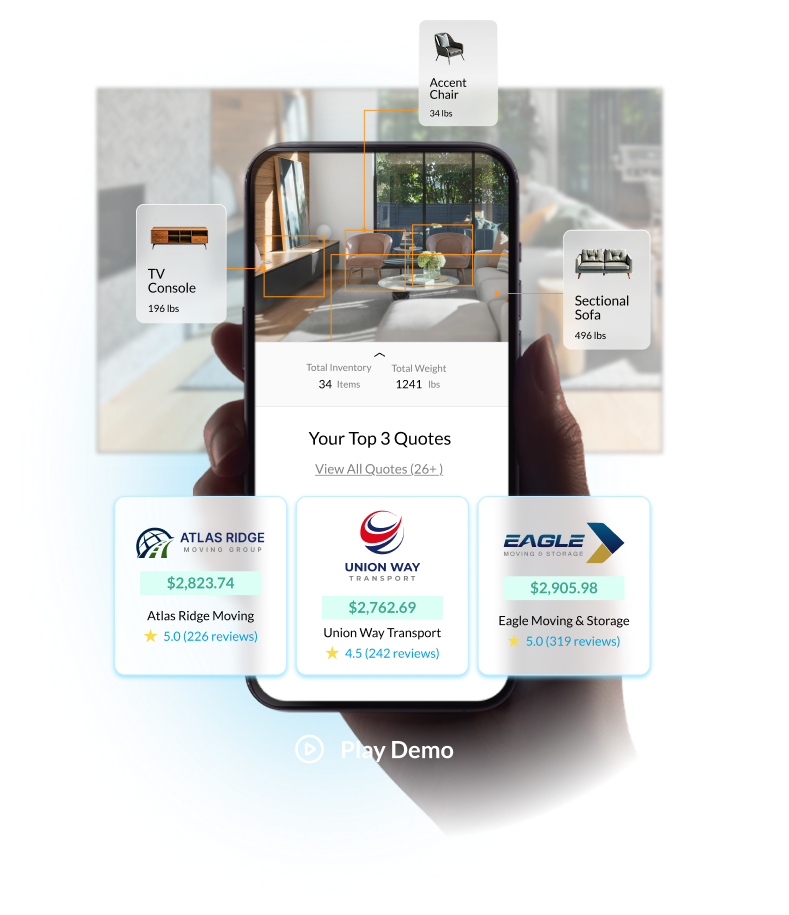
Most moving pricing was built for full houses. Minimum weights, minimum charges, and trucks priced as if every job fills them. If you are moving a studio apartment, a dorm room, a single room of furniture, or the partial contents of a house, that pricing works against you from the first quote: you pay for capacity you are not using, at rates set for shipments three times your size.
A small load is not a small version of a big move. It is a different product, priced by a different logic, and it is where the moving market’s best pricing hides. Small shipments are exactly what fills the leftover space in trucks already rolling your way, and movers discount that space rather than haul air. This guide explains what counts as a small load, why traditional minimums make small loads overpay, how capacity pricing works in practice, and how small load movers compare with renting container space, so you can pick the option that fits your shipment instead of subsidizing somebody else’s truck.
Key Numbers: Small Loads on Agoyu
- Up to 25 moving quotes in under 3 minutes. One scan of your rooms shows exact prices from the movers in the Agoyu platform for your small load.
- 86 long distance movers in the platform, with published rates and live bids on real moves, including small and partial shipments.
- $100,000 of insurance with no deductible included in the price of every move booked through Agoyu, small loads included, not sold back to you as an add on.
- A patented AI platform (U.S. Patent No. 12,602,645 B2) that prices your move from a scan of your actual rooms, so a small shipment is priced on what you actually own, not rounded up to a minimum.
- Capacity pricing, in plain terms: Movers bid against published rates for space on trucks already routed your way, and capacity on an already routed truck prices lower than a dedicated run. On average, movers discount 23% from published rates to win the move. Your actual spread is still set by live competition on your shipment, so an individual move will land above or below that average.
- 12 bids on average on a posted move, because movers with space on a routed truck bid on partial loads too.
- Delivery window for small loads (industry planning range): 12 to 28 business days for a small load shipped consolidated on a 2,500 to 2,800 mile cross country move. See the FAQ for source, limits, and how shorter routes differ.
What Counts as a Small Load?
There is no single industry definition, and any company that gives you one without asking what you own is guessing. As general guidance, a small load usually means some combination of:
- A studio or small one bedroom apartment, or part of a larger home: one room, a partial household, an estate distribution to one family member.
- A shipment well below a full truck, often described in the industry in the range of a few hundred to roughly 2,000 pounds, though movers set their own thresholds.
- A shipment that shares the truck. The defining feature is not the scale on its own. It is that your belongings travel consolidated, alongside other households heading the same general direction.
Common small load situations: a graduate moving to a first job, a senior downsizing and sending part of a home to family, a couple moving the contents of a storage unit, a single room shipped across the country for a student, or a household that sold most of its furniture and is moving what remains. If your move sounds like one of those, you are shopping in the small load market whether the quote form says so or not.
Why Small Loads Overpay: The Minimum Problem
Traditional long distance pricing carries minimums because a dedicated truck run has fixed costs: fuel, crew, and days on the road, whatever is inside. Applied to a small shipment, those minimums produce three predictable problems:
Minimum weight charges. Many long distance quotes carry a minimum billable weight. Ship less than the minimum and you pay for the minimum anyway: weight you do not own, priced as if you did.
Dedicated truck economics. A mover pricing your small load as a standalone run has to cover the whole trip with your shipment alone. The quote is honest arithmetic for the wrong product. Your load was never going to fill that truck, and pricing it as if it must makes it the most expensive way to move the least stuff.
No reason to discount. A single quote from a single mover contains no competition and no capacity information. The mover does not know, or does not say, whether a truck is rolling past your destination half empty next week. You pay the rate sheet price because the rate sheet is all you were shown.
The result is the small load paradox: per pound and per item, small shipments are often the most expensive moves in the industry, paid by the people moving the least.
Capacity Pricing: How Small Loads Should Be Priced
Movers sell space in trucks that are already traveling routes. When a truck is heading your way with room left in it, that room earns the mover nothing if it travels empty. A small shipment that fits into that space is found money: one more pickup and one more delivery on a run the mover is already making. Movers price that space to fill it, and the discount compared with a dedicated run is where small load pricing gets interesting.
That is capacity pricing, and a small load is its natural customer:
- Your shipment is priced as space, not as a truck. The bid reflects the room your belongings take in a load that is already justified by other freight.
- Consolidation is the trade. Your belongings share the truck, the truck stops for other households along the route, and delivery runs on a window rather than a single guaranteed day. In exchange, you stop paying for empty air. If a fixed delivery date matters more than price, ask what a more direct shipment costs and compare the two numbers openly.
- Competition sets the real price. Two movers with different trucks, different routes, and different amounts of space to fill that week will bid the same small load very differently. That spread is not a defect in the market. It is the market, and it only appears when movers bid against each other on your actual shipment.
No static list of “best small load moving companies” can show you any of this, because capacity changes every day and a list was written once. A live platform can, because the trucks are live too.
Small Load Movers vs Containers: An Honest Comparison
The other main option for a small shipment is container space: a container is delivered, you load it, the company drives it, and you unload it at the destination. Some container services price by the space you use inside a trailer rather than by the whole container, which suits small loads. Here is the honest comparison:
| Small load movers (full service) | Portable container | Container space by the foot | |
|---|---|---|---|
| Who does the work | The mover loads, drives, and unloads | You load and unload; the company drives | You load and unload; the company drives |
| Pricing logic | Capacity and bids on your shipment | Flat rate per container and distance | Rate per linear foot of space used |
| Best for | Small loads where you want the work done | Small loads with flexible timing and your own labor | Very small loads priced strictly by space |
| Delivery timing | A window; consolidated loads stop en route | Scheduled around container delivery and pickup | A window; space ships when the trailer fills |
| Storage | Often available through the mover | Built in; the container is storage | Limited; space is in transit, not stored |
| Main risk | Price changes on non guaranteed quotes; longer windows | Your labor; weather exposure while loading; access for container placement | Your labor; strict loading windows; space measured at the trailer |
There is no universally right column. If you can load a container yourself and your dates bend, container space is a rational buy. If you want the lifting done, or your shipment is fragile, heavy for its size, or headed somewhere a container cannot be placed, a small load mover earning your business in a bid is usually the better instrument. What neither option should involve is paying a full truck minimum for a partial truck of belongings.
Guaranteed Pricing Matters More on a Small Load
A small load quote that is not guaranteed is an invitation to a specific disappointment: the shipment gets weighed or measured after loading, the billable amount lands above the minimum you were quoted around, and the price climbs with your belongings already on the truck. The smaller the shipment, the larger that climb is as a percentage of the quote.
In Agoyu, every bid clearly shows whether the mover guaranteed the rate or not. If the rate is guaranteed, it is locked in: it can go down, but it cannot go up. If a mover does not guarantee their rate in the platform, Agoyu requires that the mover either complete a visual survey of your home within one week or less and issue a guaranteed bound quote, or honor the rate they put in the platform. On a small load, the scan is that survey: your inventory is documented item by item before anyone prices it, so the minimum games have nothing to attach to. Compare the guarantee first and the number second.
How Agoyu Works for a Small Load
Step 1: Scan your rooms. Agoyu’s AI builds the inventory from your phone scan: what you own, item by item, with the weight estimated from the actual goods. For a small load this step does double duty, because it proves the shipment is small and prices it as small.
Step 2: See exact prices. From that one scan, Agoyu shows the exact cost to move through the long distance movers in the platform, side by side, for your shipment, your route, and your dates.
Step 3: Or post your move for bids. This is where a small load earns its discount. Movers with space on trucks already routed your way bid for the shipment that fills their gap, and movers compete on a job that costs them little to add.
Step 4: Compare the whole picture. Every price sits next to the mover’s Trust Signals: a link to its US DOT license, its BBB rating, its Yelp reviews, and, where the mover holds them, its IAM and FIDI profiles. Agoyu displays those records. It does not ask you to take its word for any mover, and it does not publish a ranked list and call it research.
Step 5: Book in the platform. Pick your mover and your packing level, from packing yourself to full packing and unpacking, and book. The agreed price, the dates, the inventory, and the terms are documented in the platform record, and the move includes full insurance with no deductible up to $100,000. For household goods moves, your belongings are also documented on video at loading, stored free for up to 30 days after the move, so a claim starts from a record instead of an argument.
How to Decide: A Short Checklist
- Get your inventory documented first. A scan beats an estimate, and it beats a minimum.
- Ask every mover one question early: what is your minimum billable weight or charge, and does my shipment fall under it?
- Collect bids on your actual shipment and dates, not rate sheet quotes for a generic move.
- Ask how the shipment travels: consolidated or direct, and what the delivery window is in writing.
- Ask of every quote: is this price guaranteed, and what exactly does it include?
- Check the mover’s US DOT license, BBB rating, and Yelp reviews before the price seduces you.
- Price the container option honestly, including your own labor and loading time, before ruling it out or in.
Frequently Asked Questions
What is a small load move?
A shipment too small to fill a truck on its own: typically a studio or small one bedroom, a single room, or a partial household, traveling consolidated with other shipments heading the same direction. Exact thresholds vary by mover, which is why an inventory based price beats a category label.
Why are small load quotes so expensive per pound?
Minimums. Traditional pricing carries minimum billable weights and charges built for full houses, and a mover pricing your load as a dedicated run has to cover a whole trip with your shipment alone. Capacity pricing fixes the arithmetic: your load fills space on a truck already rolling, and bids price the space instead of the truck.
How long does a small load move take?
Longer than a dedicated full truck, as a rule, because consolidated shipments may wait to be combined and stop for other households along the route. As an industry planning range for a cross country move of 2,500 to 2,800 miles, a small load shipped consolidated runs 12 to 28 business days, a partial load shipped consolidated runs 12 to 21 business days, and a full truck shipped direct runs 7 to 12 business days (source: SafeBound Moving, via Researched Tables, Nov 24, 2026). Shorter routes generally run faster than those cross country windows, but no shorter route window is stated here without route data. The small load high end of 28 days is an editorial estimate built from published consolidated ranges, not measured small load data. These are industry planning ranges, not Agoyu booked delivery times. FMCSA requires definite agreed delivery dates or ranges on the order for service, and your pickup and delivery window is agreed and documented in the platform when you book on Agoyu.
Is a container cheaper than a small load mover?
Sometimes, if you do the loading and unloading yourself and your dates are flexible. Container space priced by the foot can suit very small shipments. A full service small load mover costs more than your own labor and less than most people expect once minimums are removed and movers bid. Price both against the same inventory before deciding.
Can I ship just a few pieces of furniture long distance?
Yes. A few pieces are the classic small load, and they are exactly what capacity pricing exists for. Scan the room or the pieces, post the shipment, and let movers with space on your route bid. A single sofa shipped as a dedicated run is the most expensive way to move a sofa. The same sofa filling a gap in a rolling truck is a different price entirely.
What insurance comes with a small load booked on Agoyu?
Full insurance with no deductible up to $100,000 is included in the price of every move booked through Agoyu, at every shipment size. It is not an add on. Combined with your scanned inventory and the video documentation of your goods at loading, a claim is a documented process rather than a dispute about what was in the truck.
How do I avoid minimum weight charges?
Have your shipment priced on a documented inventory, ask each mover directly what their minimum billable weight is and whether your shipment falls under it, and compare guaranteed bids rather than estimates. On Agoyu, the scan fixes the inventory before pricing, and every bid shows its guarantee status, so a minimum cannot quietly reappear after loading.
Your Small Load Deserves a Small Load Price
A studio apartment should not cost what a house costs to move, and with the right pricing logic it does not. Scan your rooms on Agoyu, see exact prices from 86 long distance movers, or post your small load and let movers with space heading your way bid on it, with every mover’s DOT record, BBB rating, and Yelp reviews next to the price, guaranteed pricing where it is offered, and $100,000 of no deductible insurance included. Pay for the space you use. It is the only part of the truck you are actually moving.