Free Moving Boxes: Where to Find Them, and How to Tell the Good Ones From the Bad
Yes, you can pack an entire move without buying a single box. People finish moves every day and give their boxes away, retailers recycle stacks of sturdy shipping cartons every week, and offices empty file boxes by the dozen. The catch is not finding free boxes. The catch is finding free boxes that are clean, […]
Shop Movers with AI


Yes, you can pack an entire move without buying a single box. People finish moves every day and give their boxes away, retailers recycle stacks of sturdy shipping cartons every week, and offices empty file boxes by the dozen. The catch is not finding free boxes. The catch is finding free boxes that are clean, dry, and strong enough to protect what you own, in the sizes and quantities your move actually needs, before your packing deadline arrives.
This guide covers where free moving boxes actually come from, how to inspect them so a free box does not cost you a broken dish set or a pest problem in your new home, and how many boxes a move like yours typically takes. At the end, it connects the box hunt to the rest of the move, because boxes are the one part of a move you can make free. The truck, the crew, and the price do not have to be guesswork either.
Key Numbers: Boxes and Your Move
- $0: what a full set of moving boxes can cost if you source them used and start early. Boxes are one of the few moving supplies with a real free option.
- Up to 25 moving quotes in under 3 minutes on an average lane, from published rates plus discount asks, if the rest of the move needs pricing too.
- 86 long distance movers in the Agoyu platform. On Agoyu, movers show published rates and bid on real moves, with 12 bids on average per posted move, and every move booked through the platform includes full insurance with no deductible up to $100,000.
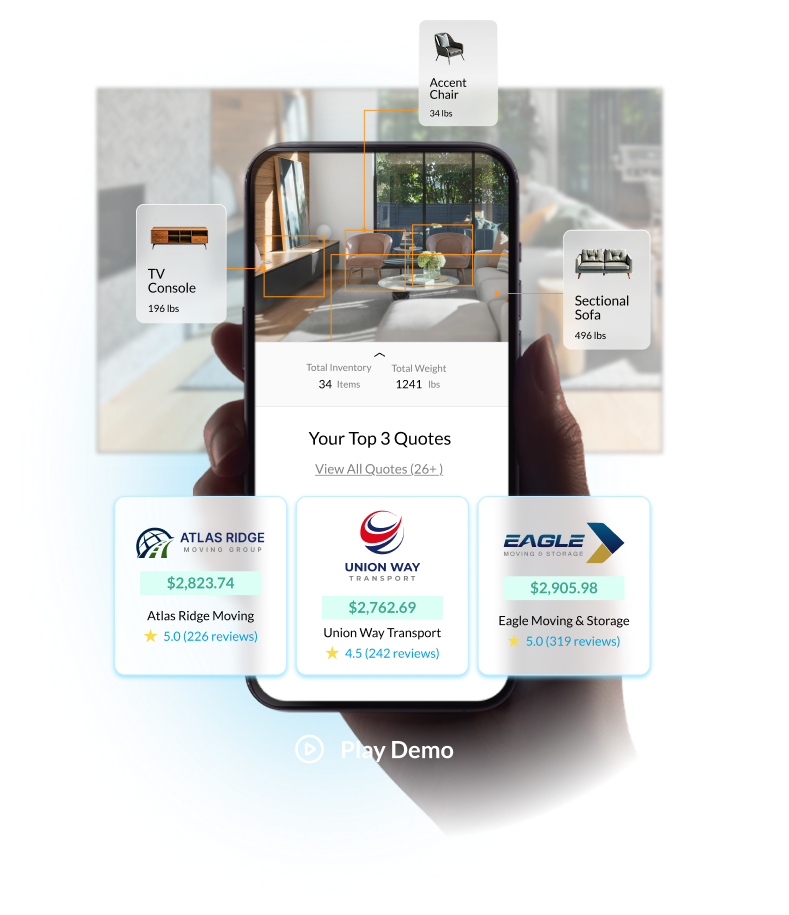
- A patented AI platform (U.S. Patent No. 12,602,645 B2) that prices your move from a scan of your actual home, so the inventory your boxes need to hold is documented before anyone quotes anything.
- Your box count can come from your own rooms. When you scan your home on Agoyu, the platform counts your rooms and builds your inventory from what you actually own, so your box estimate is based on your belongings, not a generic chart.
- What buying instead costs: retail box kits run roughly $100 to $200 for a studio, $250 to $400 for a one to two bedroom home, $350 to $500 for a three to four bedroom home, and $550 to $700 for a four plus bedroom home (U-Haul kit budgets, checked November 2026). Free sourcing is the money you do not spend there.
Where Free Moving Boxes Actually Come From
People who just moved
This is the best source, and it is not close. Someone who unpacked last week has exactly what you need: real moving boxes, in moving box sizes, often already broken down and bundled, and a strong personal motivation to get them out of the garage. Find them on:
- Facebook Marketplace and local buy nothing groups. Search “free moving boxes” and set an alert. Good listings go fast, often within hours.
- Nextdoor. Hyperlocal, which matters, because you will be making several trips with a car full of cardboard.
- Craigslist’s free section and the Freecycle Network. Older interfaces, still active for exactly this kind of giveaway.
- U-Haul’s box exchange message boards. A long running board where people post boxes they are giving away or looking for, by area.
- Your own circle. A group text, a workplace chat, a social post asking who moved recently. Coworkers who relocated for work are a quiet goldmine, because their employers often bought new boxes that were used exactly once.
Ask early. The ideal window is three to four weeks before packing starts, which gives you time to collect in batches instead of taking whatever is available the weekend before the truck comes.
Retailers and workplaces
Every store that sells physical goods receives shipments, and most of those cartons go straight to a compactor or a recycling bale. Ask, and many will hand them over instead. The most productive stops:
- Liquor stores. Their boxes are small, strong, and built with dividers, which makes them the best free box in moving for glasses, mugs, and bottles.
- Grocery stores. High volume and frequent deliveries. Apple and produce boxes are sturdy. Read the quality section below before using any box that held food.
- Bookstores and office supply stores. Boxes built for books and paper are built for weight, which is exactly what you want for your heaviest items.
- Pharmacies, dollar stores, and department stores. Steady carton flow in useful small and medium sizes.
- Big box and home improvement stores. The largest cartons, useful for light, bulky items like bedding and lampshades. Call ahead and ask when deliveries arrive and when boxes are broken down, then time your visit between the two.
- Your own workplace. Printer paper and file boxes with lids are among the sturdiest free boxes anywhere, and offices discard them constantly.
Smaller local shops count too. A coffee shop, a toy store, or a clothing boutique gets regular deliveries and has no storage room to spare. The approach that works everywhere is the same: call ahead, be specific about what you need, and show up when you said you would.
Community sources
- Apartment complexes and rental offices. Turnover means a constant stream of incoming tenants unpacking and outgoing boxes. Ask the leasing office where residents leave them.
- College dorms. Move in and move out weeks produce a surplus of boxes at the start and end of every term.
- Recycling drop off points. People leave clean, usable boxes there before collection. Get permission from whoever runs the site before taking anything.
- Mover take back. Some movers will collect their branded boxes back after a move, and some will pass used boxes to an upcoming customer or let you take boxes a previous customer returned. It costs nothing to ask your mover whether they have a take back pile, and the boxes you get that way are genuine moving boxes in genuine moving sizes. Some movers in the Agoyu platform do run take back programs like this, but Agoyu does not advertise take back through the platform, so treat it as a question to ask your mover directly, not a platform feature you can count on.
The Quality Check: When a Free Box Is Not a Bargain
Free is only a saving if the box does its one job, which is arriving intact with your belongings undamaged and uncontaminated. Used boxes carry three risks that new boxes do not, and each one has a simple inspection.
Strength. Cardboard weakens every time it is used, taped, and broken down. Squeeze the sides and press the bottom flaps. A box that feels soft, creases easily, or has torn handle holes or crushed corners is a box that can fail under load, usually at the worst moment, halfway up a flight of stairs. Retire tired boxes to light duty only: linens, pillows, and soft goods.
Cleanliness and food residue. Boxes that held food can carry grease, spills, and odors that transfer to your belongings and attract pests in a truck or storage unit. Inspect grocery and restaurant boxes piece by piece. Reject anything with stains, a sweet or sour smell, or residue you can feel. Produce boxes that held dry goods are usually fine. Boxes that held meat, dairy, or anything refrigerated are not worth the risk.
Pests. This is the risk people miss. Cockroach egg cases can be glued inside the corrugation flutes of boxes stored in infested spaces, and bed bugs can shelter in the seams and flaps of boxes kept near upholstered furniture. A box that brings either into your new home costs more than every box in the move combined. Inspect the flaps and the corrugated edges under good light, and be strict about provenance: boxes from a clean home or a high turnover retail back room are a different proposition from boxes pulled out of a basement, a dumpster area, or a curb pile of unknown origin.
The reject pile, no exceptions: damp or musty smelling boxes, boxes with mold spots, boxes with mystery stains, boxes that smell of chemicals or motor oil, and any box you would not want against your clothes or dishes. Tape cannot fix any of those. When in doubt, recycle it and keep hunting. Supply is not the problem. Judgment is the filter.
Two more rules that save moves. First, collect a mix of sizes, weighted toward small and medium. Books, tools, and kitchen gear get heavy fast, and a large box full of them is a box nobody can lift and every box is likelier to drop. Large boxes are for light and bulky things only. Second, collect more than your estimate. A surplus costs you a trip to the recycling point after the move. A shortage costs you a retail run at full price on packing day.
How Many Boxes Does a Move Need?
The honest answer depends on how much you own, not just how many rooms you have, which is why two three bedroom homes can differ by thirty boxes. The ranges below are general packing guidance used across the moving industry, presented as a planning starting point, not as Agoyu platform data and not as a quote.
| Home size | Small boxes | Medium boxes | Large boxes | Total range |
|---|---|---|---|---|
| Studio | 5 to 10 | 5 to 8 | 2 to 4 | 10 to 20 |
| 1 bedroom | 8 to 12 | 8 to 12 | 4 to 6 | 20 to 30 |
| 2 bedroom | 12 to 18 | 12 to 16 | 6 to 10 | 30 to 45 |
| 3 bedroom | 16 to 24 | 16 to 24 | 8 to 14 | 45 to 65 |
| 4 bedroom | 20 to 30 | 20 to 30 | 10 to 20 | 60 to 85 |
Add specialty boxes on top of the count: wardrobe boxes for hanging clothes (roughly one per two feet of closet rod), dish packs with cell dividers for a kitchen you care about, and picture or mirror boxes for large frames and artwork.
For a count built from your actual belongings instead of a table, use Agoyu’s moving box calculator, which works from your dwelling type and how you live rather than a generic average. And if you scan your home on Agoyu for a move price, the same inventory that prices the move tells you what has to be boxed, which is the most accurate box count of all: the one taken from your rooms, not from a chart.
When Buying New Boxes Is Worth It
Free sourcing has real limits, and knowing them keeps the strategy honest:
- Wardrobe, dish pack, and TV boxes are rarely given away in quantity, and they protect the items most likely to be damaged. Buying these three new while sourcing everything else free is the hybrid most experienced movers land on.
- A long distance move is harder on boxes than a local one. Your belongings ride for days, stacked, through vibration and temperature swings. Weakened used boxes that would survive a trip across town may not survive a trip across the country. For a long haul, new boxes for the heavy and fragile loads are cheap insurance.
- Time is a cost too. Sourcing free boxes takes trips, messages, and coordination spread over weeks. If your move is on a deadline, buying a box kit in one order can be the rational choice, and there is no prize for saving forty dollars with six hours of driving.
For scale, here is what buying the boxes instead looks like at retail. U-Haul’s published kit budgets (uhaul.com, checked November 2026) run $100 to $200 for a studio apartment kit, $250 to $400 for a one to two bedroom kit, $350 to $500 for a three to four bedroom kit, and $550 to $700 for a four plus bedroom kit, and those kits include tape and packing supplies alongside the boxes. That is the spending the free box hunt replaces, which is why the hunt is worth real effort for most moves, and why it stops being worth it when the deadline math above says otherwise.
One more consideration if a mover is packing for you: on Agoyu you choose your packing level, from packing yourself to full packing and unpacking, and the price you see reflects that choice. If you pack yourself, your boxes are the system. If the mover packs, their materials are part of the service, and the free box hunt is one you can skip entirely.
Packing Tips That Make Free Boxes Work Harder
- Reinforce every bottom with a double strip of packing tape in an H pattern, especially on used boxes and anything carrying weight.
- Line and cushion with packing paper, or with the towels and linens you have to move anyway.
- Keep boxes liftable. As a working rule, a box one person cannot comfortably carry is a box packed wrong, whatever its size.
- Stack books flat, not on end, so the weight spreads and the box stays rigid.
- Label on two sides with the contents and the destination room. Future you, standing in the new kitchen surrounded by forty identical brown boxes, will be grateful.
- Photograph the contents of boxes holding anything valuable before you seal them. Documentation is a theme at Agoyu for a reason: what is recorded is what can be claimed.
How Agoyu Fits In
Boxes are the DIY end of a move, and Agoyu is built for the rest of it. The same platform that hosts the moving box calculator prices the move itself: scan your rooms with your phone, and Agoyu’s patented AI (U.S. Patent No. 12,602,645 B2) builds your inventory and shows the exact cost to move through the platform’s 86 long distance movers, with each mover’s US DOT license link, BBB rating, and Yelp reviews displayed next to its price. Those Trust Signals are records you can check yourself. Agoyu displays them. It does not ask you to take its word for any mover.
If your dates are flexible, you can also post your move and let movers bid on it. Movers price capacity: a truck already heading your way with space in it is cheaper than a truck sent out for you alone, and bids are where that difference shows up. Every price on Agoyu shows whether the mover guaranteed it, and moves booked through the platform include full insurance with no deductible up to $100,000. Save your money on the boxes. Spend your attention on the price that actually decides what the move costs.
Frequently Asked Questions
Where is the best place to get free moving boxes?
From people who just moved. Buy nothing groups, Facebook Marketplace, Nextdoor, Craigslist’s free section, and Freecycle listings for free moving boxes are the richest source, because the boxes are real moving boxes in the right sizes and the owners want them gone. Retail back rooms and your own workplace are the reliable second source.
Are free moving boxes safe to use?
They can be, if you inspect them. Reject anything damp, musty, moldy, stained, or chemical smelling, check the flaps and corrugated edges for signs of pests, and be careful with boxes that held food, which can carry residue and odors. A box that feels soft or has crushed corners should carry linens, not dishes.
How many boxes do I need for a two bedroom home?
As general packing guidance, plan on roughly 30 to 45 boxes: about 12 to 18 small, 12 to 16 medium, and 6 to 10 large, plus wardrobe and dish pack boxes for closets and kitchen. Your real count depends on how much you own. The moving box calculator gives you a count based on your home and living style.
Can I get free boxes from a moving company?
Sometimes. Some movers take back their used boxes after a delivery and pass them on, and it always pays to ask your mover directly. If a mover is packing your move as part of the service, their boxes and materials are included in that service, so ask what the packing level you chose actually covers before you start collecting.
What boxes should I buy new instead of finding free?
Wardrobe boxes, dish packs, and TV or mirror boxes are the usual buys: they are hard to find used in good condition and they protect the items most often damaged. For a long distance move, new boxes for heavy and fragile loads are also worth it, because used cardboard weakens with every trip and a cross country ride is the hardest trip a box takes.
When should I start collecting free boxes?
Three to four weeks before you pack. Good giveaway listings go within hours, retailer cartons depend on delivery schedules, and collecting in batches over several weeks is how you end up with the right sizes instead of forty large boxes and nothing to put books in.
What do I do with the boxes after the move?
Pass them on. List them in the same groups you found them in and the next mover in your neighborhood gets the same head start you did. Boxes too worn to reuse go to cardboard recycling, broken down flat.
Start With the Boxes, Then Price the Move
Free boxes are the easiest money you will save on a move, and now you know where they hide, how to inspect them, and how many you need. The rest of the move deserves the same treatment: real numbers instead of guesses. Run your count through the moving box calculator, then scan your home on Agoyu and see the exact price of your move from 86 long distance movers, with their DOT records, BBB ratings, and Yelp reviews next to every price, and $100,000 of no deductible insurance included when you book. The boxes were free. The information should be too.


