Average Moving Costs Per Hour: What a Local Crew Really Costs
Search for average moving costs per hour and you will find a single number, usually somewhere around $80 an hour for one mover. That number is almost useless on its own. Nobody hires one mover. You hire a crew, with a truck, for a block of hours that starts before the first box is lifted […]
Shop Movers with AI


Search for average moving costs per hour and you will find a single number, usually somewhere around $80 an hour for one mover. That number is almost useless on its own. Nobody hires one mover. You hire a crew, with a truck, for a block of hours that starts before the first box is lifted and often runs past the last one, and the total depends on crew size, minimum hours, travel time, and how ready your home is when the crew arrives.
This guide starts with how an hourly bill is actually built, crew by crew. Then it explains the parts of an hourly bill that surprise people: the minimum, the travel charge, and the clock running while a crew waits on an elevator, a parking spot, or boxes that are not packed yet. Finally, it shows you when an hourly local move is the right buy, when a flat or guaranteed price is safer, and how Agoyu prices a move from your actual inventory instead of from a clock.
Key Numbers: Moving Costs and Agoyu
- 86 long distance movers in the Agoyu platform, with published rates and live bids on real moves. Agoyu’s platform is built for long distance moves; the pricing lessons on this page apply to any move where you are comparing quotes.
- $100,000 of insurance with no deductible included in the price of every move booked through Agoyu, not sold back to you as an add on.
- A patented AI platform (U.S. Patent No. 12,602,645 B2) that prices your move from a scan of your actual home, not from an hourly estimate built on a guess.
- 12 bids on average on a posted long distance move, from movers competing on your scanned inventory instead of an hourly guess.
- The winning bid averages about 23% below the first published rate on a posted long distance move, so competition, not the first rate alone, sets the long distance price.
- Local moves are covered too. Agoyu prices local moves by the hour, with platform algorithms calculating the cost, and College H.U.N.K.S. and All My Sons, the two biggest local movers in the platform, cover virtually every market.
How Much Do Movers Cost Per Hour? The Planning Ranges
Hourly rates are set crew by crew and market by market, and no single national figure survives contact with a real quote, which is why this page works from structure instead of a borrowed average. You are quoted a rate per crew per hour, most movers set a minimum of two to three hours, and your total is that rate multiplied by the hours your move actually takes, plus travel time and the add-ons below. Get two or three crew rates for your market and your date, and the planning ranges in this guide become arithmetic on your own numbers.
Hourly pricing is how most local moves, generally moves within about 100 miles that do not cross a state line, are sold. Long distance moves are usually priced by weight and distance instead, which is why the same company can quote one move by the hour and another by the pound. Mixing the two models up is the first budgeting mistake: an hourly rate tells you nothing until you know how many hours your move will actually take.
Planning Your Hours by Home Size
Budget the hours before you budget the dollars. A studio or small one bedroom with a two mover crew is a short job when it is packed and the access is easy; each step up in home size adds movers and hours together, because a bigger crew on a bigger home is how the day stays a day. A three or four bedroom house is a full day for most crews, and packing, stairs, or a long carry stretch any home well past its best case. Multiply the hours you honestly expect by the crew rates you are quoted, then add the minimum and travel rules from the next section, and you have a planning range built from your market instead of a national average built from nobody’s move.
The Three Numbers Inside Every Hourly Bill
An hourly quote is really three numbers wearing one coat. Understand all three before you compare two companies.
Crew size. The rate is quoted per crew, not per person, and crew size is a trade off, not an upgrade. Two movers cost less per hour and take more hours. Three or four movers cost more per hour and finish sooner, carry heavy items more safely, and keep a large home from turning into an all day job. For a studio or small one bedroom, two movers are usually the efficient crew. For a three or four bedroom house, a bigger crew often lowers the total even at a higher hourly rate, because the clock stops sooner.
Minimum hours. Most local movers set a minimum, commonly two to three hours, charged whether your move takes that long or not. A small, well prepared move that finishes in ninety minutes still pays the minimum. Ask for the minimum in writing before you book, and ask what happens to the rate if the move runs past it.
Travel time. The clock rarely starts at your front door. Many local movers charge travel time from their base to your home, and sometimes back again after unloading. A crew based across town can add a paid hour before any furniture moves. Ask two questions: when does the clock start, and when does it stop? Two quotes with the same hourly rate can differ by an hour or more on travel alone.
What Makes the Clock Run Longer
Hourly pricing puts the risk of a slow move on you. These are the factors that stretch a move, and most of them are in your control:
Packing readiness. A crew loading packed, sealed, labeled boxes moves fast. A crew packing as they go, or waiting while you empty a closet, bills for every minute of it. Packing services themselves are also billed by time or added as a service charge, and full service moves with packing, unpacking, and furniture assembly carry higher rates in every source, including the archived guide.
Access. Industry planning prices put stair fees at $75 to $150 per flight, with elevator charges varying, and long carry at $50 to $150 per segment (Researched Tables, Nov 24, 2026). Stairs, long carries from door to truck, elevators that must be reserved, narrow hallways, and no legal place to park the truck all add time. Tell the mover about access before the quote, not on moving day.
Specialty items. Pianos, safes, large appliances, fine art, and oversized furniture need extra crew, extra equipment, and extra care. Industry planning prices put piano or pool table handling at $200 to $1,000 per item and heavy or bulky items at $200 to $500 per item, with extra crew at about $75 per mover hour as a single carrier tariff example, not a market average (Researched Tables, Nov 24, 2026). They add hours, and on some moves they add a separate handling fee. Name them in advance.
Home size and volume. Bigger homes scale up in hours from a small apartment’s few hours, and a heavily furnished house takes longer than a lightly furnished one of the same size. Your inventory, not your room count, is what the crew actually moves.
Season and day. Peak season, weekends, and the first and last days of the month are when crews are scarcest. Some companies charge more per hour at peak times; nearly all of them book out, which removes your leverage. An off season weekday move is the most reliable way to lower an hourly bill.
Capacity, Adapted Honestly to a Local Move
On a long distance move, capacity means space in a truck already traveling your route, and it is the biggest single driver of price. Local moves work differently, and this page will not pretend otherwise. A local crew is not selling leftover space on a cross country truck. It is selling a crew and a truck for a block of time in one metro area.
But capacity still sets your local price, in a local form: crew availability. A mover whose crews are idle on a Tuesday in February needs your move and will price it to win. The same mover on the last Saturday of June has more demand than crews, and the hourly rate, the minimum, and the willingness to negotiate all move against you. Your flexibility is your capacity discount. If you can move midweek, mid month, or off season, say so when you ask for the price, and ask what the same move costs on the mover’s quietest day.
There is a second local capacity question: truck size. A crew that brings a truck too small for your home makes two trips, and on an hourly move you pay for both. A crew that knows your real inventory from the start brings the right truck once. That is an inventory problem, and it is the same problem Agoyu’s scan solves on long distance moves: price and plan from what you actually own, not from a room count guessed over the phone.
Hourly Rate vs a Guaranteed Price
An hourly quote is an estimate with a meter attached. It can be the cheapest way to move a small, simple, well prepared home across town, and it can also double between the phone call and the final bill if the move runs long. A guaranteed price is the opposite trade: a firm number agreed before the move, built from your inventory, that cannot go up because the elevator was slow.
Choose hourly when the move is small, the access is easy, everything will be packed before the crew arrives, and you can supervise the day. Prefer a firm price when the home is large, the access is difficult, the dates are fixed, or you cannot afford a surprise. Either way, ask the same question first: is this number a prediction, or a commitment?
In Agoyu, for long distance moves, every bid clearly shows whether the mover guaranteed the rate or not. If the rate is guaranteed, it is locked in: it can go down, but it cannot go up. If a mover does not guarantee their rate in the platform, Agoyu requires that the mover either complete a visual survey of your home within one week or less and issue a guaranteed bound quote, or honor the rate they put in the platform. Compare the guarantee first and the number second. The cheapest guaranteed price beats the cheapest maybe price every single time.
A Note on Car Shipping, Because the Archived Page Raised It
The original version of this page included car shipping figures inside an hourly cost guide. Car shipping is not priced by the hour. Industry planning prices put car shipping at $500 to $1,200, route dependent, as a draft value (Researched Tables, Nov 24, 2026). The archived guide also listed per mile and international figures; those archived figures are not carried as planning prices here. If you are shipping a vehicle with your move, price it as its own service, per mile and by vehicle type, and ask whether open or enclosed transport is being quoted.
How Agoyu Works, Step by Step
Agoyu’s platform covers long distance moves. If your move crosses state lines or runs long distance, this is how it replaces hourly guesswork with an exact price:
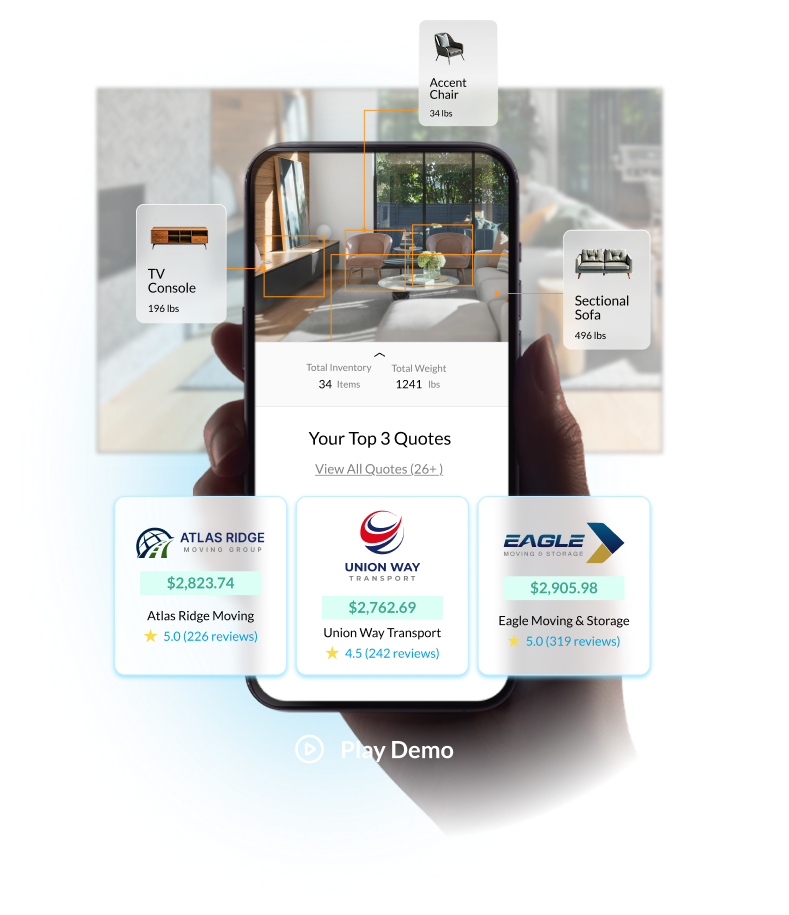
Step 1: Scan your home. You walk through your rooms with your phone and Agoyu’s AI does the inventory: it recognizes what you own, item by item, builds the list, and estimates the weight. Every moving price starts with the inventory, and the traditional inventory, a salesperson eyeballing your living room or you typing a list from memory, is where bad quotes are born.
Step 2: See exact prices. From that one scan, Agoyu shows you the exact cost to move through the long distance movers in the platform, side by side, for your home, your route, and your dates. No callbacks. No estimate visits. No meter running.
Step 3: Or post your move for bids. Put the move out and the movers in the platform bid on it. A mover with space on a truck going your way can bid a price nobody running a dedicated truck can match.
Step 4: Compare the whole picture. Every price sits next to the mover’s Trust Signals: their US DOT licensing, BBB rating, Yelp reviews, and complaint record. Price and record on one screen.
Step 5: Book in the platform. Pick your mover and your packing level, from packing yourself to full packing and unpacking, and book. The agreed price, the dates, the inventory, and the terms are all in the platform record. Like Expedia, Agoyu is free to the consumer.
Trust Signals: Check the Mover, Not the Marketing
Whether you hire by the hour locally or book a long distance move on Agoyu, check the same records. Every mover profile on Agoyu displays:
- US DOT license. Interstate movers are licensed through the U.S. Department of Transportation. The profile links to the mover’s US DOT license, so you can confirm the company is authorized for the move you are booking. Local moves within one state may also carry state licensing requirements worth asking about.
- BBB rating. The Better Business Bureau rating shows how the company handles complaints and how it has conducted itself over time.
- Yelp reviews. Real customer experiences in their own words. On hourly moves, read specifically for billing complaints: clocks that started early, hours that stretched, minimums that were never mentioned.
- IAM and FIDI profiles. Where a mover holds membership in the International Association of Movers or FIDI, the profile links to it.
For an hourly local mover who is not on any platform, do the same checks yourself before you book: license, rating, reviews, and a written statement of the rate, the minimum, and when the clock starts and stops.
How Much Should You Tip Movers?
Tipping is customary, not obligatory. Current published guidance from Angi (angi.com, “How Much to Tip Movers,” updated July 9, 2026, accessed Nov 24, 2026) puts a standard tip at $4 to $5 per hour per mover, with 10 to 20 percent of the total move cost as the common alternative. On that rate, a two mover crew on a five hour move lands at $40 to $50 in total tips, and a full eight hour day at $64 to $80. Tip more for difficult carries, stairs, bad weather, specialty items handled well, and a crew that was careful and courteous. Tip less, or not at all, for careless or rude service. Tips are normally paid in cash, and you can hand the total to the foreman for equal division, or split it between the loading and unloading crews if they are different teams. Food and a genuine thank you are also appreciated, and neither replaces a fair tip for a hard day done well.
How to Decide: A Short Checklist
- Ask for the rate, the minimum hours, and the travel time policy in writing before you book.
- Ask when the clock starts and when it stops.
- Match crew size to the home: small and simple favors two movers; large or heavy favors a bigger crew for fewer hours.
- Pack everything before the crew arrives. Readiness is the cheapest hour you will ever buy.
- Disclose stairs, elevators, long carries, parking limits, and specialty items before the quote.
- If the move is long distance, stop pricing by the hour. Get exact, inventory based prices and check whether each one is guaranteed.
- Check the mover’s US DOT license, BBB rating, Yelp reviews, and complaint record before you fall for a rate.
About the Data on This Page
The archived guide’s hourly rate ranges and home size totals tables had no benchmark counterpart in the Researched Tables and conflicted internally (its per person ranges and its totals did not reconcile), so they were removed from the body on Nov 24, 2026 and are preserved in the editor notes; this page works from the structure of an hourly bill and your own market’s quotes instead. The tipping guidance follows a current named source (Angi, updated July 9, 2026, accessed Nov 24, 2026). The platform facts stated on this page, 86 long distance movers in the platform and full insurance with no deductible up to $100,000 included on moves booked through Agoyu, are Agoyu’s own confirmed figures. Where this page identifies a needed statistic, the statistic does not yet exist in publishable form. Agoyu would rather show you a gap than a made up number.
Frequently Asked Questions
How much do movers cost per hour?
Rates are quoted per crew, not per person, and they vary by market, company, day, and season, so there is no honest single national figure. Most movers set a minimum of two to three hours. Your real cost is the crew rate you are quoted multiplied by the hours your move actually takes, plus travel time, so the inventory and access at your home matter as much as the rate.
How long does a local move take?
A small, packed, easy access home is a few hours with a two person crew; three and four bedroom houses take substantially more, especially with packing included, difficult access, or specialty items. A mover who has seen your actual inventory can estimate the hours far better than a room count can.
What is a moving minimum, and how does travel time work?
A minimum is the smallest number of hours you will be charged, whether the move takes that long or not. Travel time is the paid time for the crew to get from their base to your home, and sometimes back. Both belong in writing in your quote. Two quotes at the same hourly rate can differ by an hour or more once minimums and travel are counted.
Is an hourly rate or a flat price better?
Hourly suits small, simple, well prepared local moves where you can control the day. A flat or guaranteed price suits larger moves, difficult access, fixed dates, and anyone who cannot absorb a bill that grows with the clock. The deciding question is who carries the risk of a slow move: on an hourly move, you do.
How much should I tip my movers?
Current published guidance from Angi (angi.com, updated July 9, 2026, accessed Nov 24, 2026) is $4 to $5 per hour per mover, or 10 to 20 percent of the total move cost. Tipping is customary rather than required. Adjust for difficulty, care, and courtesy, and pay in cash if you want the crew to receive it directly.
Does Agoyu book local hourly moves?
Yes. Agoyu covers local moves at hourly rates, with the platform’s algorithms calculating the cost for local, intrastate, interstate, long distance, and international moves. The two biggest local movers in the platform, College H.U.N.K.S. and All My Sons, between them cover virtually every state and local market. If your move is local only, you can price it by the hour in the platform with your eyes open. If it is long distance, an exact guaranteed price from a scan will serve you better than any hourly estimate.
What insurance is included with an Agoyu move?
Full insurance with no deductible up to $100,000 is included in the price of every move booked through Agoyu. It is not an add on sold at signing. On an hourly local move booked outside a platform, ask what coverage is actually included, to what dollar figure, and with what deductible, before the crew starts the clock.
Get a Price That Does Not Run on a Clock
An hourly rate is not a price. It is a price per hour multiplied by a number of hours nobody has promised you. For a small local move, well prepared, that trade can be fair. For anything bigger, the honest way to budget is a price built from your actual inventory, agreed before moving day, with the mover’s record next to the number.
If your move is long distance, scan your rooms and see the exact published prices from 86 long distance movers, or post your move and let them bid for it, with DOT records, BBB ratings, and Yelp reviews next to every price, guaranteed pricing where it is offered, your agreement documented in the platform, and $100,000 of no deductible insurance included. That is what a moving price looks like when the meter is off.


