Moving Services Cost: Price the Move Line by Line
Nobody buys “a move.” You buy a list: the truck and the drive, the crew and their hours, and then a set of services you either add or do yourself. Packing. Unpacking. Loading and unloading. Storage when the dates do not line up. Furniture taken apart and put back together. The piano. Almost every moving […]
Shop Movers with AI


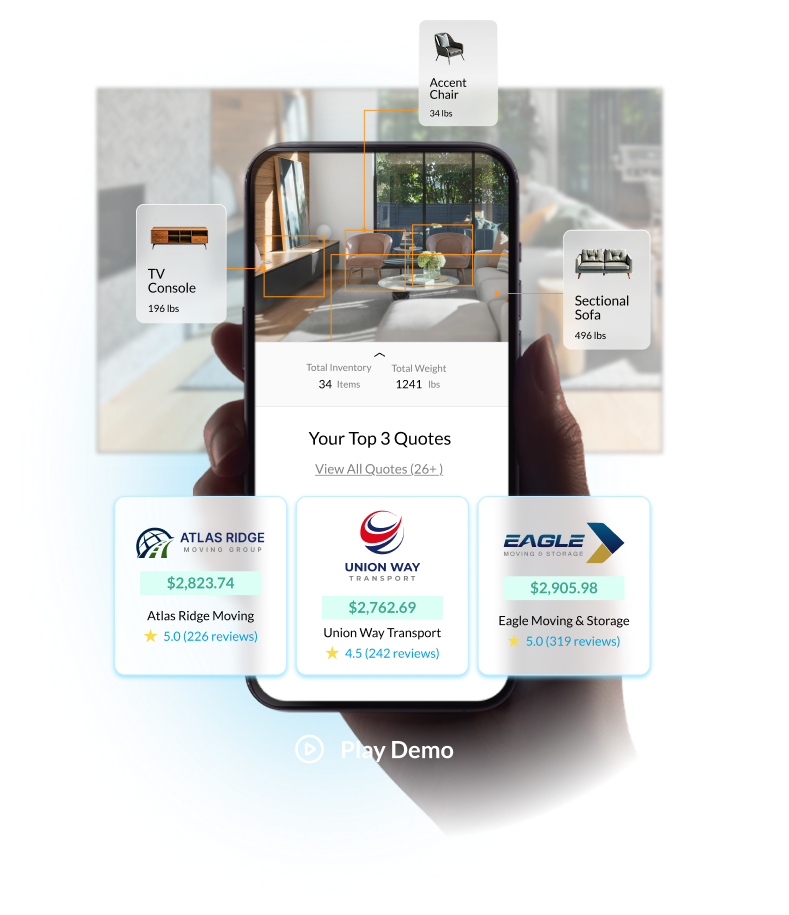
Nobody buys “a move.” You buy a list: the truck and the drive, the crew and their hours, and then a set of services you either add or do yourself. Packing. Unpacking. Loading and unloading. Storage when the dates do not line up. Furniture taken apart and put back together. The piano. Almost every moving argument about money is really an argument about that list: what was on it, what was not, and what got added after the price was quoted.
This guide prices the move the way the invoice builds it: the base move first, then each service line, what it does, and how it is priced. The planning ranges come from Agoyu’s archived services guide, flagged as archived throughout. The point of the page is not the ranges. It is showing you how to get the whole list priced, in writing, with a guarantee attached, before anyone touches your furniture.
Key Numbers: Moving Services on Agoyu
- 86 long distance movers in the Agoyu platform, with published rates and live bids on real moves.
- $100,000 of insurance with no deductible included in the price of every move booked through Agoyu, not sold back to you as an add on. On most itemized quotes, coverage is one of the add on lines. On Agoyu it is not a line at all.
- A patented AI platform (U.S. Patent No. 12,602,645 B2) that prices your move from a scan of your actual home, not from a form you filled in from memory.
- Industry planning prices for major add on services are listed in the service menu below (Researched Tables, Nov 24, 2026). They are industry planning ranges, not Agoyu platform averages.
- 12 bids on average on a posted move, so each service is priced inside a competitive bid, not as a take it or leave it add on.
- The winning bid averages about 23% below the first published rate on a posted move, so each service is priced inside a total set by competition, not by the first rate alone.
The Base Move: What the First Number Covers
Base moving costs split by move type, and the split explains most quotes. Local moves are priced mainly on time: crew size, hours, and how much you own, at an hourly crew rate the mover sets for its market. Long distance moves are priced mainly on weight and distance: distance drives fuel, tolls, and crew time, and location matters too, with mover prices in a city like Los Angeles running higher than in a rural area. The full service planning ranges by home size and distance used across Agoyu’s cost guides (Researched Tables, Nov 24, 2026, source: Moving Hub, Sep 2026) are the benchmark frame for the long distance base; a local base is the crew rate multiplied by the hours your move actually takes. On either type, access adds time and therefore money: stairs, elevators, and narrow hallways at either end slow the crew, and a well built quote says so in advance instead of billing it as a surprise.
Two things to hold onto from this section. First, the base number buys transport and the crew’s labor for loading, driving, and unloading. Almost everything else on this page is a separate line. Second, on a local move priced by the hour, the services below are not priced as services at all. They are priced as hours, which means packing help on a local move is a decision about crew time, and packing badly yourself can cost more in crew hours than packing help would have.
The Service Menu: What Each Add-On Is and How It Is Priced
Packing
Professional packing means the crew wraps, boxes, and pads your household before loading. It is priced from the inventory: more belongings, and more fragile belongings, cost more to pack. It is also the service where the packing level decision lives. On Agoyu, you choose your packing level when you book, from packing yourself to full packing and unpacking, and the price you see reflects the level you picked. The archived guide’s case for the service is practical: professional packing saves you days and gets belongings packed securely by people who do it daily. Its case against is the same as every line on this page: convenience is a cost, and it should be a chosen cost, visible before you book, not a default you discover on the invoice.
Industry planning price for full packing is $350 to $1,500 or more per move, and partial packing is $300 to $800 (Researched Tables, Nov 24, 2026, partial packing figure is a draft value).
Unpacking
Unpacking is the mirror service at destination, with an industry planning price of $150 to $450 (Researched Tables, Nov 24, 2026): boxes opened, items placed, packing material hauled away as part of the same visit in many quotes. It is the most commonly skipped line and, for anyone starting work the week they arrive, often the one people wish they had bought. Price it when you get the quote, even if you decline it. A line you declined knowingly is a good outcome. A line you never saw is not.
Loading and unloading help
If you are driving a rental truck or loading a container yourself, labor can still be bought on its own: a crew that loads, a crew that unloads, priced by the hour on the same crew size logic as any local move. This is the hybrid move, and it is frequently the smartest money on the page, because loading is the skilled, injury prone, damage prone part of a DIY move. Your belongings are packed by you, carried and stacked by professionals, and driven by you.
Industry planning price for loading and unloading help is $500 to $1,500 (Researched Tables, Nov 24, 2026, draft value).
Storage
Storage enters a move when the dates do not line up, with an industry planning price of $150 to $500 per month (Researched Tables, Nov 24, 2026): the new home is not ready, the old one had to be vacated, or a shipment arrives before you do. The archived guide lists storage plainly as an additional cost beyond basic moving services, priced for the time your belongings sit. The questions that decide what storage really costs are how long, in whose facility, and what it costs to get your goods back out and delivered. Get all three in writing. A cheap month with an expensive redelivery is not a cheap month.
Furniture disassembly and assembly
Furniture assembly and disassembly is quoted by labor hours as an industry planning approach (Researched Tables, Nov 24, 2026), rather than as a fixed per move price.
Beds, large tables, and modular furniture often cannot move assembled. Taking them apart at origin and putting them back together at destination is a standard add on line, named in the archived guide’s list of additional services. Confirm which pieces are included. “Furniture assembly” on a quote should mean a list, not a hope.
Specialty items
Industry planning prices include piano or pool table handling at $200 to $1,000 per item, heavy or bulky items at $200 to $500 per item (draft value), custom crating at $200 minimum and about $15 per cu ft (a single carrier tariff example, not a market average), stair fees at $75 to $150 per flight with elevator charges varying, long carry at $50 to $150 per segment, shuttle service at $150 to $600 per service, appliance servicing at about $100 per appliance (tariff example), and extra crew at about $75 per mover hour (tariff example) (Researched Tables, Nov 24, 2026). Specialty item handling beyond those named items is quoted by item, and debris removal is quoted by labor and volume.
Pianos, antiques, fragile and high value pieces: the archived guide names them as specialized services that add to the overall cost, and they should. Specialty handling means the right equipment, the right crew experience, and sometimes crating built for the piece. This is the line where the cheapest option is most likely to be the expensive one. It is also where documentation matters most, which is why the video record described below exists.
Supplies
Boxes, tape, paper, dish packs, blankets, and straps. With movers, supplies are either bundled into the packing line or itemized; with a truck or container, they are yours to buy. Either way they are a real line, and the archived guide lists moving supplies among the costs not included in most headline moving prices. Budget them deliberately instead of discovering them across four hardware store trips.
Insurance and coverage
The archived guide’s warning is the industry standard: most moving companies offer basic coverage, and additional coverage for valuable or fragile items costs extra. That structure, a thin included layer and a real one sold back to you, is worth naming because Agoyu’s is different. Every move booked through Agoyu includes full insurance with no deductible up to $100,000 in the price. Not an add on line, not a signing table upsell. When you compare an Agoyu price against an itemized quote, check whether the other quote’s coverage line buys anything close, because on paper the two totals are not buying the same protection.
What Moves the Price of the Services
Distance. The base driver’s seat factor: fuel, tolls, crew time, and on long hauls, crew accommodations, all scale with miles.
Labor and complexity. Crew size and hours are the local move’s whole price and a real part of every other price. Heavy, bulky, or awkward items take longer to pack, load, and carry, and complexity is labor.
Home size and volume. More rooms means more items, more packing material, more crew time, and more truck. The archived guide’s advice is the cheapest on this page: downsize before the move and every service priced from your inventory gets smaller with it.
Time of year. Summer, June through August, is peak season. Demand rises, crews are scarce, and both base rates and service rates follow. The archived guide notes movers may offer discounted rates off peak to attract customers, which is the capacity principle below arriving early.
Access. Stairs, elevators, narrow hallways, long carries. Named in the archived guide as a cost factor, and the one most often missing from a phone quote, because the person quoting has not seen either address.
Capacity: Why the Same Service List Prices Differently
Here is the thing the moving industry has never put in an advertisement: movers do not just sell labor and miles. They sell space in a truck that is already going somewhere, and crew days on a calendar that fills unevenly.
A long distance truck runs a route. If it is heading your way with room in it, the empty space earns the mover nothing, so space on that truck is cheap, and the services wrapped around that space get priced by a mover who wants the load. If a mover has to send a truck out of its way for you, or turn away other work to take your dates, your price carries all of that. Same crew, same packing, same care. Completely different total, decided by capacity on your dates.
That is why collecting one quote tells you almost nothing about what your service list should cost. Each mover is pricing a different business situation: their truck capacity that week, their crew calendar, their local costs. The spread between quotes for the identical list of services is not a defect in the market. On Agoyu, that spread between the highest bid and the lowest bid on the same scanned move averages about 32%. It is the market, and it is why the answer to “what do moving services cost” is to get the same list priced competitively, on your actual move, and compare the totals with the inclusions side by side.
A Range Is Not a Price: Guaranteed Pricing
The add on structure of moving creates the industry’s favorite trick: quote the base low, win the booking, and let the services surface later, each one reasonable, the total unrecognizable. Packing that was “probably included.” Storage that was “standard.” A specialty charge for the piano that was in the living room during the estimate. Every one of those moments is a line that was never priced in writing before the truck was loaded.
The defense is boring and total: get every service you are buying named and priced before you book, and get the total guaranteed. An estimate is a prediction. A guaranteed price is a commitment. In Agoyu, every bid clearly shows whether the mover guaranteed the rate or not. If the rate is guaranteed, it is locked in: it can go down, but it cannot go up. If a mover does not guarantee their rate in the platform, Agoyu requires that the mover either complete a visual survey of your home within one week or less and issue a guaranteed bound quote, or honor the rate they put in the platform. Compare the guarantee first and the number second. The cheapest guaranteed price beats the cheapest maybe price every single time.
How Agoyu Works, Step by Step
Step 1: Scan your home. You walk through your rooms with your phone and Agoyu’s AI does the inventory: it recognizes what you own, item by item, builds the list, and estimates the weight. Every service on this page is priced from the inventory, so the scan is what makes an itemized price honest instead of estimated.
Step 2: See exact prices. From that one scan, Agoyu shows you the exact cost to move through the long distance movers in the platform, side by side, for your home, your route, and your dates, with your chosen packing level in the price.
Step 3: Or post your move for bids. Put the move out and the movers in the platform bid on it. Capacity works for you here: a mover with space on a truck going your way can bid a total that a mover running dedicated capacity cannot match.
Step 4: Compare the whole picture. Every price sits next to the mover’s Trust Signals: their US DOT licensing, BBB rating, Yelp reviews, and complaint record. Price and record on one screen, which is the screen this industry has never wanted you to have.
Step 5: Book in the platform. Pick your mover and your packing level, from packing yourself to full packing and unpacking, and book. The agreed price, the dates, the inventory, the included services, and the terms are all in the platform record. Like Expedia, Agoyu is free to the consumer. The movers compete for your business. You watch the prices and pick.
Trust Signals: Check the Mover, Not the Marketing
Every mover profile on Agoyu displays the records that actually tell you who you are hiring:
- US DOT license. Interstate movers are licensed through the U.S. Department of Transportation. The profile links to the mover’s US DOT license, so you can confirm the company is authorized to move household goods across state lines.
- BBB rating. The Better Business Bureau rating shows how the company handles complaints and how it has conducted itself over time.
- Yelp reviews. Real customer experiences in their own words. Read for patterns: one bad review is a data point; ten reviews describing the same raised price or missed delivery window is who that mover is.
- IAM and FIDI profiles. Where a mover holds membership in the International Association of Movers or FIDI, the profile links to it, so you can see the industry standing the mover claims, from the organizations themselves.
Service disputes are where mover records earn their keep. A pattern of complaints about charges added on the day, or services promised and not performed, is visible in those records before you book, if you look. On Agoyu you do not have to go looking. The record sits next to the price.
Documented, Not Handshaken: The Digital Agreement
Your Agoyu booking documents the move the way a smart contract documents a transaction. The inventory is the scan, item by item. The price is the published rate or the winning bid, with its guarantee status stated. The included services are listed, which on an itemized product like moving is the whole ballgame: the list is the agreement. The pickup and delivery terms are agreed in the platform. And for household goods moves, the condition of your belongings is documented on video as they are loaded, so what left your home, and the shape it was in, is never a matter of opinion.
If something arrives damaged, or a service you paid for is disputed, the claim starts from that record instead of an argument. The scanned inventory says what was moved. The service list says what was bought. The load video says what condition it was in. The included insurance, full coverage with no deductible up to $100,000, says what it pays. Agoyu stores applicable moving videos at no charge for up to 30 days after the move, and you can download your videos for free before they are deleted.
The Scam Playbook Runs on Darkness
The moving industry is full of legitimate, reputable companies. It also has a bad actor problem: fraudulent or unlicensed operators, bait and switch pricing, misleading estimates, unexplained additional charges, hostage load situations, and companies operating behind fresh names to escape their complaint histories. The Federal Motor Carrier Safety Administration receives thousands of consumer complaints about household goods movers every year.
The services menu is where the quiet version of the playbook runs. Not the dramatic hostage load, just the steady drip: the packing charge that appears on delivery day, the stair fee nobody mentioned, the storage month that bills twice. None of it requires a criminal. All of it requires the same condition, a customer whose agreement never listed the services in writing. A scan that fixes the inventory, a service list priced and guaranteed in the platform, dates agreed before the truck rolls, and video of your goods at loading: documentation is how the drip stops.
“Best Moving Companies” Lists Cannot Price Your Service List
Ask a simple question of any ranked list of moving companies. Has the writer seen your home? Do they know which services you need, which you will do yourself, or what capacity any mover has on your route on your dates? The answer is no, and yet the list ranks movers for your move anyway. Many of these lists are pay to play: placement follows affiliate commissions.
“Best” is not a property of a company. It is a property of a match: your origin and destination, your dates, your inventory, the services on your list, and the capacity a mover has that week. A mover who is the right answer for a full service move in October can be the wrong answer, at the wrong price, for a load only job in July. Agoyu’s answer is not a better list. It is live published rates and live bids on your actual scanned move, from 86 long distance movers, with their DOT records, BBB ratings, and Yelp reviews attached to every number, and your service list priced into every one of them.
DIY vs Hiring Movers: The Honest Version
The archived guide asked whether it costs less to move yourself or hire a company, and its answer was the right shape: DIY looks cheaper first, and the comparison changes when you count time, effort, and risk. This page adds the middle option the question usually hides. You do not have to buy the whole list or none of it. The services unbundle: drive yourself and buy loading help. Pack yourself and buy the drive and the crew. Buy everything except the unpacking. Each combination prices differently, and the right one depends on your budget, your back, your timeline, and how much a free weekend is worth to you. The mistake is not choosing DIY or choosing full service. The mistake is choosing without seeing the same list priced both ways.
How to Decide: A Short Checklist
- List the services you actually want before you collect a single quote. Quotes are only comparable when the list is identical.
- Get every service named and priced in writing. A service that is not on the quote is a charge that arrives later.
- Ask of every total: is this price guaranteed, and what exactly does it include?
- Check what coverage is actually included, to what dollar figure, and with what deductible, before comparing totals.
- Confirm storage terms in full: the month, the facility, and the cost of getting your goods back out.
- Check the mover’s US DOT license, BBB rating, Yelp reviews, and complaint record before you fall for a price.
- Downsize before you price. Every service on the menu is priced from your inventory, so a smaller inventory is a smaller bill on every line.
About the Data on This Page
The cost ranges and hourly rates on this page come from Agoyu’s archived moving services guide, recovered from a May 2026 snapshot of the earlier page. They are presented as historical planning ranges, not current quotes, and they are scheduled for verification against current sources before this page is treated as final. The original guide gave no per service prices for packing, storage, or specialty handling. This refresh applies industry planning prices for those services from the Researched Tables, Nov 24, 2026 (sources: Moving APT interstate moving cost report, Vector Movers, and Overall Moving AZ Tariff 2026 for the tariff examples, which are single carrier charges labelled as examples, never market averages). Attach rates for add on services are Agoyu-only data, were not provided, and remain open in the editor notes. The platform facts stated on this page, 86 long distance movers in the platform and full insurance with no deductible up to $100,000 included on moves booked through Agoyu, are Agoyu’s own confirmed figures. Agoyu would rather show you a gap than a made up number.
Frequently Asked Questions
How much do movers cost?
A local move is priced by crew hours: the crew’s hourly rate multiplied by the hours your move takes, so crew size, access, and readiness set the total. A long distance move is priced by weight and distance, and the full service planning ranges by home size and distance in Agoyu’s cost guides (Researched Tables, Nov 24, 2026) frame it: a 2 bedroom home, for example, runs about $3,020 to $6,825 at roughly 1,000 miles as an industry planning range. The add-on services are priced on top of the base, at the planning prices in the service menu above. Your actual price depends on your inventory, distance, dates, and the services on your list, and an Agoyu scan produces that exact figure before you book.
What services cost extra on top of the base move?
The standard list: professional packing and unpacking, furniture disassembly and assembly, specialty handling for items like pianos and antiques, storage, moving supplies, and coverage beyond the basic layer most movers include. Vehicle shipping is a separate service with its own price (industry planning range $500 to $1,200, route dependent, draft value) and is not part of a standard moving services quote. Extra pickup or delivery carries an industry planning price of $100 to $500 (draft value). None of these should be a surprise: each one you are buying should be named and priced on your quote before you book.
Are moving costs negotiable?
The archived guide said costs can be negotiable in some cases, especially off peak. The more reliable version of that idea is competition: the same service list, priced by movers bidding against each other for your move, finds the market price without a negotiation. Off peak helps for a capacity reason, not a haggling reason: movers with empty calendars and empty trucks price to fill them.
How far in advance should I plan my move?
The archived guide advised starting 2 to 3 months ahead, especially for long distance moves. Planning early is also a pricing advantage: your dates are more likely to match a mover’s open capacity, and you have time to downsize, which shrinks every inventory priced line on the quote.
Is it cheaper to move myself or hire movers?
DIY is cheaper in cash and more expensive in time, effort, and risk, and the honest comparison usually lands in the middle: buy the services that are skilled or risky to do yourself, like loading, and do the ones that are only time consuming, like packing, if you have the time. Price the same service list both ways before you decide.
Is my moving price guaranteed?
Only if the mover says so, in writing, before you book, with the services listed. An estimate can change; a guaranteed price cannot go up. On Agoyu, every bid shows whether the rate is guaranteed. If it is not, the mover must either complete a visual survey of your home within one week or less and issue a guaranteed bound quote, or honor the rate shown in the platform. Always compare the guarantee first and the number second.
What insurance is included with an Agoyu move?
Full insurance with no deductible up to $100,000 is included in the price of every move booked through Agoyu. It is not an add on sold at signing, which matters on this page’s subject: on most itemized quotes, real coverage is one of the extra lines. On Agoyu it is already in the number you are comparing.
Get Your Real Price, Line by Line
You came here looking for what moving services cost. The honest answer is a list, priced line by line, and the ranges on this page are only the sketch of it. The real version has your inventory, your route, your dates, and your service choices in it, and it comes with the inclusions in writing and the total guaranteed.
There is a shorter way to get it than a week of phone calls. Scan your rooms, choose your packing level, see the exact published prices from 86 long distance movers, or post your move and let them bid for it, with every mover’s DOT record, BBB rating, and Yelp reviews next to the price, your agreement, dates, and service list documented in the platform, video of your goods at loading, and $100,000 of no deductible insurance already included in the number. That is what moving services cost when every line is priced before you commit, instead of discovered after.


