Moving From New York to San Francisco: What It Costs and How to Plan It
New York to San Francisco is about as far as a household can move inside the continental United States: roughly 2,900 miles, coast to coast. At that distance, almost nobody drives a rental truck themselves, and the price is set less by the miles than by three things most cost guides skip: what you actually […]
Shop Movers with AI


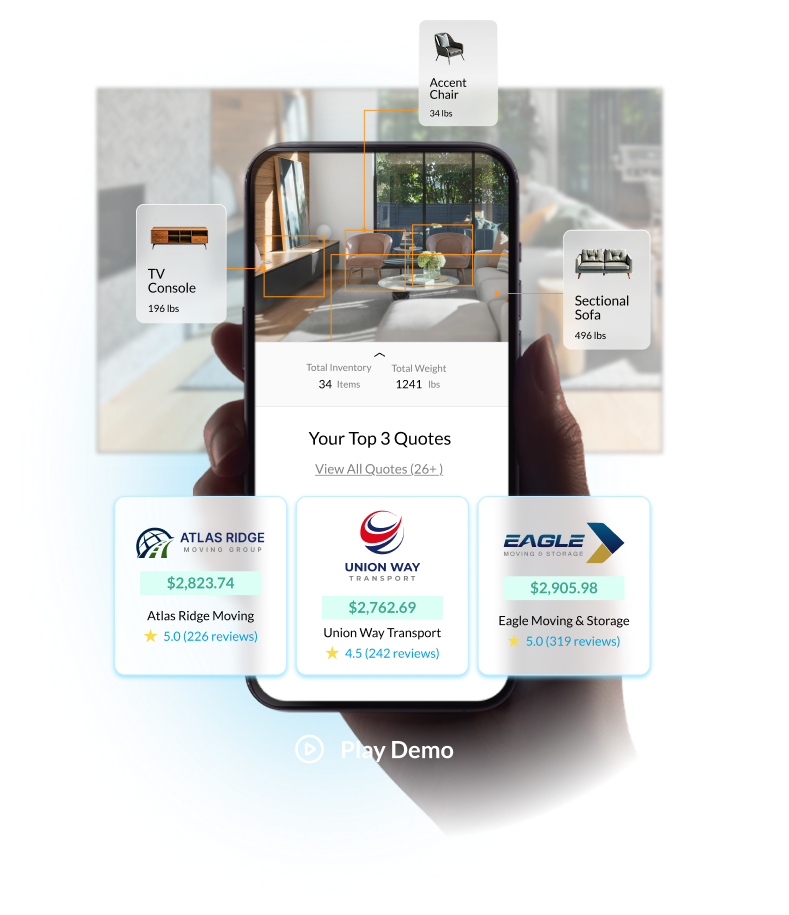
New York to San Francisco is about as far as a household can move inside the continental United States: roughly 2,900 miles, coast to coast. At that distance, almost nobody drives a rental truck themselves, and the price is set less by the miles than by three things most cost guides skip: what you actually own, when you move, and whether a mover has a truck already heading west with space in it.
This guide gives you the honest planning range first, then explains what moves the number on this specific route, how the shipment travels, and how to replace the range with an exact price for your home before you book.
Key Numbers: New York to San Francisco Moves on Agoyu
- Up to 25 moving quotes in under 3 minutes on an average lane, from published rates plus discount asks.
- 86 long distance movers in the platform, with published rates and live bids on real moves.
- $100,000 of insurance with no deductible included in the price of every move booked through Agoyu, not sold back to you as an add on.
- A patented AI platform (U.S. Patent No. 12,602,645 B2) that prices your move from a scan of your actual home, not from a form you filled in from memory.
- Movers competing on this lane: the platform movers with published rates or live bids on the New York to San Francisco lane price your move against each other, so the lane is priced by competition, not by a national average.
- 12 bids on average on a posted move.
- Delivery window (industry planning range): 7 to 12 business days for a full truck direct, 12 to 21 for a partial consolidated load, and 12 to 28 for a small consolidated load on a 2,500 to 2,800 mile cross country move. This route is about 2,900 miles, just above that band. See the delivery section for source and limits.
What a Move From New York to San Francisco Costs: The Planning Range
As a planning range, current industry data puts a full service move from New York City to San Francisco at about $2,250 to $11,000, depending on how much you move and the season (industry planning range: moveBuddha route data, updated November 2026, corroborated by GoodMigrations, October 2026). Treat that as a budget starting point, not a quote.
No range can price your move, because no range knows your inventory. On a 2,900 mile move, the spread inside that range is mostly your shipment:
- A small apartment or partial shipment sits at the low end, especially if it can travel in space left on a truck already routed west.
- A full family home sits at the high end, and can exceed it with full packing, specialty items, or a peak season date.
Industry planning ranges by home size at about 2,500 miles (full service, industry data, not Agoyu prices):
| Home size | Planning range at about 2,500 miles |
|---|---|
| Studio | $2,740 to $4,560 |
| 1 bedroom | $3,640 to $6,060 |
| 2 bedroom | $4,230 to $7,560 |
| 3 bedroom | $6,000 to $10,400 |
| 4 bedroom | $8,370 to $13,220 |
| 5 bedroom | $7,000 to $15,000 (editorial estimate) |
Source: Moving Hub, Sep 2026. The 5 bedroom row is an editorial estimate. These are industry planning ranges only, never Agoyu booked prices or AI scan averages.
At 3,000 miles or more (industry planning ranges, editorial estimates): Studio: quote by route; 1 bedroom $3,000 to $6,500; 2 bedroom $5,000 to $11,000; 3 bedroom $5,000 to $11,000; 4 bedroom $8,000 to $18,000; 5 bedroom $8,000 to $18,000. Source: Moving Hub, Sep 2026.
- Your exact addresses matter. A walk up in New York and a hillside home with limited truck access in San Francisco both add labor that a city to city average never sees.
The Real Price of This Route Is Capacity
Movers do not just sell labor and miles. They sell space in a truck that is already going somewhere.
New York to California is a major one way corridor, and trucks run it constantly. If a truck is heading west with room left in it, that empty space earns the mover nothing, so space on that truck is cheap. If a mover has to position a truck for you, or turn away other work to take your move, your price carries that cost. Same mover, same crew, same care. Completely different price, decided by which way the trucks are rolling on your dates.
That is why shipment size cuts both ways on this route:
A small or partial shipment fits into leftover space on a truck already going your way. This is where the deepest discounts in long distance moving live. On Agoyu, movers discount on average 23% from published rates to win the move, and a partial shipment filling space on a truck already routed west is where that discount is most available.
A big shipment that fills a whole truck is the most efficient load a mover can run: one pickup, one delivery, no time spent combining households. Movers want full truck loads, and when several want the same load, the bids show it.
No static cost guide can show you any of this, because capacity changes every day. A live platform can, because the trucks are live too.
What Else Moves the Price
Distance and weight. The two foundations of every long distance price. At roughly 2,900 miles there is no cheap version of the miles themselves, which makes the weight half of the equation the part you control. Every item you sell, donate, or leave behind is weight you do not pay to haul across the country.
Time of year. Peak moving season runs June through August, when school is out, demand is high, and trucks are scarce. If your dates are flexible, an off season move is the most reliable single way to lower the price of any method.
Packing level. On Agoyu you choose the packing level, from packing yourself to full packing and unpacking, and the price changes with the choice. At this distance, packing quality also decides how your goods survive a cross country ride, so the cheapest packing option is not always the cheapest outcome.
Access at both ends. New York pickups can involve walk ups, elevators that need reserving, and streets where a large truck cannot wait. San Francisco deliveries can involve steep streets, limited parking, and buildings with their own move in rules. Both ends can add labor, a shuttle truck, or a long carry. A quote that never asked about access at either end is a quote that will change.
Additional services. Storage at either end, vehicle shipping, specialty items such as a piano, and extra crew all add to the bill. All of them should be visible before you book, not discovered on delivery day. As industry planning prices (sources: Moving APT, Vector Movers, Overall Moving AZ Tariff 2026; tariff figures are single carrier examples): full packing $350 to $1,500 or more; unpacking $150 to $450; storage $150 to $500 per month; car shipping $500 to $1,200 (route dependent); piano or pool table $200 to $1,000 per item; stair or elevator $75 to $150 per flight; long carry $50 to $150 per segment; shuttle $150 to $600. These are planning examples, not Agoyu prices.
Your own travel. You will most likely fly while the truck is in transit. Budget the flights and any hotel nights alongside the move itself. They are part of the real cost of relocating, even though no mover charges them.
How the Shipment Travels, and How Long It Takes
A full truck carrying only your household drives close to straight through. A partial shipment usually travels consolidated: your belongings share the truck with other households going the same general direction, the truck stops along the route, and each stop adds time. A small shipment may wait to be combined with enough freight to justify the run.
Delivery windows (industry planning ranges, business days): For cross country moves of 2,500 to 2,800 miles, plan on 7 to 12 business days for a full truck shipped direct, 12 to 21 business days for a partial load shipped consolidated, and 12 to 28 business days for a small load shipped consolidated. These are industry planning ranges, not Agoyu booked delivery times. Source: SafeBound Moving. FMCSA requires definite agreed delivery dates or ranges on the order for service, and your agreed dates are documented in the platform when you book on Agoyu. The small load high end of 28 days is an editorial estimate: an allowance built from published consolidated ranges, not measured small load data.
Note on this route: New York to San Francisco is about 2,900 miles, just above the 2,500 to 2,800 mile band those ranges were published for, so treat them as planning ranges, not a promise for this exact route.
Whichever option you pick, your pickup and delivery dates are agreed and documented in the platform when you book on Agoyu, not estimated over the phone and renegotiated later. If a lease start, a closing date, or a first day at a new job makes timing worth paying for, ask what a direct shipment costs before you choose. On Agoyu, that trade off is a visible price, not a hope.
New York Out, San Francisco In: What Changes
People make this move for the milder coastal weather, the outdoor access, and a pace of life more relaxed than New York. Two planning points matter as much as the logistics:
Do not move expecting a cheaper life. San Francisco’s cost of living is comparable to New York’s, with housing at the top of the list in both cities. Treat this as a lifestyle move, not a savings move, and budget your first months accordingly.
Transit works differently. San Francisco is smaller and denser than New York, with bus, streetcar, cable car, and ferry options. The practical point: many households that needed a car in the New York suburbs find they can delay buying one, or skip a second car, in San Francisco. Decide that before you pay to ship a vehicle across the country.
Selling in New York, Buying in San Francisco
If this move includes selling a home in New York and buying one in San Francisco, the timing of the real estate side drives the moving side: closing dates set your pickup and delivery windows, and a gap between closings is where storage costs appear.
One brief note, because it belongs in any move that includes a home sale or purchase: ARC Relocation, Agoyu’s sister company, offers a Realtor Rebate referral program for buyers and sellers. If you are buying or selling as part of this move, it is worth one question before you choose a real estate agent on your own, since a referral made after you have already signed with an agent usually cannot be applied.
A Range Is Not a Price: Guaranteed Pricing
The most dangerous number in moving is a low estimate that is not guaranteed. The classic cross country bait and switch runs on it: a low quote wins the booking, the truck gets loaded, and the real price appears somewhere down the road, with your belongings already on board and your leverage gone.
An estimate is a prediction. A guaranteed price is a commitment. Before you compare any two quotes for this route, ask which one you are holding.
In Agoyu, every bid clearly shows whether the mover guaranteed the rate or not. If the rate is guaranteed, it is locked in: it can go down, but it cannot go up. If a mover does not guarantee their rate in the platform, Agoyu requires that the mover either complete a visual survey of your home within one week or less and issue a guaranteed bound quote, or honor the rate they put in the platform. Compare the guarantee first and the number second.
How Agoyu Works, Step by Step
Step 1: Scan your home. You walk through your rooms with your phone and Agoyu’s AI does the inventory: it recognizes what you own, item by item, builds the list, and estimates the weight. Every price in long distance moving is built on the inventory, and a guessed inventory is where bad quotes are born.
Step 2: See exact prices. From that one scan, Agoyu shows you the exact cost to move through the long distance movers in the platform, side by side, for your home, your route, and your dates. No callbacks. No estimate visits.
Step 3: Or post your move for bids. Put the move out and the movers in the platform bid on it. This is where capacity works for you: a mover with space on a truck heading west can bid a price nobody running a dedicated truck can match.
Step 4: Compare the whole picture. Every price sits next to the mover’s Trust Signals: their US DOT licensing, BBB rating, Yelp reviews, and complaint record. Price and record on one screen.
Step 5: Book in the platform. Pick your mover and your packing level, and book. The agreed price, the dates, the inventory, and the terms are all in the platform record. Like Expedia, Agoyu is free to the consumer. The movers compete for your business. You watch the prices and pick.
Trust Signals: Check the Mover, Not the Marketing
Every mover profile on Agoyu displays the records that actually tell you who you are hiring:
- US DOT license. Interstate movers are licensed through the U.S. Department of Transportation. The profile links to the mover’s US DOT license, so you can confirm the company is authorized to move household goods across state lines.
- BBB rating. The Better Business Bureau rating shows how the company handles complaints and how it has conducted itself over time.
- Yelp reviews. Real customer experiences in their own words. Read for patterns: one bad review is a data point; ten reviews describing the same raised price or missed delivery window is who that mover is.
- IAM and FIDI profiles. Where a mover holds membership in the International Association of Movers or FIDI, the profile links to it, so you can see the industry standing the mover claims, from the organizations themselves.
None of this asks you to take Agoyu’s word for anything. The records are the mover’s own, displayed next to the price they are asking you to pay. The Federal Motor Carrier Safety Administration’s Protect Your Move resources recommend the same checks from the government’s side.
Documented, Not Handshaken: The Digital Agreement
Your Agoyu booking documents the move the way a smart contract documents a transaction. The inventory is the scan, item by item. The price is the published rate or the winning bid, with its guarantee status stated. The included services are listed. The pickup and delivery terms are agreed in the platform. And for household goods moves, the condition of your belongings is documented on video as they are loaded, so what left your New York home, and the shape it was in, is never a matter of opinion.
That video documentation matters most on the worst day: if something arrives damaged in San Francisco, the claim starts from the record instead of an argument. Agoyu stores applicable moving videos at no charge for up to 30 days after the move, and you can download your videos for free before they are deleted. Combined with the included insurance, full coverage with no deductible up to $100,000, a claim becomes a short, factual process instead of a fight.
“Best Movers From New York to San Francisco” Lists Cannot Price Your Move
The shortcut people take is the ranked list: “best movers” for this route, scored and badged. Ask a simple question of any such list. Has the writer seen your home? Have they seen the mover’s trucks, its route this week, or the space left in one on Friday? The answer is no, and yet the list ranks movers for your move anyway. Many of these lists are pay to play: placement follows affiliate commissions.
The deeper problem is that “best” is not a property of a company. It is a property of a match: your origin and destination, your dates, your shipment size, the capacity a mover has heading west that week, and what you need done. Agoyu’s answer is not a better list. It is live published rates and live bids on your actual scanned move, from 86 long distance movers, with their DOT records, BBB ratings, and Yelp reviews attached to every number.
How to Decide: A Short Checklist
- Get your inventory right first. Every honest price starts there. A scan beats a guess.
- Collect prices for your actual move, on your actual dates, not national averages.
- Ask of every quote: is this price guaranteed, and what exactly does it include?
- Check the mover’s US DOT license, BBB rating, Yelp reviews, and complaint record before you fall for a price.
- Ask how your shipment travels: direct or consolidated, and what the delivery window is in writing.
- Confirm access at both ends: elevator, walk up, parking, and building rules in New York and San Francisco.
- Confirm what insurance is actually included, to what dollar figure, and with what deductible.
About the Data on This Page
The platform facts on this page are Agoyu’s own confirmed figures: 86 long distance movers in the platform, 12 bids on average on a posted move, movers discounting on average 23% from published rates to win a move, and full insurance with no deductible up to $100,000 included on moves booked through Agoyu. The cost ranges and delivery windows are industry planning ranges from the sources named with them (Moving Hub, Sep 2026; SafeBound Moving; moveBuddha route data, updated November 2026), not Agoyu booked prices or Agoyu delivery times. Where a figure is marked an editorial estimate, it is an allowance built from published ranges, not measured data. Agoyu would rather show you a range with its source than a made up number.
Frequently Asked Questions
How much does it cost to move from New York to San Francisco?
As an industry planning range, about $2,250 to $11,000 for a full service move (moveBuddha route data, updated November 2026). Small apartments and partial shipments land at the low end; full homes, full packing, and peak season dates land at the high end or above it. The price for your specific move depends on your inventory, your exact addresses, and your dates, and an Agoyu scan produces that exact figure before you book.
How far is San Francisco from New York City?
Roughly 2,900 miles by road, coast to coast. At that distance the move is priced as a long distance interstate move, and your shipment will typically travel by truck over several days, direct or consolidated depending on its size.
When is the cheapest time of year to make this move?
Generally outside peak season. Peak moving season runs June through August, when demand and prices are highest. If your dates are flexible, moving outside those months is the most reliable single way to lower the price.
How long does a move from New York to San Francisco take?
It depends on how your shipment travels. A full truck shipped direct is the fastest option. A consolidated partial load takes longer, because the truck stops for other households along the route, and a small consolidated shipment usually takes the longest. As industry planning ranges for a 2,500 to 2,800 mile cross country move, in business days: full truck direct 7 to 12, partial consolidated 12 to 21, small consolidated 12 to 28 (source: SafeBound Moving; the small load high end of 28 is an editorial estimate). This route is about 2,900 miles, just above that band. Your pickup and delivery dates are agreed and documented in the platform when you book on Agoyu.
Is my moving price guaranteed?
Only if the mover says so, in writing, before you book. An estimate can change; a guaranteed price cannot go up. On Agoyu, every bid shows whether the rate is guaranteed. If it is not, the mover must either complete a visual survey of your home within one week or less and issue a guaranteed bound quote, or honor the rate shown in the platform.
Is San Francisco cheaper than New York?
Do not count on it. Both are among the most expensive cities in the United States, and San Francisco’s cost of living is comparable to New York’s, with housing the largest cost in both. Most people make this move for weather, work, and lifestyle, not for savings.
How do I know a mover on this route is legitimate?
Check the records Agoyu displays on every mover profile: the US DOT license (interstate movers must be licensed through the U.S. Department of Transportation), the BBB rating, Yelp reviews, and, where held, IAM and FIDI profiles. Then read the complaint record for patterns. The FMCSA’s Protect Your Move guidance recommends the same checks.
What insurance is included with an Agoyu move?
Full insurance with no deductible up to $100,000 is included in the price of every move booked through Agoyu. It is not an add on sold at signing. Combined with your scanned inventory and the video documentation of your goods at loading, it makes any claim a documented process.
Get Your Real New York to San Francisco Price
You came here looking for what this move costs. The honest answer is a range, and now you know why: your price lives in your inventory, your dates, and the space in a truck heading west that has not been assigned to you yet. The old way of finding it is a week of phone calls and estimates built on guesses.
There is a shorter way. Scan your rooms, see the exact published prices from 86 long distance movers, or post your move and let them bid for it, with every mover’s DOT record, BBB rating, and Yelp reviews next to the price, guaranteed pricing where it is offered, your agreement and dates documented in the platform, video of your goods at loading, and $100,000 of no deductible insurance included. That is what a move from New York to San Francisco looks like when the number is real.


