Home Depot Truck Rental Cost: Two Rentals Wearing One Name
Ask what a Home Depot truck rental costs and you are really asking about two different rentals. The first is Load N Go: the flatbeds, cargo vans, and box trucks parked at the store, rented by the 75 minutes, the day, or the week, built for hauling purchases home and for short local jobs. The […]
Shop Movers with AI


Ask what a Home Depot truck rental costs and you are really asking about two different rentals. The first is Load N Go: the flatbeds, cargo vans, and box trucks parked at the store, rented by the 75 minutes, the day, or the week, built for hauling purchases home and for short local jobs. The second is the Penske counter inside Home Depot, where you rent one way moving trucks from 12 to 26 feet for real household moves. The prices, the mileage rules, and the right use for each are completely different, and mixing them up is how people budget a cross town move on a 75 minute rate.
This guide separates the two, gives you the published starting rates for the store rentals and explains how the one way trucks are really priced, lists the fees that sit on top, and then runs the honest comparison every DIY renter should run before reserving: the all in rental total against an exact, guaranteed price from professional movers for the same move.
Key Numbers: Home Depot Rentals and Agoyu
- Up to 25 moving quotes in under 3 minutes on an average lane, from published rates plus discount asks.
- 86 long distance movers in the Agoyu platform, with published rates and live bids, so a Home Depot or Penske rental can be compared against a real mover price for the same move.
- $100,000 of insurance with no deductible included in the price of every move booked through Agoyu. Rental coverage, by contrast, is an added cost with options you have to choose and read.
- A patented AI platform (U.S. Patent No. 12,602,645 B2) that prices your move from a scan of your actual home, which also tells you exactly how much truck space your household needs.
- Movers bid on your actual move. A mover total for the same long distance move comes from published rates and live bids on your scanned inventory, not from a rental style average. On average, the winning bid comes in about 23% below the first published rate on the same move.
- 12 bids on average on a posted move, from movers competing for the move a rental truck would have you drive yourself.
- Your scan measures your actual household. The scan builds your inventory item by item and estimates its weight and volume, so the truck size guidance below can be matched against your real rooms instead of a generic estimate.
Load N Go: The Store Rental, Priced by Time
Load N Go is Home Depot’s own short term rental fleet: an F250 flatbed truck, a T250 flatbed truck, a cargo van, and a box truck. It suits small studio and one bedroom moves, local moves, college moves, and furniture or appliance runs, which is another way of saying short distances and short clocks.
| Vehicle | From, per 75 minutes | From, per day |
|---|---|---|
| Flatbed trucks and cargo van | $19 | about $129 to $149 |
| Box truck (12 foot) | $29 | about $139 to $159 |
Source: Home Depot publishes starting rates for Load N Go, not a national rate card, and the rate at your store can differ; the structure above is the published program structure as reviewed Nov 26, 2026 (moveBuddha, Home Depot Truck Rental Review, 2026). Load N Go rentals are charged on time rather than distance, with unlimited miles on Home Depot’s own vehicles.
The trap in this table is the first column. A 75 minute rate is priced for a store run, not a move. Loading a household, driving it, unloading it, and returning the truck inside 75 minutes is not a plan; it is a penalty waiting to happen, because the meter converts your rental to the next time block the moment you run over. For anything beyond a few pieces of furniture, budget the daily rate and treat an early return as a bonus.
Penske Trucks Through Home Depot: Priced Per Trip, Not by Distance Band
For household moves, Home Depot rents Penske one way trucks in four sizes. Penske publishes no distance band rate table, because one way rentals are quoted per trip, on your pickup and drop off points and your dates, with unlimited miles included. Any table that prices these trucks by mileage band is inventing a structure Penske does not sell. What can be stated honestly is the size lineup and what each size is for, which matches Penske’s own published size guidance:
- 12 foot truck: a studio or small one bedroom, about 1 to 2 rooms.
- 16 foot truck: most two bedroom homes or apartments, about 2 to 3 rooms.
- 22 foot truck: a three bedroom house, about 3 to 5 rooms.
- 26 foot truck: four bedrooms and up, about 5 to 7 rooms, and full household or cross country loads.
Get the per trip quote for your route and dates, and read it to the out the door line: truck, taxes, coverage choices, and any equipment, before you compare it with anything else on this page.
For scale when you match a home to a truck size, industry planning bands put a typical household shipment at about: studio, 1,000 to 2,000 pounds and 150 to 300 cubic feet; one bedroom, 2,000 to 4,000 pounds and 300 to 550 cubic feet; two bedroom, 4,000 to 7,000 pounds and 550 to 1,000 cubic feet; three bedroom, 6,000 to 10,000 pounds and 850 to 1,450 cubic feet; four bedroom, 9,000 to 13,000 pounds and 1,250 to 1,850 cubic feet; five bedroom, 12,000 to 17,000 pounds and 1,700 to 2,400 cubic feet. These are industry planning bands, not Agoyu scan measurements and not a substitute for an inventory of your own home.
What Pushes the Total Up
Truck size. Larger trucks cost more per day and burn more fuel. Size the truck from an inventory, not a guess, and remember that one size too small means a second trip at full price.
Distance and mileage model. Load N Go is charged on time, with unlimited miles on Home Depot’s own vehicles. Penske one way rentals are priced per trip with unlimited miles included. Know which model your rental uses before you plan a route with detours, because other rental brands charge by the mile.
Duration. Hours, days, or a week: the rate structure rewards finishing fast and punishes running long. Loading and unloading days count.
Seasonal demand. Peak moving season raises rental prices and, worse, empties the lot. Limited availability in peak season is a real drawback. A reservation for the wrong size, or no truck at all, on moving day is the DIY move’s most common disaster.
Coverage. On the Penske side, the optional protection products are Limited Damage Waiver, Personal Accident Insurance, and Supplemental Liability Insurance. Each adds to the total. Check your own auto policy first, but do not assume it covers a 26 foot truck, because many policies do not.
Supplies and equipment. Dollies, blankets, straps, and boxes are extra, and loading without them is how furniture and walls get damaged.
The Container Alternative, Without the Sales Pitch
A portable container sits between a rental truck and full service movers. The company delivers it, you load it at your pace, the company drives it, and it can double as storage between homes. You still do the loading, and capacity on a large household can run out. Price it alongside the truck and the movers, on the same inventory, and let the totals decide.
Capacity: Why the Rental Price Is Not the Price of the Move
Capacity decides moving prices everywhere, and a rental lot shows you only half of it. The half you can see is truck capacity: cubic feet, matched against your household. The half you cannot see from a rental counter is route capacity: the trucks professional movers already have traveling your direction, with space in them that earns nothing empty.
That invisible half is why a long distance rental total and a mover’s bid can cross. The renter pays for the whole truck, every mile, every gallon, every day, whether it is full or half empty. A mover with space on a truck already rolling your way prices the space, not the truck, and a mover who wants your full load bids for the most efficient run they operate. On average, movers discount about 23% from published rates to win a move. On Agoyu, that market is visible: 86 long distance movers publish rates and bid on real moves scanned from real homes. Before you reserve a 22 or 26 foot truck for a long move, see what that same move costs as a bid. The comparison costs you a scan. Skipping it can cost you the difference.
How to Rent a Truck From Home Depot
- Check availability on the Home Depot website or at your nearest store, for your dates, not just your size.
- Choose the truck size from your inventory and the fit guidance above.
- Verify the rate, the mileage model, the included time, and the return deadline for that specific truck.
- Book with your identification, contact details, and payment information.
- Read the rental agreement before signing: late return terms, mileage overages, coverage choices, and who may drive.
- Pick up on the rental day, inspect and note the truck’s condition before you leave the lot, and return it on time and at the required fuel level.
Pros and Cons
Pros. Locations are widespread, so finding a truck nearby is usually easy. The range of sizes covers most moves. Rental durations are flexible, from 75 minutes to multi day rentals on Load N Go, and the fleet is maintained by the rental operator.
Cons. Availability is limited exactly when you most need a truck, in peak season. Fees stack on top of the headline rate. Coverage costs extra. And the largest cost is not on the receipt at all: your labor, your driving, and your responsibility for everything that happens between the two homes.
A Range Is Not a Price
The Load N Go figures above are published starting rates, and Penske trucks carry no published rate at all. Your actual rental total is knowable only from a live quote for your store, your dates, and your truck, read all the way to the out the door line. The same discipline applies on the mover side, where the danger is a low estimate that is not guaranteed.
In Agoyu, every bid clearly shows whether the mover guaranteed the rate or not. If the rate is guaranteed, it is locked in: it can go down, but it cannot go up. If a mover does not guarantee their rate in the platform, Agoyu requires that the mover either complete a visual survey of your home within one week or less and issue a guaranteed bound quote, or honor the rate they put in the platform. Compare a guaranteed mover price against the rental’s true all in total. That is the only fair fight between the two options.
How Agoyu Works, Step by Step
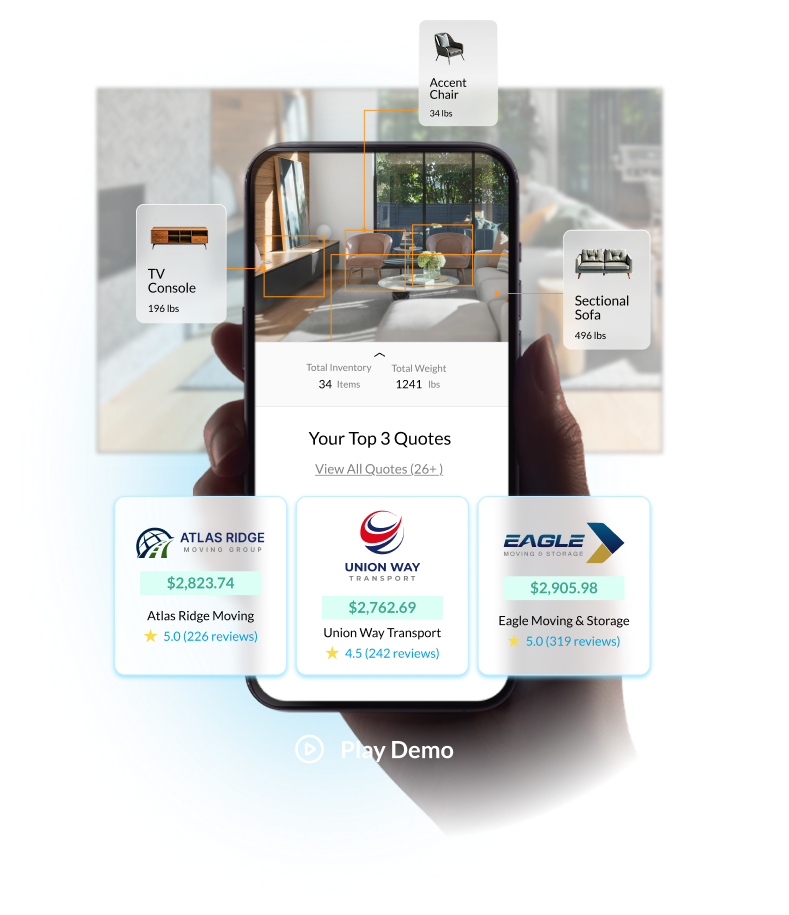
Step 1: Scan your home. Walk through your rooms with your phone. Agoyu’s AI builds the inventory, item by item, and estimates weight and volume. That inventory sizes a rental truck precisely, and prices a mover exactly.
Step 2: See exact prices. From that one scan, Agoyu shows you the exact cost to move through the long distance movers in the platform, side by side, for your home, your route, and your dates.
Step 3: Or post your move for bids. Put the move out and the movers in the platform bid on it, including movers with space on trucks already traveling your route.
Step 4: Compare the whole picture. Every price sits next to the mover’s Trust Signals: their US DOT licensing, BBB rating, Yelp reviews, and complaint record.
Step 5: Book in the platform. Pick your mover and your packing level, and book. The agreed price, dates, inventory, and terms are documented in the platform. Like Expedia, Agoyu is free to the consumer.
Trust Signals: Check the Mover, Not the Marketing
If the mover option wins your comparison, check the records Agoyu displays on every mover profile:
- US DOT license. Interstate movers are licensed through the U.S. Department of Transportation. The profile links to the mover’s US DOT license.
- BBB rating. How the company handles complaints and how it has conducted itself over time.
- Yelp reviews. Real customer experiences in their own words. Read for patterns.
- IAM and FIDI profiles. Where a mover holds membership in the International Association of Movers or FIDI, the profile links to it.
And remember what sits behind the profile: every move booked through Agoyu includes full insurance with no deductible up to $100,000, documented inventory from your scan, and video documentation of your goods at loading, stored at no charge for up to 30 days after the move and downloadable for free before deletion. A rental agreement documents a truck. An Agoyu booking documents your move.
How to Decide: A Short Checklist
- Decide which rental you actually need: Load N Go for short local jobs, a one way moving truck for a household move.
- Budget the daily or trip rate, never the 75 minute rate, for anything resembling a move.
- Confirm the mileage model, the included time, the late return cost, and the fuel requirement in writing.
- Price coverage after checking your own auto policy, not before and not by assumption.
- Size the truck from an inventory. One size up beats a second trip.
- For any long distance move, get a guaranteed mover price for the identical move before you reserve, and compare all in totals.
About the Data on This Page
The Load N Go figures on this page are Home Depot’s published starting rates as reviewed Nov 26, 2026 (moveBuddha, Home Depot Truck Rental Review, 2026); Home Depot publishes no national rate card and rates vary by store. Penske publishes no distance band rates; its one way trucks are quoted per trip with unlimited miles included, so this page prints no Penske prices. The platform facts stated on this page, 86 long distance movers in the platform and full insurance with no deductible up to $100,000 included on moves booked through Agoyu, are Agoyu’s own confirmed figures.
Frequently Asked Questions
How much does a Home Depot truck rental cost?
It depends on which rental you mean. Load N Go store rentals start from $19 per 75 minutes for the flatbeds and cargo van and from $29 per 75 minutes for the 12 foot box truck, with daily rates from roughly $129 to $159 depending on the vehicle (published starting rates as reviewed Nov 26, 2026; your store’s rate can differ). Penske moving trucks rented through Home Depot have no published rate: they are quoted per trip for your route and dates, with unlimited miles included. Current prices require a live quote for your store and dates.
Do Load N Go rentals have unlimited mileage?
Yes: Load N Go rentals are charged on time rather than mileage, with unlimited miles on Home Depot’s own vehicles. Confirm the terms on your specific rental agreement, because terms can change and can differ by vehicle.
What truck sizes does Home Depot offer?
Load N Go offers flatbed trucks, a cargo van, and a box truck at the store, and Penske trucks from 12 to 26 feet are rented through Home Depot for household moves. The 12 foot suits a studio or small one bedroom, the 16 foot most two bedroom homes, the 22 foot a three bedroom house, and the 26 foot four bedrooms and up.
What insurance options does Home Depot offer for truck rentals?
On the Penske trucks rented through Home Depot, the optional protection products are Limited Damage Waiver, Personal Accident Insurance, and Supplemental Liability Insurance. Check your own auto insurance policy before buying coverage, and confirm what it actually covers on a large rental truck.
Is renting from Home Depot cheaper than hiring movers?
For a short local move with a small household, usually yes in cash terms, provided you finish inside the time you paid for. As distance and home size grow, mileage, fuel, extra days, coverage, and your own labor close the gap, and a mover bidding for space on a truck already traveling your route can win outright. Compare the rental’s all in total with a guaranteed mover price for the same move.
What happens if I return the truck late?
Expect to be charged for additional time, potentially a further day at the full rate, under the rental agreement. Return on time to avoid extra charges, and build slack into your loading and driving schedule rather than planning to the deadline.
What insurance is included with an Agoyu move?
Full insurance with no deductible up to $100,000 is included in the price of every move booked through Agoyu, with your scanned inventory and load video on record if a claim is ever needed. Rental coverage, by contrast, is a set of optional paid add ons with their own limits.
Get Both Numbers Before You Reserve
A Home Depot truck can be the right tool for your move, especially a short, local, small one. It can also be a day rate that quietly becomes a four figure total on a long move you could have handed to a professional for less. You cannot know which until both numbers are real: the rental’s all in total from a live quote, and a mover’s exact price from a scan of your home, bid on by 86 long distance movers with their DOT records, BBB ratings, and Yelp reviews next to every price. Get both. Then rent, or do not, with your eyes open.


