Moving Box Calculator: How Many Boxes Do You Need?
Every move has the same two box stories. In one, you run out of boxes at 9 p.m. the night before the truck comes, and the last of the kitchen ends up in grocery bags and a laundry basket. In the other, you buy a kit sized for a house twice yours and finish with […]
Every move has the same two box stories. In one, you run out of boxes at 9 p.m. the night before the truck comes, and the last of the kitchen ends up in grocery bags and a laundry basket. In the other, you buy a kit sized for a house twice yours and finish with a stack of unused cardboard you cannot return. Both stories start the same way: with a guess.
Box counts get guessed wrong because the guess is based on the wrong unit. People count rooms. Boxes do not care about rooms. They care about how much stuff you own, how heavy it is, and how much of it is fragile. A minimalist two bedroom and a collector’s two bedroom can differ by forty boxes, and both owners will tell you they have a normal amount of stuff.
This page does the calculator’s job in plain text. It gives you the industry’s planning counts by home size, broken down by box size, then shows you how to adjust them room by room and habit by habit, because that adjustment is where the real number lives. It ends with the better way to get the count: from an inventory of what you actually own, which is how Agoyu prices the move itself.
Key Numbers: Boxes and Your Move
Up to 25 moving quotes in under 3 minutes on an average lane, from published rates plus discount asks, if the rest of the move needs pricing too.
86 long distance movers in the Agoyu platform, showing published rates and bidding on real moves, with 12 bids on average per posted move. Every move booked through the platform includes full insurance with no deductible up to $100,000.
A patented AI platform (U.S. Patent No. 12,602,645 B2) that prices your move from a scan of your actual home.
Peak moving season is June through August. Moves in that window should order boxes early. Everyone else is packing too.
About 40 pounds is the working weight ceiling for a packed box under standard moving industry guidance. The sizes section below explains why.
The Box Counts by Home Size
Start here. The table below is general industry packing guidance, the ranges movers and moving supply retailers plan around, for a typically furnished home. It is not Agoyu platform data and it is not a quote. Your real count comes from the adjustments in the next section, so treat the table as the baseline you correct, not the answer you order.
Home size
Small boxes
Medium boxes
Large boxes
Wardrobe boxes
Total range
Studio
5 to 10
5 to 8
2 to 4
1 to 2
15 to 25
1 bedroom
8 to 12
8 to 12
4 to 6
2 to 3
25 to 35
2 bedroom
12 to 18
12 to 16
6 to 10
3 to 5
35 to 50
3 bedroom
16 to 24
16 to 24
8 to 14
5 to 8
50 to 70
4 bedroom and up
20 to 30
20 to 30
10 to 20
8 to 10
65 to 90
Totals are rounded planning ranges, and homes keep scaling past four bedrooms: as a rule of thumb from the same industry guidance, each additional bedroom adds roughly 15 to 25 boxes, mostly medium and wardrobe.
Three things to notice about the mix. First, small and medium boxes do almost all the work. Large boxes are the smallest count in every row, and that is deliberate, because a large box invites overloading. Second, wardrobe boxes are counted separately because they follow your closet, not your room count: the working rule is roughly one wardrobe box for every two feet of hanging clothes on the rod. Third, add dish packs on top: most kitchens need one to three, with cell dividers, and they are rarely in the standard counts.
If you are sourcing boxes free instead of buying, the companion guide to free moving boxes covers where to find them and how to inspect them. The count you need is the same either way. Only the price changes.
Adjust the Count Room by Room
The home size table assumes an average home. Yours is not average in specific, knowable ways, and this is where you fix the estimate. Walk the rooms and adjust.
Kitchen: the heaviest room in the count. A typical kitchen takes 10 to 20 boxes, more than any other room, because nearly everything in it is fragile or dense. Dishes and glassware pack loosely with a lot of paper. Canned goods and cookware pack heavy. The mix runs to small boxes and dish packs, with medium boxes for appliances and pantry stock. Cook seriously, with baking gear and a full pantry, and add 6 to 15 boxes for the kitchen alone.
Books and media: the silent multiplier. Books are the most common reason a box estimate fails. A serious home library adds 10 to 25 small boxes to a move. The rule is absolute: books go in small boxes only, packed flat, because a medium box of books blows through the weight ceiling before it is half full. Records, files, and board games follow the same rule.
Bedrooms: count the closet, not the bed. A primary bedroom generates 8 to 15 boxes plus its wardrobe boxes. Additional bedrooms run 5 to 12. A child’s bedroom runs 8 to 15, because toys and gear pack bulky. Folded clothes go in medium boxes. Hanging clothes follow the two feet of rod rule above.
Living and dining rooms: lighter than they look. A living room usually takes 5 to 15 boxes, mostly medium, for decor, electronics, and shelf contents. A dining room takes 3 to 10, mostly dish packs if the good china lives there. Furniture does not get boxed. Everything sitting on it and in it does. Bathrooms are the smallest count of all: two to five boxes each, mostly small, with liquids sealed so nothing leaks across a truck.
Home office: small boxes, heavy load. Plan on 5 to 15 boxes. Paper is the trap: files and documents are as dense as books, so the mix runs heavily to small boxes even when the room looks sparse. Equipment goes in medium boxes with padding, in its original packaging if you kept it.
Garage, basement, and attic: the wild card. These spaces run from almost nothing to 40 boxes and beyond, and no table can call it. Walk yours before you finalize any count. Tools go in small boxes, seasonal and stored items in medium and large.
The lifestyle correction. After the room walk, apply the honest multiplier. Published calculator guidance scales the baseline by how much you keep: roughly four fifths of the standard count for a genuine minimalist, roughly a quarter more for a heavy household or collector. Kids add 10 to 25 medium and large boxes beyond their bedrooms, for toys and gear. Then add a buffer of 10 to 15 percent on the final number. A surplus of boxes is cheap. A shortage is a crisis, and the buffer absorbs the drawer you forgot you had.
Box Sizes Explained
Ordering the right total in the wrong sizes is its own failure mode. Here is what each size is actually for.
Book boxes (about 1 cubic foot) and small boxes (about 1.5 cubic feet). The two smallest sizes carry the densest loads: books, files, records, canned goods, tools, and kitchen gear. If an item makes you grunt on a shelf, it belongs in one of these. Most households underbuy small boxes, because most households underestimate how much of their stuff is heavy.
Medium boxes (about 3 cubic feet). The default box, and the most useful one you will own during a move. Kitchenware that is not fragile, toys, decor, folded clothes, small appliances, electronics. If you are unsure which size an item wants, it usually wants a medium.
Large boxes (about 4.5 cubic feet). For light and bulky only: linens, pillows, comforters, lampshades, folded towels. A large box has exactly one correct use, which is holding things that take up space without weighing anything. The moment a large box starts getting heavy, it has been packed wrong. Extra large boxes, at about 6 cubic feet, take the bulkiest soft goods of all, and the same warning applies squared.
Dish packs (about 5 cubic feet, with cell dividers). A double walled box with a grid that gives every plate and glass a cell of its own. This is the box that decides whether your dishware survives, and it is the specialty box most worth buying new.
Wardrobe boxes (tall, with a hanging bar). Clothes move on their hangers, closet to closet, with no folding and no ironing at the other end. Roughly two feet of hanging rod fills one. They are the most expensive standard box, which is why the count should come from measuring your closets rather than guessing.
The 40 pound rule. Standard moving industry guidance puts the working ceiling at about 40 pounds per packed box. The cardboard is often rated higher, but the rating is not the point. The point is the person carrying the box, the bottom holding under a carried load, and the box at the bottom of a stack in the truck. A 70 pound medium box fails on all three counts. When a box approaches the ceiling, stop, seal it, and start the next one. Weight, not fullness, is the signal.
The Cost of Getting the Count Wrong
Too few boxes is the expensive direction, and it fails in a specific sequence. You run short mid pack, usually in the kitchen, usually late. What follows is a retail run at full price for whatever sizes the store has left, then improvisation: heavy items doubled into large boxes because those are what remain, fragile items wrapped in towels and hope, and a final layer of bags and loose items that movers cannot stack and cannot protect the way they protect a sealed, labeled box. Overstuffed boxes burst. Overweight boxes get dropped. And the shortage steals the one resource you cannot buy back, which is time on the last day.
Too many boxes fails more quietly. Unused boxes from an opened kit usually cannot be returned, so the overbuy is a straight loss, and the subtler cost is packing behavior: people with too many boxes pack loosely, one item rattling in a box built for ten, which wastes truck space and invites the movement that breaks things. Boxes should be packed full and firm, with paper taking up the slack, not air.
What buying the boxes actually costs. If you buy a retail kit instead of sourcing boxes free or individually, U-Haul’s published kit budgets (uhaul.com, checked November 2026) run $100 to $200 for a studio kit, $250 to $400 for a one to two bedroom kit, $350 to $500 for a three to four bedroom kit, and $550 to $700 for a four plus bedroom kit. Those kits include tape and packing supplies alongside the boxes, which is part of why the ranges are wide. The point of the table and the room walk is that you can buy to your real count instead of a kit’s guess, or pay nothing at all if you source free and start early.
How Agoyu Counts Differently
Every number on this page so far is a range built from other people’s moves. That is the best a table can do, and it is why the table needs the adjustments, the buffer, and the honest multiplier. The estimate improves when it stops being built from averages and starts being built from your rooms.
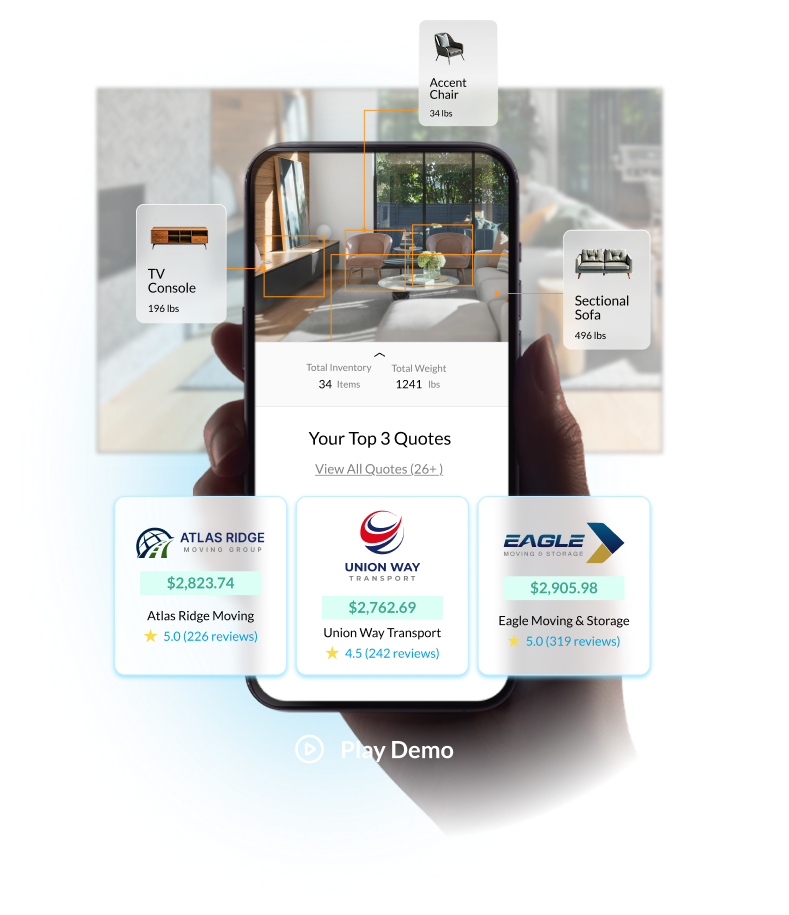
That is what the Agoyu scan does. You walk your home with your phone, and the platform’s patented AI (U.S. Patent No. 12,602,645 B2) builds your inventory from what is actually in the rooms: the bookcase that adds a dozen small boxes, the closet rod that needs four wardrobe boxes, the garage you forgot to count. The box estimate comes from that inventory, not from your bedroom count. The movers in the platform see the same belongings you scanned, so the count and the quote agree with each other. They show their published rates or bid on the move, and display their US DOT license link, BBB rating, and Yelp reviews next to the price. Those records are there for you to check yourself. Agoyu displays them. It does not ask you to take its word for any mover.
You also choose your packing level on Agoyu, from packing everything yourself to full packing and unpacking by the mover, with the price reflecting the choice. If the mover packs, their boxes and materials are part of the service and this entire page becomes a reference instead of a shopping list.
Frequently Asked Questions
How many boxes do I need for a two bedroom apartment?
As general industry guidance, plan on 35 to 50 boxes in total: roughly 12 to 18 small, 12 to 16 medium, 6 to 10 large, and 3 to 5 wardrobe boxes, plus one to three dish packs if your kitchen holds real dishware. A minimalist two bedroom lands at the bottom of that range, a full one at the top.
Are wardrobe boxes worth it?
If you have hanging clothes you care about, yes. A wardrobe box moves clothes on their hangers, so they come out ready to hang, with no folding, no creasing, and no ironing session on your first night. Plan on roughly one box for every two feet of closet rod. They are the priciest standard box, so measure the rod rather than guessing. For mostly casual, wrinkle proof clothes, medium boxes or bags grouped on hangers do the job for less.
Should I buy more small boxes or more medium boxes?
Medium boxes are the workhorse and usually the largest single count, but small boxes are the one people underbuy. Books, files, tools, and kitchen gear all belong in small boxes, and most homes have more dense weight than they realize. For a typical home, order small and medium in roughly equal numbers, medium slightly ahead, and let large boxes be the smallest stack.
How many boxes does one room take, on average?
Most rooms land between 5 and 15 boxes. The kitchen sits at the top of the range at 10 to 20, a bedroom at 8 to 15 for the primary and 5 to 12 for additional rooms, a living room at 5 to 15, and a bathroom at the bottom at 2 to 5. Across a whole home it works out to roughly 8 to 12 boxes per room, but the spread is why the room by room walk beats the average.
Does the box count include packing paper and tape?
No. The counts on this page are boxes only. Paper and tape scale with the box count: as general guidance, budget roughly one roll of packing tape for every 10 boxes and a bundle of packing paper for every 8 to 10 boxes, more paper if your kitchen is large or your dishware is fragile.
What if my home falls between two sizes in the table?
Round by lifestyle, not by square footage. If you have a garage, a storage unit, full closets, or collecting habits, take the larger row. If you have genuinely purged and your closets are half empty, take the smaller row and keep the 10 to 15 percent buffer on top. Being between sizes is exactly the case the buffer exists for.
Scan First, Then Buy Boxes Once
The table gives you the industry’s best guess. The room walk turns it into your estimate. The scan turns it into your count. Whichever route you take, the discipline is the same: get the number from your actual belongings, order once with the buffer included, and spend your packing days packing instead of driving to a store for emergency cardboard. And when you are ready to price the move itself, scan your home on Agoyu and see the exact cost from 86 long distance movers, with their DOT records, BBB ratings, and Yelp reviews next to every price, and $100,000 of no deductible insurance included when you book. The boxes were the guessable part. The price does not have to be.
Why settle for stressful moving experiences? Unlock precise pricing and reliable movers with Agoyu. Click below and start your journey to a smoother move.
We use cookies and similar technologies to enhance your experience,
analyze traffic, and show relevant content.
Read our
Privacy Policy
and
Cookie Policy
to learn more.