How Much Does It Cost to Move to Hawaii? Add Up the Whole Move
Most Hawaii cost guides answer the wrong question. They quote the shipping and stop, as if the move ends when your container docks. It does not. The real cost of moving to Hawaii is everything from the day you pack the first box to the day you make your first coffee in a home that […]
Shop Movers with AI


Most Hawaii cost guides answer the wrong question. They quote the shipping and stop, as if the move ends when your container docks. It does not. The real cost of moving to Hawaii is everything from the day you pack the first box to the day you make your first coffee in a home that is actually yours: the ocean freight, your vehicle, your flights, temporary housing while your goods are still on the water, the deposit or down payment on the new place, and a first month of island prices.
This page adds up the whole move, line by line, using planning ranges. The shipping line gets its own deep treatment in our companion guide to the cost to move to Hawaii, which covers ocean freight methods and container pricing in detail. This page uses that freight number as one line in a bigger budget, then keeps going, because the other lines are where Hawaii budgets actually break.
Key Numbers: Hawaii Moves and the Agoyu Platform
- Up to 25 moving quotes in under 3 minutes on an average lane, from published rates plus discount asks.
- 86 long distance movers in the Agoyu platform, with published rates and live bids on real moves.
- $100,000 of insurance with no deductible included in the price of every move booked through Agoyu, not sold back to you as an add on.
- A patented AI platform (U.S. Patent No. 12,602,645 B2) that prices your move from a scan of your actual home, not from a form you filled in from memory.
- 28 movers in the Agoyu platform serve Hawaii, and the lanes are live. Hawaii moves are treated as international shipments in the platform, because your goods travel through international air or waters to get there.
- 12 bids on average on a posted move across the platform, and 8 bids on average on a posted vehicle shipment, with a $75,000 per car insurance cap included on vehicle shipments.
- Posted moves are priced by competition. Movers bid against each other on your actual scanned move, so the price you book is set by the market for your route and your dates, not by a single take it or leave it quote.
The Whole Budget at a Glance
Add every line of a Hawaii move together and the total lands anywhere from roughly $15,000 for a lean renter move to well past $250,000 when a home purchase is part of it. That spread is worth understanding rather than just quoting, because most of it is not the move. It is the housing. A rental deposit and first months are one kind of number; a down payment on a Hawaii home is a completely different one, and mixing them into a single total is how a budget stops being useful.
| Budget line | Industry planning range | What drives it |
|---|---|---|
| Shipping your household goods | $3,500 to $25,000 or more | Home size, origin coast, method, service level |
| Flights and travel | $150 to $500 or more per person, one way | Party size, origin, season |
| Shipping your vehicle | $2,000 to $2,500, plus registration on arrival | Vehicle size, origin port |
| Temporary housing | $3,000 to $10,000 | Weeks until your goods arrive and your home is ready |
| Housing set up (deposit or down payment) | About $4,000 to $8,000 renting; $50,000 to $250,000 or more buying | Renting vs buying, island, neighborhood |
| Furniture and household set up | $5,000 to $10,000 | What you shipped vs what you replace on the island |
| Vehicle set up (registration, insurance, running costs) | $2,000 to $5,000 | Ship your car vs buy on the island |
| Employment costs (licensing, wardrobe, commute set up) | $1,000 to $5,000 | Profession, licensing transfers |
| Storage | $1,200 to $3,600 per year | Unit size, and the gap between arrival and your permanent home |
| First month living costs (utilities, food, miscellaneous) | Roughly $1,500 to $3,000 per month | Island prices, household size |
Industry planning ranges, checked against the published sources named in the sections below in November 2026. They are starting points for building a budget, not quotes for your move.
Read the table the way a budget actually behaves. Rent, and the housing line collapses to a deposit and a few months of payments. Buy, and it dominates everything else on the page combined. Ship a studio in a shared container, and freight is a minor line. Sail a four bedroom house from the East Coast, and freight becomes the second largest check you write.
Line 1: Shipping Your Household Goods
The freight line is the one most people mean by “the cost of moving to Hawaii,” and it is covered properly in our cost to move to Hawaii guide: shared container, full container, a container you load yourself, and the air freight exception, method by method. This page only needs the summary ranges, drawn from published 2026 mover pricing for mainland to Hawaii moves:
- Studio to 1 bedroom home: $3,500 to $6,500 from the West Coast; $6,500 to $10,000 from the East Coast.
- 2 bedroom home: $5,500 to $9,500 from the West Coast; $9,000 to $14,000 from the East Coast.
- 3 bedroom home: $7,500 to $12,500 from the West Coast; $12,000 to $18,000 from the East Coast.
- 4 bedroom home and up: $10,000 to $25,000 or more, depending on coast and volume.
- Reference shipments in the same ranges: a studio from California at $4,000 to $6,000, a 2 bedroom house from the East Coast at $10,000 to $14,000, and a 4 bedroom house from the Midwest at $12,000 to $18,000. Specialty items, a piano is the classic example, are priced on top of the household rate.
For an anchor underneath those ranges: ocean freight alone for a 20 foot container from a West Coast port to Honolulu ran about $8,060 to $8,910 under Matson’s published household goods rates in mid 2026, before trucking and loading at either end. Full service prices sit above the ocean leg because they include the work on both ends of it.
Notice what those ranges are really measuring. The ocean does not care how big your house is; the container does. Price follows the space your shipment occupies and how far it travels on land before it ever sees a ship. That is why the single most effective budget move on this entire page is deciding what not to ship. Ocean freight prices volume, so every cubic foot you sell, donate, or plan to replace on the island is a cubic foot you do not pay to float across the Pacific.
Line 2: Your Vehicle
You have three options, and the right one is arithmetic, not sentiment:
Ship your car. Budget $2,000 to $2,500 to ship a car to Hawaii, the standard figure used across both of Agoyu’s Hawaii pages, plus a few hundred dollars for registration and the safety inspection on arrival. Hawaii registers vehicles by weight, and registration typically totals about $150 to $400 a year depending on the vehicle and the county.
Sell on the mainland and buy on the island. Island asking prices for comparable cars run above mainland prices, because the cars themselves were shipped in. That premium is the number to compare against the shipping cost, along with the hassle of car shopping during your first weeks.
Go without a car. Realistic in parts of Honolulu, much harder elsewhere. Public transportation is limited outside Honolulu, so price this option against your actual commute, not against the idea of island life.
Whichever route you choose, island running costs belong in the budget too. Gasoline is the big one: Hawaii’s average price for regular was $5.59 a gallon in late November 2026, against a national average of $3.64 (AAA), a gap of about $2 a gallon. You will also need a Hawaii no fault insurance policy from a Hawaii licensed insurer before you can register the car, so get island quotes before you decide the mainland policy number carries over.
Line 3: Getting Yourself There
Your goods sail. You fly. One way tickets from the mainland typically run about $150 to $500 or more per person depending on your origin city and the season: West Coast departures sit at the low end, East Coast departures and peak season family bookings at the top. Add fuel and lodging for anyone driving a vehicle to its shipping port first. Two timing facts shape this line. First, your flight date and your goods’ arrival date are weeks apart, which is what creates the temporary housing line below. Second, one way tickets for a family, bought for a fixed move date, rarely catch the cheapest fares. Book the people with the same care as the freight.
Line 4: Temporary Housing, the Line Everyone Underbudgets
Your container is on the water. Your new home may not be ready, or may not even be chosen. The weeks in between are a real cost of a Hawaii move in a way they are not on the mainland, where a truck arrives in days. Published carrier schedules put the port to port ocean leg from the West Coast at roughly two weeks, and door to door delivery takes several weeks in total once trucking, port handling, and the final delivery are counted. Current planning ranges for the wait:
- Extended stay hotel: $100 to $250 per night, with multi week and monthly rates lower.
- Short term rental apartment: around $2,000 per month for a small furnished unit; $3,500 to $6,000 for a multi bedroom home.
- Vacation rental: $5,000 to $10,000 per month.
- Corporate housing: $3,000 to $5,000 per month.
- Nightly rentals: around $125 per night for a 1 bedroom, $200 to $300 for 2 to 3 bedrooms, with weekly and monthly discounts.
Plan on booking one to two months while you explore neighborhoods and finalize a permanent home. Whether or not that exact span fits your move, the principle is the point: on a Hawaii move, temporary housing is not an emergency expense. It is a planned line, and it belongs in the budget before you book the freight.
Line 5: Housing and the First Month
Housing is the largest cost of living in Hawaii and the largest line in this budget. Median single family home sale prices in October 2026 were about $1,150,000 on Oahu, $1,179,000 on Maui, $1,300,000 on Kauai, and $514,500 on Hawaii Island, per the island boards of REALTORS. On a median priced Oahu home, even a 20 percent down payment is about $230,000, and the monthly carrying costs, mortgage, property tax, and insurance, run to several thousand dollars on top of it. Renting, 1 bedroom homes typically run about $1,600 to $2,100 per month depending on the island, and 2 bedrooms about $2,100 to $2,650.
The point behind those figures is structural: Hawaii’s overall price level sits about 10 percent above the national average, with rents about 25 percent above it (U.S. Bureau of Economic Analysis, Regional Price Parities, 2024), and median home prices on three of the four main islands above $1 million. The housing decision, which island, rent or buy, which neighborhood, moves your total budget more than every moving decision combined. The island by island snapshot makes the same point in miniature: median single family prices from $514,500 on Hawaii Island to $1,300,000 on Kauai in October 2026, and 1 bedroom rents from about $1,600 on Hawaii Island to about $2,000 on Oahu and Maui.
If you are buying rather than renting, one offset belongs on the buyer’s side of that ledger. Agoyu is operated by ARC Relocation, and if you buy your Hawaii home through a Realtor in ARC’s network you can be eligible for a cashback rebate after closing through ARC’s Realtor Rebate program. The rebate scales with the home price, a few states prohibit rebates, and ARC publishes the full breakdown, the eligible states, and charts on that page. On the largest line in this budget, it is worth asking about before you sign.
First month costs ride along with the housing line. Electricity is the standout: Hawaii’s average residential electricity bill was about $212 a month in 2024, the highest of any state (U.S. Energy Information Administration), and homes running air conditioning land well above the average; budget $200 to $400 a month. Water and sewer run about $100 to $150 a month, internet $60 to $100, and cell phone service $75 to $100 per person. Food costs more too: per person grocery spending in Hawaii runs about 30 percent above the national figure (U.S. Bureau of Economic Analysis), and goods overall price about 12 percent above the national average because nearly everything arrives by ship. That premium is the arithmetic behind the $5,000 to $10,000 set up line in the budget table: replacing things on the island is expensive, and that fact should feed back into your ship or sell decisions on Line 1. If you need storage while you settle, Honolulu storage averages roughly $100 to $300 a month depending on unit size, so a year of it runs about $1,200 to $3,600.
The Taxes and Employment Lines, Briefly
Hawaii’s income tax is progressive, with twelve brackets running from 1.4 percent up to a top rate of 11 percent; for 2026, the broad middle band of taxable income for single filers, $48,000 to $125,000, is taxed at 7.6 percent. On top of that, Hawaii charges a general excise tax of 4 percent on most goods and services, 4.5 percent with the county surcharge, which shows up inside the prices you pay rather than as a separate sales tax line. Employment related costs run $1,000 to $5,000 across the move: license and credential transfers at $100 to $500 or more for regulated professions, work wardrobe at $500 to $2,000, and job search costs if you are arriving without a role. None of these lines is large next to housing or freight. All of them are real, and a budget that omits them is a budget that gets surprised in month one.
Where Capacity Fits in a Hawaii Budget
Capacity is the central concept in mainland moving: movers sell space in trucks that are already going somewhere, and a shipment that fits space on a routed truck prices differently from one that needs a dedicated run. Hawaii moves run on the same principle, one level up. Carriers sell space in containers on ships that are already sailing. A consolidated shipment, your crated goods sharing a container, exists because capacity was available to share, and it is the cheapest freight on this page for exactly that reason.
The budget consequence is that your freight line is not fixed. It moves with your volume, your flexibility on dates, and the capacity on your route in your sailing window. A static cost guide can only give you the range. A live platform, where movers with capacity bid on your actual scanned move, can give you the number. That distinction, range versus number, is the whole reason the next two sections exist.
A Range Is Not a Price: Guaranteed Pricing
Every line in the budget table is a planning range, and planning ranges are honest tools for deciding whether a move is feasible. They are a bad tool for signing a contract. The freight line in particular can hide separate charges for each leg of the chain, and a low headline number that covers only part of the chain is a partial price, not a low one.
Before you compare any two quotes, ask what the number includes and whether the total is guaranteed in writing. An estimate is a prediction. A guaranteed price is a commitment. In Agoyu, every bid clearly shows whether the mover guaranteed the rate or not. If the rate is guaranteed, it is locked in: it can go down, but it cannot go up. If a mover does not guarantee their rate in the platform, Agoyu requires that the mover either complete a visual survey of your home within one week or less and issue a guaranteed bound quote, or honor the rate they put in the platform. Compare the guarantee first and the number second.
How Agoyu Works, Step by Step
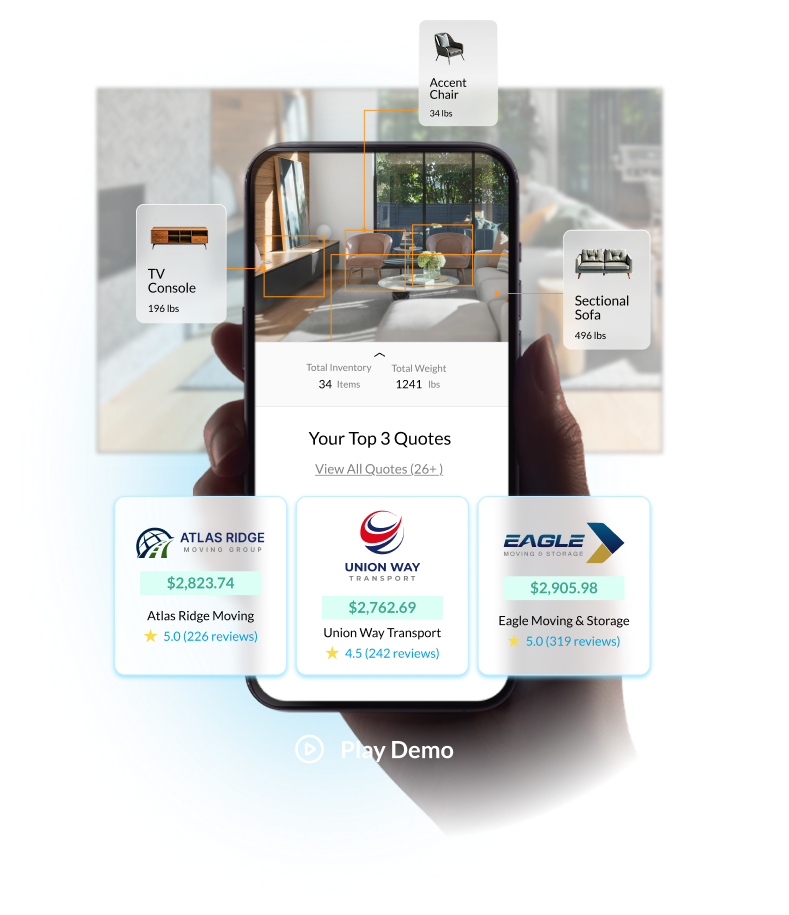
Step 1: Scan your home. You walk through your rooms with your phone and Agoyu’s AI does the inventory: it recognizes what you own, item by item, and builds the list. On a Hawaii budget the scan does extra work, because a documented inventory is what every ship or sell decision on this page depends on: ocean freight prices the space a shipment occupies, so knowing what you actually have beats guessing at volume.
Step 2: See exact prices. From that one scan, Agoyu shows you the exact cost to move through the movers in the platform, side by side, for your home, your route, and your dates. That converts your largest budget line from a range into a figure you can build the rest of the budget around.
Step 3: Or post your move for bids. Put the move out and the movers in the platform bid on it. Capacity works for you here: a mover with space on a truck or a route going your way can bid a price nobody running dedicated capacity can match.
Step 4: Compare the whole picture. Every price sits next to the mover’s Trust Signals: their US DOT licensing, BBB rating, Yelp reviews, and complaint record. Price and record on one screen.
Step 5: Book in the platform. Pick your mover and your packing level, from packing yourself to full packing and unpacking, and book. The agreed price, the dates, the inventory, and the terms are all in the platform record. Like Expedia, Agoyu is free to the consumer.
Trust Signals: Check the Mover, Not the Marketing
Every mover profile on Agoyu displays the records that actually tell you who you are hiring:
- US DOT license. Interstate movers are licensed through the U.S. Department of Transportation. The profile links to the mover’s US DOT license, so you can confirm the company is authorized to move household goods across state lines.
- BBB rating. The Better Business Bureau rating shows how the company handles complaints and how it has conducted itself over time.
- Yelp reviews. Real customer experiences in their own words. Read for patterns: one bad review is a data point; ten reviews describing the same raised price or missed delivery window is who that mover is.
- IAM and FIDI profiles. Where a mover holds membership in the International Association of Movers or FIDI, the profile links to it, so you can see the industry standing the mover claims, from the organizations themselves.
A Hawaii move hands your household to a chain of companies across an ocean. Checking the record of the company managing that chain, before the container is sealed, is the cheapest diligence you will ever do.
Documented, Not Handshaken: The Digital Agreement
Your Agoyu booking documents the move the way a smart contract documents a transaction. The inventory is the scan, item by item. The price is the published rate or the winning bid, with its guarantee status stated. The included services are listed. The pickup and delivery terms are agreed in the platform. And for household goods moves, the condition of your belongings is documented on video as they are loaded.
If something arrives damaged after an ocean crossing and several hand offs, that record is what a claim stands on: the scanned inventory says what was moved, the load video says what condition it was in, and the included insurance, full coverage with no deductible up to $100,000, says what it pays. Agoyu stores applicable moving videos at no charge for up to 30 days after the move, and you can download your videos for free before they are deleted.
“Best Hawaii Movers” Lists Cannot Build Your Budget
A ranked list of movers cannot tell you what your move costs, and on a Hawaii move the gap between a list and a budget is at its widest. The list writer has not seen your home, your island, your sailing window, or your vehicle. Many of these lists are pay to play: placement follows affiliate commissions, and the “research” is a spreadsheet of payouts.
“Best” is not a property of a company. It is a property of a match: your origin, your island, your dates, your shipment volume, and the capacity available on your route. Agoyu’s answer is not a better list. It is live published rates and live bids on your actual scanned move, from 86 long distance movers, with their DOT records, BBB ratings, and Yelp reviews attached to every number, so the largest line in your budget is a real figure instead of a range copied from a guide.
How to Build Your Hawaii Budget: A Short Checklist
- Start with the freight: scan your home, get the exact shipping figure, then budget around a number instead of a range.
- Decide the vehicle with arithmetic: shipping cost versus the island price premium and your actual need for a car.
- Book temporary housing as a planned line, sized to the gap between your flight and your goods arriving.
- Make the housing decision early. Renting versus buying moves the total more than every other line combined.
- Run every ship or sell decision against island replacement prices, which run above mainland levels on nearly everything that arrives by ship.
- Add the small lines on purpose: licensing, storage, first month utilities and food at island prices.
- Ask of every quote: is this price guaranteed, and what exactly does it include?
About the Data on This Page
The budget ranges on this page are industry planning ranges, checked in November 2026 against published sources: Matson’s published household goods container rates and 2026 mover pricing guides for the shipping lines, AAA state gas price averages for fuel, U.S. Energy Information Administration data for electricity, U.S. Bureau of Economic Analysis Regional Price Parities and consumer spending data for island price levels, October 2026 median sale prices from the island boards of REALTORS, and current Honolulu furnished rental and storage listings for the temporary housing and storage lines. They describe the market a Hawaii move is priced in, not Agoyu’s booked prices. The platform facts stated on this page, 86 long distance movers in the platform, 28 of them serving Hawaii, and full insurance with no deductible up to $100,000 included on moves booked through Agoyu, are Agoyu’s own confirmed figures. Your exact move price comes from your scan and the published rates and bids it produces, not from any range on this page.
Frequently Asked Questions
How much does it cost to move to Hawaii, all in?
Adding the lines on this page together, a renter’s version of the move commonly lands between about $15,000 and $50,000 once freight, vehicle, flights, temporary housing, deposit, and set up are counted. A buyer’s version is dominated by housing: at October 2026 island medians, a down payment alone runs from about $50,000 to well over $250,000. The moving lines themselves, freight, vehicle, flights, and temporary housing, are the part this page breaks out line by line so you can build your own total.
What does it cost just to ship my belongings to Hawaii?
As industry planning ranges from published 2026 mover pricing: $3,500 to $6,500 for a studio to 1 bedroom home from the West Coast, $5,500 to $9,500 for a 2 bedroom from the West Coast, and up to $18,000 to $25,000 or more for a large home from the East Coast. Method matters as much as distance: the companion cost to move to Hawaii guide breaks down shared container, full container, and air freight pricing in detail.
How much does it cost to ship a car to Hawaii?
Car shipping to Hawaii runs $2,000 to $2,500, the standard figure used across both of Agoyu’s Hawaii pages. Add a few hundred dollars for registration and the safety inspection on arrival; Hawaii registration is weight based and typically totals about $150 to $400 a year.
How much temporary housing should I budget?
Current planning ranges run from around $2,000 per month for a small furnished short term rental to $5,000 to $10,000 per month for a vacation rental, with extended stay hotels at $100 to $250 per night. Your goods are on the water for weeks, so treat temporary housing as a planned line, not a contingency.
Which Hawaiian island is cheapest to move to?
Hawaii Island, on both measures that dominate the budget. In October 2026 it had the lowest median single family sale price of the four main islands at about $514,500, against about $1,300,000 on Kauai, and the lowest 1 bedroom rents at about $1,600 a month. Housing dominates the difference; freight varies less by island, though neighbor island delivery adds an inter-island leg to the shipping cost.
Is my moving price guaranteed?
Only if the mover says so, in writing, before you book. An estimate can change; a guaranteed price cannot go up. On Agoyu, every bid shows whether the rate is guaranteed. If it is not, the mover must either complete a visual survey of your home within one week or less and issue a guaranteed bound quote, or honor the rate shown in the platform. Always compare the guarantee first and the number second.
What insurance is included with an Agoyu move?
Full insurance with no deductible up to $100,000 is included in the price of every move booked through Agoyu. It is not an add on sold at signing. Combined with your scanned inventory and the video documentation of your goods at loading, it makes any claim a documented process: what was moved, what condition it was in, and what the coverage pays are all on record.
Get Your Real Hawaii Number
A budget built on ranges can tell you whether Hawaii is feasible. It cannot tell you what your move costs, because the largest moving line in it, the freight, is a range wide enough to hide a car. Start by making that line real. Scan your rooms, see the exact published prices from 86 long distance movers, or post your move and let them bid for it, with every mover’s DOT record, BBB rating, and Yelp reviews next to the price, guaranteed pricing where it is offered, your agreement and dates documented in the platform, video of your goods at loading, and $100,000 of no deductible insurance included.
Then build the rest of the budget, vehicle, flights, temporary housing, and first month, on top of a number instead of a guess. That is what the cost of moving to Hawaii looks like when the biggest line in it is real. For the freight itself, method by method and container by container, see our guide to the cost to move to Hawaii.


