Out of State Moving Quotes: Compare Real Prices, Not Estimates
Every out of state move starts the same way: you need a price, and the industry hands you three different ways to get a wrong one. A phone estimate built on what you remember owning. An in person visit built on what a salesperson thinks you own. A form that sells your details and starts […]
Shop Movers with AI


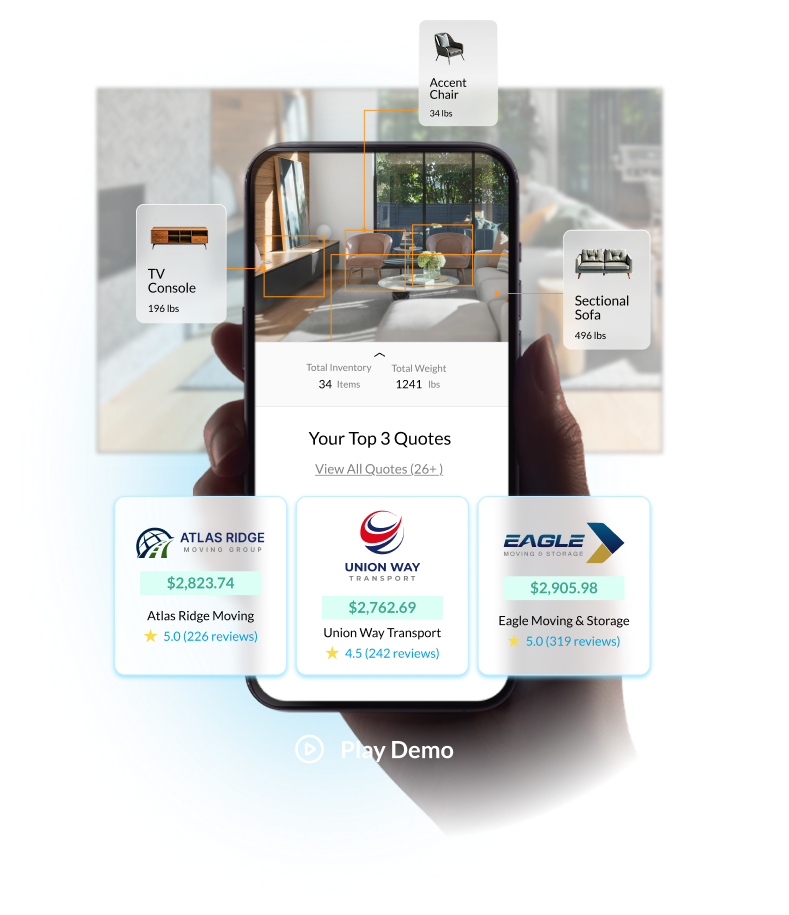
Every out of state move starts the same way: you need a price, and the industry hands you three different ways to get a wrong one. A phone estimate built on what you remember owning. An in person visit built on what a salesperson thinks you own. A form that sells your details and starts a week of callbacks. None of those numbers is the price of your move. They are guesses about your move, and the gap between the guess and the real price is where moving day surprises live.
This guide walks through how out of state quotes are built, what a real quote should include, and how to compare quotes so you are comparing commitments, not guesses. Then it shows you the shorter route: one scan of your home, exact prices and live bids from movers competing for that specific move, and the mover’s record on the same screen as the price.
Key Numbers: Out of State Quotes on Agoyu
- 86 long distance movers in the platform, with published rates and live bids on real moves.
- $100,000 of insurance with no deductible included in the price of every move booked through Agoyu, not sold back to you as an add on.
- A patented AI platform (U.S. Patent No. 12,602,645 B2) that prices your move from a scan of your actual home, not from a form you filled in from memory.
- 12 bids on average on a posted move, which is what turns a quote into a market price.
- How bidding changes the price: Movers bid against published rates on the same scanned move, and capacity on trucks already routed your way prices lower than a dedicated run. On average, the winning bid runs about 23% less than the first published rate, and the spread between the highest bid and the lowest bid on the same scanned move runs about 32% on average. Both gaps are set by live competition on that move, so an individual move will land above or below those averages.
- One inventory, many prices: Because every price is built on the same scan, the high to low spread you see is a real market spread for your move, not a difference in guessed inventories. On Agoyu, that spread runs about 32% on average.
What an Out of State Move Costs: The Planning Ranges
An out of state move is priced mainly on distance and weight, so any honest range has to be stated by both. The table below gives full service industry planning ranges by home size and distance. Treat it as a planning range for a budget, not as a quote, and not as Agoyu pricing. No table knows what you own, and the spread inside each cell is the whole story: the same home, on the same route, gets priced thousands of dollars apart by different movers.
| Home size | Under 50 miles | About 250 miles | About 1,000 miles | About 2,500 miles | 3,000 miles or more |
|---|---|---|---|---|---|
| Studio | $620 to $1,120 | $1,180 to $1,960 | $1,910 to $3,180 | $2,740 to $4,560 | Quote by route |
| 1 bedroom | $810 to $1,460 | $1,560 to $2,600 | $2,540 to $4,230 | $3,640 to $6,060 | $3,000 to $6,500 |
| 2 bedroom | $1,150 to $2,400 | $1,830 to $4,970 | $3,020 to $6,825 | $4,230 to $7,560 | $5,000 to $11,000 |
| 3 bedroom | $1,350 to $3,300 | $2,210 to $5,300 | $4,200 to $7,250 | $6,000 to $10,400 | $5,000 to $11,000 |
| 4 bedroom | $1,550 to $3,600 | $2,470 to $5,960 | $4,950 to $8,100 | $8,370 to $13,220 | $8,000 to $18,000 |
| 5 bedroom | $2,500 to $6,500 | $3,000 to $8,000 | $5,500 to $12,000 | $7,000 to $15,000 | $8,000 to $18,000 |
Source: Moving Hub, Sep 2026, via Researched Tables, Nov 24, 2026, Table 1. Industry planning ranges only, not Agoyu booked prices or AI scan averages. MODEL soft cells: the entire 5 bedroom row and the 3,000 miles or more column for 1 to 5 bedroom homes come from the supplied draft, not from Moving Hub. Your actual price depends on your inventory, your exact addresses, your dates, and the services you choose. This table replaces the archived table from Agoyu’s earlier out of state quotes guide (May 2026 snapshot), which grouped homes as 1 bedroom, 2 to 3 bedrooms, and 4 to 5 bedrooms at different distance points.
The Three Ways Quotes Are Built, and What Each One Is Worth
Over the phone estimates. You describe your home, the mover names a number. It is fast and it is the least reliable method there is, because the inventory is your memory. Forgotten items become added weight, and added weight becomes a higher price later, usually at the worst possible moment.
In person quotes. A representative walks your home and builds the inventory by eye. Better than a phone guess, and the traditional advice for accuracy. It still costs you scheduling, waiting, and a sales visit per company, and three visitors will still produce three different inventories and three numbers you cannot cleanly compare.
App and scan based quotes. You document the home once and every price is built on the same inventory. That is the Agoyu model: you scan your rooms with your phone, the AI builds the item list and estimates the weight, and movers price that documented inventory. One inventory, many prices, all of them comparable. That comparability is the point. Quotes built on different inventories cannot be compared at all.
The Real Price of an Out of State Move Is Capacity
Here is the thing the moving industry has never put in an advertisement: movers do not just sell labor and miles. They sell space in a truck that is already going somewhere.
A long distance truck runs a route. If that truck is heading your way with room left in it, the empty space earns the mover nothing, so space on that truck is cheap. If a mover has to send a truck out of its way for you, or turn away other work to take your move, your price carries all of that cost. Same mover, same crew, same care with your furniture. Completely different price, decided by which way the trucks are rolling on your dates.
A small or partial shipment fits into space left on a truck that is already going your way. This is where the deepest discounts in moving live, because your move is found money to a mover whose truck is rolling past your new city half full. On Agoyu, movers discount on average 23% from published rates to win the move, and filling space on a truck already routed your way is where that discount is earned.
A big shipment that fills a whole truck sounds like the expensive case, and at published rates it is. But bid it out anyway. A full truck is the most efficient load a mover can run: one pickup, one delivery, no time spent combining households. Movers want full truck loads, and when several of them want the same load, the bids show it.
No phone estimate can show you any of this, because capacity changes every day. A live platform can, because the trucks are live too. That is why collecting three quotes the old way still leaves you uninformed: you have three guesses, and none of them reflects the capacity market on your route that week.
What a Real Quote Must Include
Before you compare any two numbers, check that each quote actually contains the same move:
- Cargo weight and inventory. The weight of your belongings drives the price. A quote that does not state the inventory and weight it is based on is not a quote you can hold anyone to.
- Distance. Origin to destination, stated plainly. Longer distance means higher transport cost under every method.
- Included services. Loading, transport, and unloading at minimum, with packing, unpacking, and any other service you requested itemized, not buried.
- Additional services, priced. Storage time, specialty items, extra crew, and similar add ons should appear as line items before you book, not as surprises after loading. As industry planning prices (Researched Tables, Nov 24, 2026; sources: Moving APT, Vector Movers, Overall Moving AZ Tariff 2026, with tariff examples labeled as single carrier examples): full packing $350 to $1,500 or more; partial packing $300 to $800 (draft figure); unpacking $150 to $450; custom crating $200 minimum, about $15 per cubic foot (tariff example); storage $150 to $500 per month; container rental $200 to $500 per month (draft figure, rental only); car shipping $500 to $1,200 (draft figure, route dependent); piano or pool table $200 to $1,000 per item; heavy or bulky items $200 to $500 (draft figure); extra pickup or delivery $100 to $500 (draft figure); loading or unloading help $500 to $1,500 (draft figure); stair or elevator $75 to $150 per flight; long carry $50 to $150 per segment; shuttle $150 to $600; appliance servicing about $100 (tariff example); extra crew about $75 per mover hour (tariff example). Furniture assembly and disassembly, specialty handling, and debris removal are quoted by labor hours, by item, or by labor and volume, with no fixed planning range stated. Attach rates for these add ons were not provided in the researched tables and remain open. These are planning examples, not Agoyu prices.
- Guarantee status. Whether the price is guaranteed or an estimate that can change. This is the single most important line on the page, and it is covered next.
A Quote Is Not a Price: Guaranteed Pricing
The most dangerous number in moving is a low estimate that is not guaranteed. The classic out of state bait and switch runs on it: a low quote wins the booking, the truck gets loaded, and the real price appears somewhere down the road, with your belongings already on board and your leverage gone.
An estimate is a prediction. A guaranteed price is a commitment. Before you compare any two quotes, ask which one you are holding.
In Agoyu, every bid clearly shows whether the mover guaranteed the rate or not. If the rate is guaranteed, it is locked in: it can go down, but it cannot go up. If a mover does not guarantee their rate in the platform, Agoyu requires that the mover either complete a visual survey of your home within one week or less and issue a guaranteed bound quote, or honor the rate they put in the platform. Either way, your price becomes a firm commitment before your move, not a number that gets renegotiated with your furniture on the truck.
Compare the guarantee first and the number second. The cheapest guaranteed price beats the cheapest maybe price every single time.
How to Compare Quotes Without Being Fooled
The standard advice is to contact at least three moving companies, and it is not wrong. It is incomplete. Three quotes only help if they price the same inventory, include the same services, and carry the same guarantee status. Line them up on those three points first. Then look past the headline number at reputation and record: a quote is also a claim about who will show up, and the mover’s licensing and complaint history is the evidence. Finally, ask how the shipment travels and what the delivery window is, in writing. A cheap quote on a slow consolidated load and a higher quote on a direct truck are different products, and the right choice depends on your dates.
How Agoyu Works, Step by Step
Step 1: Scan your home. You walk through your rooms with your phone and Agoyu’s AI does the inventory: it recognizes what you own, item by item, builds the list, and estimates the weight. Every price in out of state moving is built on the inventory, and the traditional inventory, a salesperson eyeballing your living room or you typing a list from memory, is where bad quotes are born. The scan documents what you actually have, in minutes, before anyone prices anything.
Step 2: See exact prices. From that one scan, Agoyu shows you the exact cost to move through the long distance movers in the platform, side by side, for your home, your route, and your dates. No callbacks. No estimate visits. No range that quietly grows later.
Step 3: Or post your move for bids. Put the move out and the movers in the platform bid on it. This is where capacity works for you: a mover with space on a truck going your way can bid a price nobody running a dedicated truck can match, and a mover who wants your full truck will bid like it.
Step 4: Compare the whole picture. Every price sits next to the mover’s Trust Signals: their US DOT licensing, BBB rating, Yelp reviews, and complaint record. Price and record on one screen, which is the screen this industry has never wanted you to have.
Step 5: Book in the platform. Pick your mover and your packing level, from packing yourself to full packing and unpacking, and book. The agreed price, the dates, the inventory, and the terms are all in the platform record. Like Expedia, Agoyu is free to the consumer. The movers compete for your business. You watch the prices and pick.
Trust Signals: Check the Mover, Not the Marketing
Every mover profile on Agoyu displays the records that actually tell you who you are hiring:
- US DOT license. Interstate movers are licensed through the U.S. Department of Transportation. The profile links to the mover’s US DOT license, so you can confirm the company is authorized to move household goods across state lines.
- BBB rating. The Better Business Bureau rating shows how the company handles complaints and how it has conducted itself over time.
- Yelp reviews. Real customer experiences in their own words. Read for patterns: one bad review is a data point; ten reviews describing the same raised price or missed delivery window is who that mover is.
- IAM and FIDI profiles. Where a mover holds membership in the International Association of Movers or FIDI, the profile links to it, so you can see the industry standing the mover claims, from the organizations themselves.
None of this asks you to take Agoyu’s word for anything. The records are the mover’s own, displayed next to the price they are asking you to pay. The Federal Motor Carrier Safety Administration’s Protect Your Move resources make the same point from the government’s side: check the license and the complaint record before you hand anyone your household.
Documented, Not Handshaken: The Digital Agreement
Travel used to be booked the way moving still is: phone calls, paper, and trust me. Expedia digitized travel. Agoyu digitizes the move itself, and digitizing is not a cosmetic upgrade. It changes who holds the power, because everything about the move is written down and agreed before it happens.
Your Agoyu booking documents the move the way a smart contract documents a transaction. The inventory is the scan, item by item. The price is the published rate or the winning bid, with its guarantee status stated. The included services are listed. The pickup and delivery terms are agreed in the platform. And for household goods moves, the condition of your belongings is documented on video as they are loaded, so what left your home, and the shape it was in, is never a matter of opinion.
That video documentation matters most on the worst day: if something arrives damaged, the claim starts from the record instead of an argument. The scanned inventory says what was moved. The load video says what condition it was in. Agoyu stores applicable moving videos at no charge for up to 30 days after the move, and you can download your videos for free before they are deleted. Combined with the included insurance, full coverage with no deductible up to $100,000, a claim becomes a short, factual process instead of a fight.
The Scam Playbook Runs on Darkness
The moving industry is full of legitimate, reputable companies. It also has a bad actor problem, and vague quotes are where it starts: a fraudulent or unlicensed operator quotes low from a phone description, takes a deposit, and then the price climbs once your belongings are on the truck. In the worst version, the load is held until you pay the new number. Bait and switch pricing, misleading estimates, unexplained charges, hostage loads, and companies operating behind fresh names to escape their complaint histories: in 2022 alone, the Federal Motor Carrier Safety Administration received more than 7,500 consumer complaints against moving companies and brokers.
Every element of that playbook needs the same condition: nothing in writing. A scan that fixes the inventory, a price that is guaranteed in the platform, a DOT record pinned to the bid, dates agreed before the truck rolls, and video of your goods at loading. Documentation does not make a bad mover good. It makes the bad mover visible before you book, which is the only moment you have leverage.
“Best Movers” Lists Cannot Quote Your Move
The other shortcut people take is the ranked list: “best out of state movers,” scored, badged, and ranked. Ask a simple question of any such list. Has the writer seen your home? Have they seen the mover’s trucks, its route this week, or the space left in one on Friday? The answer is no, and yet the list ranks movers for your move anyway. Many of these lists are pay to play: placement follows affiliate commissions, and the “research” is a spreadsheet of payouts.
The deeper problem is that “best” is not a property of a company. It is a property of a match: your origin and destination, your distance, your dates, your shipment size, the capacity a mover has on your route that week, and what you need done. A mover who is the right answer for a full house in October can be the wrong answer, at the wrong price, for a partial load in July.
Agoyu’s answer is not a better list. It is the end of the list: live published rates and live bids on your actual scanned move, from 86 long distance movers, with their DOT records, BBB ratings, and Yelp reviews attached to every number. The best mover is not the one at the top of somebody’s list. It is the right mover for your specific move, at the right price, with the right capacity.
How to Decide: A Short Checklist
- Get your inventory right first. Every honest quote starts there. A scan beats a guess.
- Collect prices for your actual move, on your actual dates, not national averages.
- Refuse to compare quotes built on different inventories or different included services.
- Ask of every quote: is this price guaranteed, and what exactly does it include?
- Check the mover’s US DOT license, BBB rating, Yelp reviews, and complaint record before you fall for a price.
- Ask how your shipment travels: direct or consolidated, and what the delivery window is in writing.
- Confirm what insurance is actually included, to what dollar figure, and with what deductible.
About the Data on This Page
The cost table on this page is a full service industry planning range by home size and distance from Moving Hub, Sep 2026, via Researched Tables, Nov 24, 2026, with MODEL soft cells noted below the table. It replaces the archived table from Agoyu’s earlier guide. It is industry data, not a current quote and not Agoyu booked pricing. The platform facts stated on this page, 86 long distance movers in the platform and full insurance with no deductible up to $100,000 included on moves booked through Agoyu, are Agoyu’s own confirmed figures. Two bidding averages supplied by Agoyu’s owner on Nov 24, 2026 are also stated: winning bids run about 23% less on average than published rates, and the high to low spread on the same scanned move runs about 32% on average. Where this page identifies a needed statistic, the statistic does not yet exist in publishable form: it will come from Agoyu’s platform data (moves priced and booked through the platform) or from the named federal source, and the page will be updated when it does. Agoyu would rather show you a gap than a made up number.
Frequently Asked Questions
How are out of state moving quotes calculated?
Mainly on distance and cargo weight, plus the services you choose. Distance sets the transport cost; weight and volume set how much truck and labor your move needs; packing, storage, and specialty items add line items on top. Every one of those inputs traces back to the inventory, which is why a quote built on a guessed inventory is a guess all the way down.
What is the best way to get a quote for an out of state move?
Get competing prices built on one documented inventory, and compare the guarantee status before the number. On Agoyu, you scan your home once, see exact published prices from 86 long distance movers, or post the move for bids, with each mover’s US DOT license, BBB rating, and Yelp reviews next to the price. One inventory, many comparable prices, records attached.
Does it cost less to do a DIY move?
Usually, on the invoice. A rental truck avoids the mover’s labor and margin, but you take on the truck rental, fuel, tolls, your own packing labor, a long drive, and the risk of damage with no crew and, often, thin coverage. For a small move over a short distance, DIY can be the right call. For a full household crossing the country, price both honestly before deciding.
How many quotes should I get for an out of state move?
At least three is the standard advice, and it holds, with one condition: the quotes only teach you something if they price the same inventory and the same services. Three guesses teach you nothing. One documented inventory priced by many movers teaches you the market for your move.
Is my moving quote guaranteed?
Only if the mover says so, in writing, before you book. An estimate can change; a guaranteed price cannot go up. On Agoyu, every bid shows whether the rate is guaranteed. If it is not, the mover must either complete a visual survey of your home within one week or less and issue a guaranteed bound quote, or honor the rate shown in the platform. Always compare the guarantee first and the number second.
How do I know an out of state mover is legitimate?
Check the records Agoyu displays on every mover profile: the US DOT license (interstate movers must be licensed through the U.S. Department of Transportation), the BBB rating, Yelp reviews, and, where held, IAM and FIDI profiles. Then read the complaint record for patterns. A legitimate mover’s paperwork survives daylight. The FMCSA’s Protect Your Move guidance recommends the same checks.
What insurance is included with an Agoyu move?
Full insurance with no deductible up to $100,000 is included in the price of every move booked through Agoyu. It is not an add on sold at signing. Combined with your scanned inventory and the video documentation of your goods at loading, it makes any claim a documented process: what was moved, what condition it was in, and what the coverage pays are all on record.
Get Your Real Out of State Price
You came here looking for a quote. What the old process hands you is three guesses, a week of phone calls, and a number that can change with your furniture on the truck. There is a shorter way. Scan your rooms, see the exact published prices from 86 long distance movers, or post your move and let them bid for it, with every mover’s DOT record, BBB rating, and Yelp reviews next to the price, guaranteed pricing where it is offered, your agreement and dates documented in the platform, video of your goods at loading, and $100,000 of no deductible insurance included. That is what an out of state quote looks like when the number is real.


