Cost to Move a 3 Bedroom House Long Distance: See Your Real Price Before You Book
The industry planning range for moving a 3 bedroom house long distance with full service movers is $2,210 to $5,300 at about 250 miles, $4,200 to $7,250 at about 1,000 miles, and $6,000 to $10,400 at about 2,500 miles (Researched Tables, Nov 24, 2026). These are industry planning ranges, not Agoyu booked prices. That spread […]
Shop Movers with AI


The industry planning range for moving a 3 bedroom house long distance with full service movers is $2,210 to $5,300 at about 250 miles, $4,200 to $7,250 at about 1,000 miles, and $6,000 to $10,400 at about 2,500 miles (Researched Tables, Nov 24, 2026). These are industry planning ranges, not Agoyu booked prices. That spread is not sloppy pricing. It is the honest shape of this move: a 3 bedroom house can be 1,400 square feet or 2,600, weigh half as much or twice as much, and travel 400 miles or 2,800.
This guide gives you the honest planning ranges first, broken down by home size and distance together, which is how the price is actually built. Then it explains what moves the number, including the capacity pricing that decides what real movers charge for real moves. And it shows you how to skip the range entirely and see the exact price for your move before you book, which is the problem Agoyu was built to solve. For the all distances version of this move, including local moves, see our guide to the average cost to move a 3 bedroom house.
Key Numbers: Long Distance 3 Bedroom Moves on Agoyu
- 86 long distance movers in the platform, with published rates and live bids on real moves.
- $100,000 of insurance with no deductible included in the price of every move booked through Agoyu, not sold back to you as an add on.
- A patented AI platform (U.S. Patent No. 12,602,645 B2) that prices your move from a scan of your actual home, not from a form you filled in from memory.
- 12 bids on average on a posted move, so a long distance 3 bedroom price is set by competition, not by one rate card.
- The winning bid averages about 23% below the first published rate on a posted move, so the winning price is set by competition among movers with capacity on your route, not by the first rate alone.
What a Long Distance 3 Bedroom Move Costs: The Planning Ranges
Long distance moving is generally any move that crosses a state line, or runs more than about 400 miles. Price is built from how much you have (weight and volume), how far it is going, and how the truck that carries it is being used. Within the 3 bedroom category, a lightly furnished home prices toward the bottom of each range and a heavily furnished one toward the top, which is why the planning ranges below are stated by distance:
By distance
| Distance | Planning range |
|---|---|
| About 250 miles | $2,210 to $5,300 |
| About 1,000 miles | $4,200 to $7,250 |
| About 2,500 miles | $6,000 to $10,400 |
| 3,000 plus miles | $5,000 to $11,000 |
Source: professional mover figures are industry planning ranges from the Researched Tables, Nov 24, 2026 (Table 1, 3BR row, source: Moving Hub, Sep 2026), applied at the closest approximate mileage points. They are not Agoyu booked prices and not AI scan averages. The 3,000 plus mile figure is a draft value retained from the supplied draft and is a MODEL estimate. Planning ranges only. Your actual price depends on your inventory, your exact addresses, your dates, and the services you choose.
The Real Price of a Long Distance Move Is Capacity
Here is the thing the moving industry has never put in an advertisement: movers do not just sell labor and miles. They sell space in a truck that is already going somewhere.
A long distance truck runs a route. If that truck is heading across the country with room left in it, the empty space earns the mover nothing, so space on that truck is cheap. If a mover has to send a truck out of its way for you, or turn away other work to take your move, your price carries all of that cost. Same mover, same crew, same care with your furniture. Completely different price, decided by which way the trucks are rolling on your dates.
That is why the size of your shipment matters so much on a long distance 3 bedroom move:
A smaller 3 bedroom shipment fits into space left on a truck that is already going your way. This is where the deepest discounts in moving live, because your move is found money to a mover whose truck is rolling past your new city half full.
A large 3 bedroom shipment that fills a whole truck sounds like the expensive case, and at published rates it is. But bid it out anyway. A full truck is the most efficient load a mover can run: one pickup, one delivery, no time spent combining households. Movers want full truck loads, and when several of them want the same load, the bids show it.
Agoyu is where that capacity market actually happens. There are 86 long distance movers in the platform, and at any given time multiple of them have trucks on the road with space to fill. You can see their published rates, or post your move and let those movers bid on it and discount to win it. A static list cannot show you any of this, because capacity changes every day. A live platform can, because the trucks are live too.
What Else Moves the Price
Capacity is the factor most guides miss. The rest of the price is built from things you can plan around:
Weight. The single biggest lever you control. Industry planning bands for a 3 bedroom home are typically 6,000 to 10,000 pounds and 850 to 1,450 cu ft. These are typical planning bands used by the industry, not scan measurements and not Agoyu AI scan averages. Trimming weight for a long distance move lowers the cost materially. Every item you sell, donate, or leave behind is weight you do not pay to ship. Get the weight from an inventory, not a guess: go room by room, list the furniture and boxes, and be skeptical of any quote built on a weight that sounds too low. A low weight estimate is how a low quote is manufactured.
Time of year. Peak season (June through August) prices higher than off peak for this move, on higher demand alone. October through April is the slower window, and movers compete harder for fewer moves.
Packing services. Industry planning prices put partial packing at $300 to $800 and full packing at $350 to $1,500 or more per move (Researched Tables, Nov 24, 2026). Packing yourself is $0 in labor. Professional packing protects belongings and costs real money; the choice should be a line item you pick, not a surprise.
Additional services. Industry planning prices for the common extras on this move (Researched Tables, Nov 24, 2026) are: piano or pool table moving at $200 to $1,000 per item, car shipping at $500 to $1,200 (route dependent), custom crating at $200 minimum and about $15 per cu ft (a single carrier tariff example, not a market average), extra pickup or delivery at $100 to $500, and storage at $150 to $500 per month. Heavy or bulky items such as safes and machinery run $200 to $500 per item.
Insurance choices. Released value protection is typically included and pays based on weight. Full value protection, which covers replacement cost, typically costs an additional 1 to 3 percent of the total value of the shipment. On Agoyu, full insurance with no deductible up to $100,000 is included in the price, which removes this line item from the comparison entirely.
Doing It Yourself: What a DIY Long Distance 3 Bedroom Move Really Costs
Renting a truck removes the mover’s labor bill, not the cost of the move. The DIY total is a stack, and every layer is yours: the truck rental itself, fuel for a loaded truck across your whole route, food and lodging en route, packing supplies, equipment rentals, insurance, tolls and parking, and paid help loading and unloading at one or both ends if you do not have it for free. Price every layer for your route before you compare, because the rental rate on the truck is only the first of them.
That stack buys you the driving, the loading risk, and the schedule risk as well as the truck. It is the right choice for some households and a false economy for others, and the honest comparison is against a guaranteed professional price for the same inventory, not against a low estimate.
A Range Is Not a Price: Guaranteed Pricing
The most dangerous number in moving is a low estimate that is not guaranteed. The classic long distance bait and switch runs on it: a low quote wins the booking, the truck gets loaded, and the real price appears somewhere down the road, with your belongings already on board and your leverage gone.
An estimate is a prediction. A guaranteed price is a commitment. Ask for a binding estimate in writing, clearly outlining final costs and services included, before you book anyone. Before you compare any two quotes, ask which document you are holding.
In Agoyu, every bid clearly shows whether the mover guaranteed the rate or not. If the rate is guaranteed, it is locked in: it can go down, but it cannot go up. If a mover does not guarantee their rate in the platform, Agoyu requires that the mover either complete a visual survey of your home within one week or less and issue a guaranteed bound quote, or honor the rate they put in the platform. Either way, your price becomes a firm commitment before your move, not a number that gets renegotiated with your furniture on the truck.
Compare the guarantee first and the number second. The cheapest guaranteed price beats the cheapest maybe price every single time.
How Agoyu Works, Step by Step
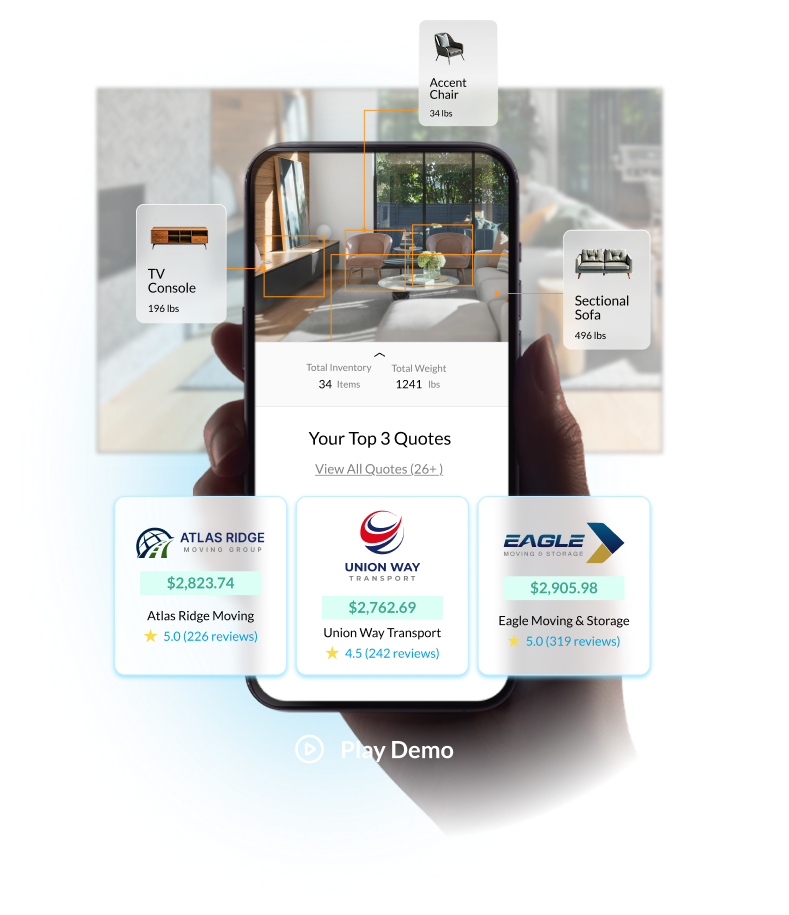
Step 1: Scan your home. You walk through your rooms with your phone and Agoyu’s AI does the inventory: it recognizes what you own, item by item, builds the list, and estimates the weight. Every long distance price is built on weight and inventory, and the traditional inventory, a salesperson eyeballing your living room or you typing a list from memory, is where bad quotes are born. The scan documents what you actually have, in minutes, before anyone prices anything.
Step 2: See exact prices. From that one scan, Agoyu shows you the exact cost to move through the long distance movers in the platform, side by side, for your home, your route, and your dates. No callbacks. No estimate visits. No range that quietly grows later.
Step 3: Or post your move for bids. Put the move out and the movers in the platform bid on it. This is where capacity works for you: a mover with space on a truck going your way can bid a price nobody running a dedicated truck can match, and a mover who wants your full truck will bid like it.
Step 4: Compare the whole picture. Every price sits next to the mover’s Trust Signals: their US DOT licensing, BBB rating, Yelp reviews, and complaint record. Price and record on one screen, which is the screen this industry has never wanted you to have.
Step 5: Book in the platform. Pick your mover and your packing level, from packing yourself to full packing and unpacking, and book. The agreed price, the dates, the inventory, and the terms are all in the platform record. Like Expedia, Agoyu is free to the consumer. The movers compete for your business. You watch the prices and pick.
Trust Signals: Check the Mover, Not the Marketing
Every mover profile on Agoyu displays the records that actually tell you who you are hiring:
- US DOT license. Interstate movers are licensed through the U.S. Department of Transportation. The profile links to the mover’s US DOT license, so you can confirm the company is authorized to move household goods across state lines. You can also verify licensing yourself through the Federal Motor Carrier Safety Administration, as the archived guide recommended.
- BBB rating. The Better Business Bureau rating shows how the company handles complaints and how it has conducted itself over time.
- Yelp reviews. Real customer experiences in their own words. Read for patterns: one bad review is a data point; ten reviews describing the same raised price or missed delivery window is who that mover is.
- IAM and FIDI profiles. Where a mover holds membership in the International Association of Movers or FIDI, the profile links to it, so you can see the industry standing the mover claims, from the organizations themselves.
None of this asks you to take Agoyu’s word for anything. The records are the mover’s own, displayed next to the price they are asking you to pay. Ask any mover you are considering, on or off the platform, the questions that matter: Are you licensed for interstate moves, and what is your US DOT number? How was my weight estimate calculated? What could change my final price? What is your claims process? A legitimate mover answers all of them in writing.
Documented, Not Handshaken: The Digital Agreement
Travel used to be booked the way moving still is: phone calls, paper, and trust me. Expedia digitized travel. Agoyu digitizes the move itself, and digitizing is not a cosmetic upgrade. It changes who holds the power, because everything about the move is written down and agreed before it happens.
Your Agoyu booking documents the move the way a smart contract documents a transaction. The inventory is the scan, item by item. The price is the published rate or the winning bid, with its guarantee status stated. The included services are listed: crew size, packing supplies, loading and unloading, transportation, and any specialty services. The pickup and delivery terms are agreed in the platform. And for household goods moves, the condition of your belongings is documented on video as they are loaded, so what left your home, and the shape it was in, is never a matter of opinion.
That video documentation matters most on the worst day: if something arrives damaged, the claim starts from the record instead of an argument. The scanned inventory says what was moved. The load video says what condition it was in. Agoyu stores applicable moving videos at no charge for up to 30 days after the move, and you can download your videos for free before they are deleted. Combined with the included insurance, full coverage with no deductible up to $100,000, a claim becomes a short, factual process instead of a fight.
The Scam Playbook Runs on Darkness
The moving industry is full of legitimate, reputable companies. It also has a bad actor problem, and the playbook is consistent: a fraudulent or unlicensed operator quotes low, often on a weight estimate that was never real, takes a deposit, and then the price climbs once your belongings are on the truck. In the worst version, the load is held until you pay the new number. Bait and switch pricing, misleading estimates, unexplained charges, hostage loads, and companies operating behind fresh names to escape their complaint histories: in 2022 alone, the Federal Motor Carrier Safety Administration received more than 7,500 consumer complaints against moving companies and brokers.
Every element of that playbook needs the same condition: nothing in writing. A scan that fixes the inventory and the weight, a price that is guaranteed in the platform, a DOT record pinned to the bid, dates agreed before the truck rolls, and video of your goods at loading. Documentation does not make a bad mover good. It makes the bad mover visible before you book, which is the only moment you have leverage.
“Best Long Distance Movers” Lists Cannot Price Your Move
The other shortcut people take is the ranked list: “best long distance movers,” scored, badged, and ranked. Ask a simple question of any such list. Has the writer seen your home? Have they weighed it? Have they seen the mover’s trucks, its route this week, or the space left in one on Friday? The answer is no, and yet the list ranks movers for your move anyway. Many of these lists are pay to play: placement follows affiliate commissions, and the “research” is a spreadsheet of payouts.
The deeper problem is that “best” is not a property of a company. It is a property of a match: your origin and destination, your distance, your dates, your shipment weight, the capacity a mover has on your route that week, and what you need done. Agoyu’s answer is not a better list. It is the end of the list: live published rates and live bids on your actual scanned move, from 86 long distance movers, with their DOT records, BBB ratings, and Yelp reviews attached to every number. The best mover is not the one at the top of somebody’s list. It is the right mover for your specific move, at the right price, with the right capacity. Going further than 2,000 miles? Our cost to move cross country guide prices that version of the move route by route.
How Long Does a Long Distance 3 Bedroom Move Take?
Delivery time depends on how your shipment travels. A full truck carrying only your household drives close to straight through. A partial shipment usually travels consolidated: your belongings share the truck with other households going the same general direction, the truck stops to load and unload along the route, and each stop adds time. A small shipment may wait to be combined with enough freight to justify the run, then make the most stops of all. For a cross country move of about 2,500 to 2,800 miles, industry planning windows are 7 to 12 business days for a full truck shipped direct, 12 to 21 business days for a partial load shipped consolidated, and 12 to 28 business days for a small load shipped consolidated (Researched Tables, Nov 24, 2026, source: SafeBound Moving).
Whichever option you pick, your pickup and delivery dates are agreed and documented in the platform when you book, not estimated over the phone and renegotiated later. Book 4 to 8 weeks out where you can, keep irreplaceable items, cash, and keys with you rather than on the truck, and confirm dates with the contacts at your new home before the truck rolls.
How to Save on a Long Distance 3 Bedroom Move
- Get competing prices on the same inventory. Three to five quotes built on three different guessed inventories cannot be compared. One scan, many prices, can.
- Avoid peak season if you can. Fall and winter moves price lower than June through August moves.
- Stay flexible on dates. Midweek and off peak dates can price noticeably lower, and flexibility lets a mover match you to a truck already going your way.
- Pack yourself where it is safe to. Your labor is free; use free or used boxes where they are sound.
- Reduce the weight. Sell or donate what you do not need before the inventory. On a long distance move, this is the saving that scales.
- Keep the move together. Separate pickups and deliveries each add fees.
How to Decide: A Short Checklist
- Get your inventory and weight right first. Every honest price starts there. A scan beats a guess.
- Collect prices for your actual move, on your actual dates, not national averages.
- Ask of every quote: is this price guaranteed, and what exactly does it include?
- Check the mover’s US DOT license, BBB rating, Yelp reviews, and complaint record before you fall for a price.
- Ask how your shipment travels: direct or consolidated, and what the delivery window is in writing.
- Confirm what insurance is actually included, to what dollar figure, and with what deductible.
- Get the agreement, the price, the dates, and the inventory in a documented record before the truck is loaded.
About the Data on This Page
The professional mover cost figures on this page are industry planning ranges applied from the Researched Tables, Nov 24, 2026 (source: Moving Hub, Sep 2026), presented as planning ranges, not current quotes, not Agoyu booked prices, and not AI scan averages. The archived guide’s by-home-size table, sample-moves DIY column, and DIY cost breakdown had no benchmark counterpart in the Researched Tables and were removed from the body on Nov 24, 2026; they are preserved in the editor notes. The platform facts stated on this page, 86 long distance movers in the platform and full insurance with no deductible up to $100,000 included on moves booked through Agoyu, are Agoyu’s own confirmed figures. Where this page identifies a needed statistic, the statistic does not yet exist in publishable form: it will come from Agoyu’s platform data (moves priced and booked through the platform) or from the named federal source, and the page will be updated when it does. Agoyu would rather show you a gap than a made up number.
Frequently Asked Questions
What is the average cost to move a 3 bedroom house long distance?
Industry planning ranges put a 3 bedroom long distance move at $2,210 to $5,300 at about 250 miles, $4,200 to $7,250 at about 1,000 miles, and $6,000 to $10,400 at about 2,500 miles with full service movers (Researched Tables, Nov 24, 2026), depending on home size, season, and services. Those are planning ranges, not quotes. The price for your specific move depends on your inventory and weight, distance, dates, and services, and an Agoyu scan produces that exact figure before you book.
How much does a 3 bedroom house weigh?
Industry planning bands put a typical 3 bedroom home at 6,000 to 10,000 pounds and 850 to 1,450 cu ft, as typical planning bands used by the industry, not scan measurements. Your real weight comes from your inventory, which is why a scan based estimate beats a room count guess, and why you should be wary of any quote built on a weight that seems too low.
How can I save money on a long distance 3 bedroom move?
Reduce the weight before you price, pack yourself where it is safe, move off season or on flexible dates if you can, and compare guaranteed prices built on the same inventory. The archived guide claimed strategic planning could cut total costs by 20 to 30 percent; that figure is not carried into this page as fact, because no source was given for it. The savings that are real come from weight, timing, and competition, and competition is the one you can switch on today by posting the move for bids.
What should be included in a long distance moving quote?
Crew size, a total weight estimate for your household goods, an itemized list of packing supplies and materials, loading and unloading at both ends, transportation costs (mileage, fuel, tolls), travel time and estimated days, any equipment fees, insurance costs, storage fees if required, and any specialty services for vehicles, pianos, or similar items. A reputable mover itemizes all of it. Be wary of any quote that seems abnormally low or refuses specifics.
What questions should I ask a long distance mover before booking?
Ask for their US DOT license number and insurance certificate. Ask how long they have moved homes like yours, and how your weight estimate was calculated. Ask whether packing materials are included, what could change the final price, how many movers will be on the job, whether furniture disassembly and reassembly is offered, what valuation coverage is included, how their claims process works, and what storage costs if you need it. Get the answers that matter in writing.
Is my moving price guaranteed?
Only if the mover says so, in writing, before you book. An estimate can change; a guaranteed price cannot go up. On Agoyu, every bid shows whether the rate is guaranteed. If it is not, the mover must either complete a visual survey of your home within one week or less and issue a guaranteed bound quote, or honor the rate shown in the platform. Always compare the guarantee first and the number second.
What is capacity pricing?
Movers sell space in trucks that are already traveling routes. If a truck is heading your way with space in it, that space is cheap, and a mover will discount to fill it rather than haul air. A partial shipment fits into leftover space at a discount; a full truck is the most efficient load a mover can run, so movers bid aggressively for those too. Capacity is the single biggest reason the same move gets priced thousands of dollars apart. On Agoyu, movers discount on average 23% from published rates to win the move.
What insurance is included with an Agoyu move?
Full insurance with no deductible up to $100,000 is included in the price of every move booked through Agoyu. It is not an add on sold at signing. Combined with your scanned inventory and the video documentation of your goods at loading, it makes any claim a documented process: what was moved, what condition it was in, and what the coverage pays are all on record.
Get Your Real Long Distance 3 Bedroom Price
You came here looking for the cost to move a 3 bedroom house long distance. The honest answer is a set of ranges, and now you know why: your price lives in your weight, your distance, your dates, and the space in a truck that has not been assigned to you yet. The old way of finding it is a week of phone calls, estimates built on guessed weights, and a name picked off a list somebody was paid to write.
There is a shorter way. Scan your rooms, see the exact published prices from 86 long distance movers, or post your move and let them bid for it, with every mover’s DOT record, BBB rating, and Yelp reviews next to the price, guaranteed pricing where it is offered, your agreement and dates documented in the platform, video of your goods at loading, and $100,000 of no deductible insurance included. That is what the cost to move a 3 bedroom house long distance looks like when the number is real.


