White Paper written by: Bill Mulholland SCRP, GMS
Abstract
The global moving industry, valued at over $130 billion, remains one of the last major service sectors without a true digital foundation. While other industries have been transformed by platforms that standardize pricing, create transparency, and simplify decision-making, moving continues to rely on fragmented lead generation, manual estimation, and inconsistent execution.
At the same time, user behavior is changing. As AI adoption accelerates, people are no longer seeking information alone. They expect systems that can define scope, make decisions, and complete tasks. Software is shifting from traffic-driven models toward systems that deliver outcomes.
This exposes a structural gap in the moving industry. Existing solutions layer tools onto a manual process instead of addressing the transaction itself. Agoyu introduces an execution-based AI platform that defines scope, returns exact pricing, and manages the move from start to finish. Early results show that removing uncertainty improves conversion, stabilizes operations, and creates better, more predictable outcomes for all parties involved.
As software evolves from assisting decisions to executing them, the moving industry is positioned for a fundamental reset.
Introduction
Moving is one of the largest and most stressful transactions most people will experience. Despite its scale, the process remains difficult to navigate. Customers face unclear pricing, inconsistent service, and limited ability to compare options in a meaningful way.
At the same time, expectations have changed. Across industries, users are moving away from manual workflows and toward systems that can deliver answers and complete tasks with minimal effort.
This creates a clear disconnect. While other sectors have developed structured systems that simplify complex transactions, moving still relies on lead generation, manual estimation, and disconnected tools.
This paper looks at how the industry developed, how shifts in AI and user behavior are changing expectations, and why a different model is now required.
The Current State of the Moving Industry
The U.S. moving market is approximately $22 billion and roughly $130 billion globally. Despite its size, it lacks a unified system that connects pricing, execution, and trust. There is no Amazon, Expedia, or Uber equivalent for moving. While retail, travel, transportation, and financial services have spent decades building platforms that standardize pricing and simplify decision-making, moving remains fragmented and largely unchanged.
Instead of infrastructure, the industry operates on lead generation.
Consumers searching for movers are routed through paid funnels that present themselves as objective rankings. Once a user submits their information, it is often distributed to multiple movers or moving brokers at the same time. The result is immediate outreach from several parties, forcing the customer to manage responses rather than evaluate options.
Pricing is the next point of breakdown. Estimating a move is complex. Household goods vary widely, and accurate pricing depends on labor, materials, equipment, access, and logistics. Despite this, most estimates are still produced manually. Quotes differ significantly in scope and accuracy, and there is no consistent way for a customer to compare them.
The operational process is equally fragmented. Some estimates are conducted in person, others through video calls, and many through phone or email with limited detail. The outcome is a set of inconsistent proposals that require the customer to make a decision without reliable information.
These gaps become visible on move day. Scope changes, costs increase, and disputes follow. Accountability is limited, particularly outside of structured corporate relocation programs.
Trust signals exist, but they are disconnected from the transaction. Licensing data and third-party profiles are available but they are hard to find and they are not integrated into pricing or decision-making. At the same time, paid rankings continue to influence customer choice.
The result is a process where information is incomplete, pricing is uncertain, and outcomes are difficult to predict.
The core issue is not execution quality. It is the lack of a system that defines scope, standardizes pricing, and connects trust to the transaction.
The Global Shift
The environment that sustained this model is changing.
Search behavior is evolving as traffic and clicks decline. At the same time, AI adoption is accelerating. Users are increasingly starting with AI instead of traditional search, and AI-driven interactions are growing rapidly.
More importantly, expectations are changing.
Users are no longer asking for information alone. They expect systems to produce results.
The model is shifting from “help me” to “do it for me.”
This changes how software is designed. Traditional platforms are built around traffic. They attract users, guide them through a process, and monetize intent through lead capture or contact form submissions.
AI systems operate differently. They are designed to complete tasks. Instead of guiding a user through multiple steps, they define scope, make decisions, and execute the outcome.
This introduces a new category of software: outcome-based systems.
Traditional tools support navigation, input, and comparison. Outcome-based systems take responsibility for completing the transaction.
As this model develops, the role of people also changes. Instead of managing the process, users move into validation roles. For example, customers confirm what needs to be done, and service providers verify pricing and execution. The system handles coordination and consistency.
This shift moves value away from traffic and toward execution.
Enter Agoyu
Agoyu is a digital platform built to operate as an execution system for moving. It can function independently online or as an app, or it can be embedded within existing workflows such as real estate, mortgage, and leasing.
The platform manages the transaction from initial scope through completion. It defines what is being moved, calculates pricing, and connects customers with pre-vetted service providers based on consistent criteria.
How it works
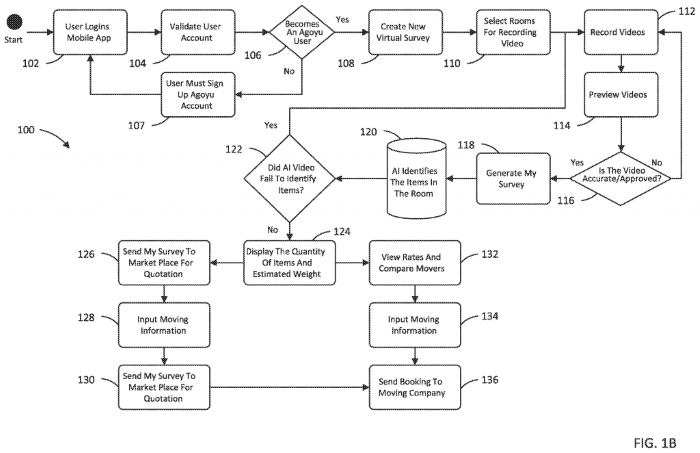
Step 1: AI-driven room scan
Users scan their space with a phone. The system identifies items, builds an inventory, and calculates weight and volume. The user reviews and edits the inventory by adding or removing items before confirming the final scope.
Step 2: Deterministic pricing
Users enter move details including date and locations. The platform returns exact prices from the top moving companies based on defined scope.
In addition to returning exact prices, the platform introduces a reverse marketplace dynamic. Users can request a discount, inviting pre-vetted movers to offer discounts against the system price.
This creates structured competition within a defined scope, where service providers compete on efficiency rather than information asymmetry.
This shifts the model from opaque quoting to structured competition. Instead of customers chasing estimates, service providers compete within a defined scope. Pricing becomes transparent, and competition is based on capacity and efficiency rather than information asymmetry.
Step 3: Booking and execution
Pricing is guaranteed, contracts are documented, and the system manages the process through completion.
Agoyu is already in production.
It functions as infrastructure for moving, handling the underlying transaction rather than sitting on top of it.
Agoyu Patent: US20220300901A
Why This Model Converts
At its core, the difference is simple: when uncertainty is removed, behavior changes.
In today’s moving process, the customer is forced to manage everything themselves. They are comparing estimates that don’t match, speaking to multiple salespeople, trying to determine who is credible, and ultimately making a decision without ever feeling fully confident. Most don’t trust the pricing, don’t understand the scope, and expect that something will go wrong on move day. As a result, many delay decisions, continue shopping, or disengage entirely.
Agoyu changes that dynamic by removing the need for the customer to “figure it out.”
Instead of navigating an unclear and fragmented process, the customer is presented with a clearly defined scope of work, real pricing that reflects the actual move, and transparent performance data on the service providers. There is no need to wait for callbacks, interpret conflicting quotes, or guess what is included. The decision becomes straightforward: the customer can see what they are getting, what it costs, and who is performing the service.
When that level of clarity is introduced, decision-making accelerates. The customer no longer feels like they are taking a risk—they feel like they are selecting a solution.
This shift has a measurable impact.
Case Study: ARC Relocation
ARC Relocation, an employee relocation management company, historically followed the standard industry approach. Transferees were introduced to multiple moving companies and asked to coordinate estimates directly.
For fully paid relocations with no budget the old model is fine. For lump sum and capped budget moves, conversion rates averaged approximately 9 percent.
As relocation programs shifted toward giving employees more control over their move, a new problem emerged. Instead of working through structured corporate channels, transferees began sourcing movers on their own. Many were drawn into online lead funnels, often resulting in poor experiences, unclear pricing, and unreliable service providers.
Agoyu was initially developed to address this problem within ARC’s own workflow.
After embedding the platform, conversion rates increased to 76 percent.
This change was not incremental. It was structural.
The process shifted from requiring the customer to manage multiple vendors and uncertain pricing to providing a defined solution with pricing that could be acted on immediately.
A key driver of this change is pricing confidence.
Approximately 94 percent of moves booked through the platform are structured as guaranteed not to exceed. The price presented to the customer will not increase. In some cases, it may decrease if the final scope is lower, but it does not go up.
This reflects a shift in how risk is handled.
In the traditional model, the customer carries the majority of the risk. Pricing is uncertain, scope is loosely defined, and final costs often change.
In this model, risk is distributed across the system. Scope is defined upfront, pricing is anchored to that scope, and both the customer and service provider operate within clear parameters.
The fact that most moves are executed under guaranteed pricing is not simply a feature. It reflects that service providers trust the accuracy of the system and are willing to stand behind it.
For the customer, this removes one of the biggest barriers in the decision process: the concern that the final price will exceed the initial quote. The system makes the relationship between scope and price explicit. If items are added, pricing adjusts. If scope remains consistent, pricing holds.
When pricing is defined and trust is built into the process, users move forward instead of dropping off.
What began as an internal solution to a growing problem proved to be broadly applicable. The same dynamics that affected relocation programs exist across the entire consumer market. Customers want clarity, fairness, and a process they do not have to manage themselves.
The Economic Impact
When you remove uncertainty from the moving process, you do not just improve the customer experience, you change how the entire transaction works financially.
In the traditional model, the economics are broken at almost every step. Customer acquisition is expensive because most leads never convert. Companies spend money to generate or purchase leads, only to compete with multiple other movers for the same customer. That customer then shops around, delays making a decision, or stops engaging altogether. The result is low conversion and a high cost to win each job.
The estimating process adds another layer of inefficiency. Salespeople are spending time scheduling surveys, walking through homes, building quotes, and following up. A large percentage of that work goes nowhere. It is time and labor spent on jobs that are never booked.
Even when a move is secured, pricing is inconsistent. Estimates vary widely depending on who is quoting, how thorough they are, and how aggressive they want to be to win the job. This leads to change orders, disputes, and margin pressure. Some jobs lose money. Others create a poor customer experience that impacts future business.
The system is built on effort, not efficiency.
The execution-based model changes that.
By automating the estimating process and giving the customer real pricing upfront, a large portion of that manual work goes away. The customer does not need to wait for multiple quotes or manage conversations with different companies. They can make a decision immediately.
When that happens, conversion increases. Not slightly, but meaningfully.
Higher conversion changes acquisition economics. Instead of paying for a large volume of leads that never turn into jobs, companies are able to generate more bookings from the same demand. The cost per acquired customer goes down while revenue per lead goes up.
At the same time, pricing becomes more consistent. With clearly defined scope and data driving the estimate, movers are not relying on guesswork. This leads to more stable margins and fewer disputes after the move is completed.
There is also less operational waste. Fewer handoffs, fewer mistakes, and less back-and-forth reduce internal costs and make the business easier to scale.
This is not a small improvement to the existing process. It is a different model entirely. The industry moves from a sales-heavy, manual system to one that is driven by execution, clarity, and efficiency.
When that shift happens, the economics do not just improve. They fundamentally change.
Why This Has Not Existed Before
To understand why this model is new, you have to understand how the current system came to exist.
Lead generation, for example, thrives on uncertainty. The less clarity a customer has, the more likely they are to submit their information, compare multiple options, and stay in the system longer. That creates more opportunities to sell the same lead multiple times. From a lead generation perspective, confusion is not a problem. It was part of the model.
On the service provider side, pricing flexibility has always been a way to manage risk. Movers are dealing with a product that is difficult to standardize. Every home is different, every shipment is different, and the cost drivers are not always visible upfront. As a result, estimates are often used as a starting point rather than a commitment. That flexibility protects the mover, but it shifts risk to the customer.
Technology, when it has been introduced, has largely focused on improving pieces of the process rather than fixing the system itself. Better CRM tools, better dispatch systems, better lead management platforms. All of these make the existing process more efficient, but none of them change how the transaction actually works.
Customers have also been conditioned over time. Many have learned to focus on the lowest initial price, even if they suspect it may not be accurate. That behavior reinforces the cycle, rewarding providers who underbid and adjust later.
All of these forces work together to maintain the status quo. The system continues not because it is effective, but because each participant has adapted to it in a way that serves their short-term needs.
Breaking that cycle requires a different structure. One where scope is clearly defined at the beginning, pricing is consistent, and risk is not passed back and forth between parties.
That structure simply did not exist before.
Why Now
The problem hasn’t changed. What’s changed is our ability to solve it.
Until recently, there was no reliable way to capture the details of a move without sending someone physically to the home. That made it difficult to standardize scope, and without a defined scope, accurate pricing was not possible at scale.
Advances in mobile technology and computer vision have changed that. A customer can now use a phone to capture their home in a way that provides a detailed and usable representation of what needs to be moved. What used to require an in-person visit can now be done remotely with a high degree of accuracy.
At the same time, AI has reached a point where it can take that unstructured input and turn it into something actionable. It can identify items, estimate volume and weight, and translate that into a defined scope of work that can be priced consistently.
Perhaps most importantly, user expectations have shifted. In other parts of their lives, people are used to getting immediate answers. They can book travel, order products, and arrange transportation in minutes. Waiting days for estimates and managing multiple conversations feels outdated. People are open to using AI and how it can make their lives easier.
These changes, taken together, make something possible that was not possible before. For the first time, you can define scope, generate pricing, and present a complete solution to the customer in real time.
Conclusion
The moving industry did not fail to innovate. It operated within the limits of what was possible at the time.
What exists today is not a system in the true sense. It is a collection of tools and processes layered onto a manual foundation. Each part works in isolation, but there is no single structure tying it all together in a consistent and reliable way.
At the same time, customer expectations are moving in a different direction. People are no longer looking for more information. They are looking for outcomes. They want to know what it will cost, what will happen, and that it will be done correctly.
That gap between how the industry operates and what the customer expects creates an opportunity.
For the first time, the moving experience can be designed around a defined scope, transparent pricing, and consistent execution. Instead of asking the customer to manage the process, the system can deliver a complete solution.
Agoyu is built to support that model.
About the Author
Bill Mulholland, SCRP, GMS is the founder of Agoyu, an AI-driven platform designed to modernize the moving process and of ARC Relocation, a global employee relocation management company servicing the US Government, the US Military and Corporations around the globe.
He has spent over 26 years operating within the employee relocation and moving industry and is widely regarded as a subject matter expert. Bill serves on industry boards, holds leading professional certifications, and has built long-standing relationships across the supply side of the industry.
Known for his neutrality and practical understanding of how moves are priced and executed, he brings a unique perspective shaped by experience across corporate relocation, service providers, and technology. His work has focused on improving transparency, efficiency, and outcomes in an industry that has historically lacked system-level infrastructure.
Bill is also a member of YPO.
Bill Mulholland
Owner
Agoyu