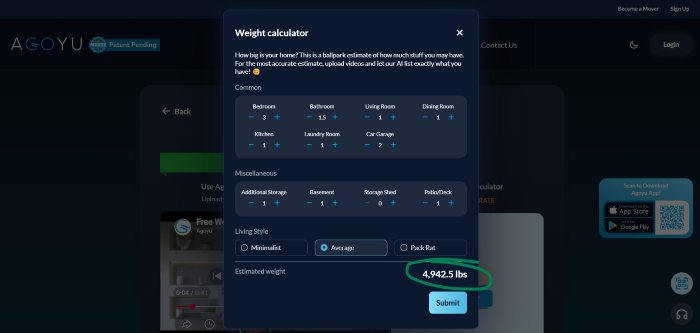
A moving cost calculator estimates what your move will cost from three inputs: how much you are moving, how far, and how much help you need. For a local move the math is usually:
Hours Spent x Number of Crew Members x Hourly Rate
And for a long-distance move it is shipment weight times a per-pound rate that shrinks as the load gets heavier. Most local moves land between $400 and $5,000, and most 1,000-mile moves land between $1,200 and $13,500, depending on home size. But those are extremely wide ranges, and both local and long distance moves can also be affected by seasonality, access, special handling requirements, and more. The absolute best way to calculate your moving expenses is to quickly check with Agoyu, the free app that uses AI to add up the total weight of the belongings in your home, and then returns multiple moving quotes from vetted movers. Simply input your move details in the fields below, to see what your exact move will cost.

The AI-Powered Moving Calculator
Agoyu’s AI video scanning technology gives you quick, precise moving estimates. Scan your rooms, receive instant quotes from multiple vetted movers, and select the best option for you.
STEP 1 OF 3
Quick Moving Cost Estimates by Home Size
If you just want a ballpark, the ranges in the table below correspond with the full breakdown in our guide on how much it costs to move. Weight is the number that drives a long-distance price, so it is listed first.
| Home size | Typical weight | Local move | 1,000-mile move |
| Studio | 1,500 to 2,500 lbs | $400 to $750 | $1,200 to $3,000 |
| 1 bedroom | 2,000 to 4,000 lbs | $450 to $1,200 | $1,500 to $4,000 |
| 2 bedrooms | 4,000 to 7,000 lbs | $700 to $1,750 | $3,000 to $6,500 |
| 3 bedrooms | 7,000 to 10,000 lbs | $1,400 to $2,750 | $4,500 to $8,500 |
| 4 bedrooms | 10,000 to 13,000 lbs | $2,000 to $4,000 | $6,500 to $11,000 |
| 5 bedrooms | 13,000 to 16,000 lbs | $2,800 to $5,000 | $8,500 to $13,500 |
Ranges are planning figures, not quotes. Your price moves with season, stairs, access and what you own.
How to Calculate Moving Costs Yourself
Local moves: time is the price
Local movers bill by the hour, so the formula is simple:
- Crew size x hours x hourly rate per mover = base labor cost
- Add the truck fee, travel time, packing materials and any special-item charges
- Add a tip, usually a few dollars per mover per hour or a flat amount per person
Example: a two-bedroom apartment with a crew of three, six hours on the job, at $50 per mover per hour comes to $900 before add-ons. A one-bedroom with two movers for five hours at the same rate is $500.
Long-distance moves: weight and miles are the price
Long-distance carriers charge by the weight of your shipment and the distance it travels. If you only know volume, movers convert it at about 7 pounds per cubic foot. A load of 800 cubic feet is roughly 5,600 pounds.
As a benchmark, Allied Van Lines, citing industry data, puts the average at about $4,300 to move a 7,400-pound household more than 1,000 miles (Source: Allied moving resources). That works out to roughly 58 cents per pound.
Example: 5,600 pounds at 58 cents per pound is about $3,250 before packing, stairs and other add-ons. That sits inside the 2-bedroom range in the table above.
Remember, use this as a sanity check only, not a promise. Rates vary by carrier, route and time of year. If you really want to get an accurate calculation of how much your move would cost, Agoyu is the quickest way to do it without having to give movers your contact information.
What Else Changes Your Moving Estimate
The base number is only part of the bill. These are the factors that most often move the final price:
| Factor | How it affects cost |
| Move date | Summer, month-end and weekends are the busiest and priciest. A midweek move in winter is usually the cheapest. |
| Stairs and elevators | Many movers add a flat fee or extra time for multiple flights or long carries. |
| Parking and truck access | If the truck cannot park close, crews walk farther and the clock keeps running. |
| Packing and supplies | Boxes, paper, mattress covers and full packing labor are billed on top of the move. |
| Heavy or specialty items | Pianos, safes, hot tubs, pool tables and motorcycles often carry their own charge. |
| Extra stops | Picking up from or dropping at a second address adds time or a stop fee. |
| Storage | Short-term storage in transit is billed per day or per month. |
| Valuation coverage | Basic liability is included. Higher protection levels cost extra. |
Why Packing Changes the Total
Packing is one of the easiest line items to underestimate. Doing it yourself costs only boxes and time. Having the crew do it can add several hundred dollars on a small apartment and well over a thousand on a larger home.
Packing also affects coverage. Federal guidance warns that if items you pack yourself are damaged, it can be harder to prove a claim against the mover, and that poorly packed boxes can limit the mover’s liability. Before you decide, ask what the mover will cover for boxes you pack and get the terms in writing.
Binding, Non-Binding and Not-to-Exceed Estimates
Most online moving cost calculators work from averages. You pick a home size and a distance, and the tool returns a range based on what a typical household of that size weighs. That is a useful planning number, but it is a guess about your stuff, and weight is the key input that drives a long-distance price.
Agoyu starts from your actual belongings instead. You scan your home with your phone, the app’s AI builds an inventory with an estimated weight, and movers quote from that list. Because every mover is pricing the same inventory, the quotes are easier to compare, and the number is less likely to jump later because someone guessed wrong.
How firm that number is depends on the type of estimate. Agoyu labels each quote so you can see which type you are looking at:
- Non-binding estimate: based on the mover’s best guess. The final price depends on actual weight and services. Under federal rules for interstate household goods moves, a mover can require you to pay no more than 110 percent of a non-binding estimate at delivery, and you have up to 30 days to pay the rest.
- Binding estimate (shown as “Guaranteed Price” on Agoyu): the price is fixed for the services and inventory listed. If you add items or services, the price can change.
- Bound Not-to-Exceed estimate: you pay the lower of the estimate or the actual cost. The price can only go down, never up.
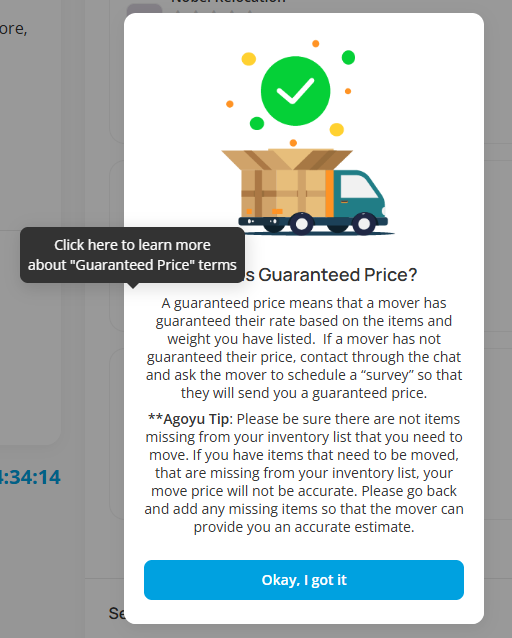
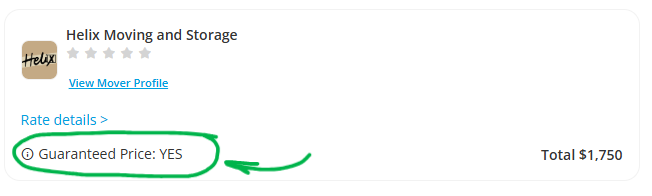
Look for the “Guaranteed Price” label when you compare quotes. Click the info icon next to it to see what the price is based on. A guaranteed price covers the items and weight on your inventory list, so check that nothing is missing before you book. Every mover handles estimates a little differently, so confirm the type in writing before you sign anything.
How to Lower Your Moving Cost
The biggest savings usually come from timing. Movers are busiest in summer, on weekends and at the end of the month, and they price accordingly. If you can move midweek, mid-month and outside peak season, you give yourself the best shot at a lower rate.
The next lever is how much you move. On a long-distance move you pay by weight, so every pound is money. Sell, donate or toss anything you will not use before you get your estimate, not after. If you are packing yourself, stick to non-fragile items like clothes, linens and books, and source free boxes from local stores or neighbors instead of buying new ones. Your own time is cheaper than the crew’s, but keep fragile and high-value items for the pros, since damage to boxes you pack yourself can be harder to claim.
Then comes how you buy. Prices for the same move can vary quite a bit from one mover to the next. A low number that leaves out packing, stairs or valuation coverage is not really lower.
One factor many people miss is truck capacity. If a mover already has a truck heading along your route with room to spare, filling that space is worth money to them, and they may price your move lower to do it. Agoyu’s Bid My Move feature is built around this. Once you are comparing quotes, you can submit your move to Agoyu’s network of movers, and they have two business days to come back with a better price. You choose the services and add notes on anything that needs special handling. For how Bid My Move works, see our guide to moving quotes online.
Get a Moving Estimate Built From Your Actual Inventory
Calculators are only as good as the numbers you type in, and the hardest number to guess is weight. People routinely under or overestimate their belongings by thousands of pounds, which is exactly where surprise charges come from.
Agoyu takes a different route. Scan your home with your phone and the app builds an inventory of what you own, including an estimated weight, then uses it to request quotes from movers. You skip the guessing and the phone tag. Start your free scan and get quotes.
Moving Cost Calculator FAQs
How accurate is a moving cost calculator?
It is as accurate as the inputs. A calculator gives a planning range from home size, distance and date. Only an estimate based on your actual inventory sets a price, and a binding estimate is the only type that fixes it.
How do I calculate my moving costs?
The simplest and most accurate way to do it is to use an AI moving calculator like Agoyu. Otherwise you can get a rough idea for a local move by multiplying crew size by hours by the hourly rate, then add the truck fee, travel time, packing and a tip. For a long-distance move, multiply your shipment weight by the carrier's per-pound rate for your distance, then add packing and other services.
What should a moving estimate include?
The mover's name and address, your origin and destination, the estimated weight or hours, the type of estimate, every service and fee listed by line, valuation coverage, and the payment terms.
How many pounds is a 2-bedroom apartment?
Typically 4,000 to 7,000 pounds. Movers convert cubic feet to pounds at about 7 pounds per cubic foot.
What is the 110 percent rule for movers?
On an interstate move with a non-binding estimate, the mover can require payment of no more than 110 percent of the estimate at delivery. Any remainder is billed afterward, with 30 days to pay.
Do I pay movers before or after the move?
Many pay on delivery. Some require a deposit, and terms vary by company and estimate type. Confirm payment terms and accepted payment methods in writing.
What is the cheapest time to move?
Generally midweek, mid-month and between fall and early spring. Summer and the end of the month are the most expensive.
How much does packing cost?
It depends on home size and whether you want full or partial packing. Expect materials alone to be modest and full-service labor to run from a few hundred dollars to well over a thousand.
Do I tip movers?
Tipping is customary and recommended but optional. A common range is a few dollars per mover per hour, or a flat amount per person on a long job.
Is there a free moving cost calculator?
Yes. Agoyu is free to use. Scan your home, get an inventory with estimated weight, and compare quotes from movers.


